I don't think I quite appreciated the depth of the RIAA's animosity towards Charles Nesson, the founder of the Berkman Center at Harvard, until very recently. It's well known that Nesson is defending Joel Tenenbaum in the case for p2p copyright infringement brought against him by the RIAA. He is also using it as a case for his students to observe the US legal system in real time, something the opposition attorneys are not too keen on. The latest development in the case is that the RIAA are reportedly asking the judge in the case to order Nesson to remove “unauthorized and illegal recordings” of pretrial hearings and depositions from the net.
I was prompted by the story to listen, for the first time, to Nesson's recording of Tenenbaum's deposition in September 2008 (available at the Berkman Center).
Right from the start it is clear the RIAA lawyer doing the main questioning is trying to deconstruct Nesson's involvement in the case, presumably to gather evidence for the courtroom battles to come. The emotion in the voices of both the RIAA supervising attorney and in-house counsel - and this is purely subjective perspective on my part - displays more than simple irritation with Tanenbaum and Nesson. The in-house counsel got particularly annoyed at one point when declaring that Nesson didn't seem to appreciate that many people were getting laid-off every year because of lost sales due to file-sharing and that was who he was fighting for. In fairness to him he seemed genuinely upset at the job losses and committed to his desparate attempts to stem the flow by pursuing file sharers through the courts.
But in spite of drm, draconian copyright laws, monster lawsuits, lack of interoperability, Apple's oliopoly on online music sales, electronic files are unlikely to get harder to copy and distribute because computers are continually getter faster, storage is getting cheaper and more compact and internet pipes are getting fatter. So the RIAA has to find a new strategy, beyond litigation, to work with the technology to monetize their wares - more competition in cheap, reliable, convenient, clean, comprehensive catalogue of online music sales. Convenient, clean and reasonably priced will beat free every time.
Thursday, July 09, 2009


Wednesday, July 08, 2009
Pope criticises rich countries excessive zeal on intellectual property
The Pope has decided to get involved in the debate about the value of intellectual property. In section 22 of Encyclical Letter Caritas in Veritate of the Supreme Pontiff Benedict XVI, he says:
"The world's wealth is growing in absolute terms, but inequalities are on the increase. In rich countries, new sectors of society are succumbing to poverty and new forms of poverty are emerging. In poorer areas some groups enjoy a sort of “superdevelopment” of a wasteful and consumerist kind which forms an unacceptable contrast with the ongoing situations of dehumanizing deprivation. “The scandal of glaring inequalities”[56] continues. Corruption and illegality are unfortunately evident in the conduct of the economic and political class in rich countries, both old and new, as well as in poor ones. Among those who sometimes fail to respect the human rights of workers are large multinational companies as well as local producers. International aid has often been diverted from its proper ends, through irresponsible actions both within the chain of donors and within that of the beneficiaries. Similarly, in the context of immaterial or cultural causes of development and underdevelopment, we find these same patterns of responsibility reproduced. On the part of rich countries there is excessive zeal for protecting knowledge through an unduly rigid assertion of the right to intellectual property, especially in the field of health care. At the same time, in some poor countries, cultural models and social norms of behaviour persist which hinder the process of development."
Tuesday, July 07, 2009
JK Rowling heading for court again
From Fernando Barrio (something I missed at the time):
"The Australian Daily Telegraph brings the news that the estate of Adrian Jacobs is suing JK Rowling’s publisher, Bloomsbury, for copyright infringement and claiming £500 million. The suit has its origin on the allegation that Harry Potter and the Goblet of Fire contains the same concepts presented in Jacobs’ Willy the Wizard, a 36 page book of which 1,000 copies were made."Fernando does a terrific analysis of the case. Highly recommended.
The web, copyright and enlightening discussion
This is an example of one of the things I like about the web. Barrister and computer forsensics expert, Alistair Kelman, wrote a short review of Music and Copyright by Ronald S. Rosen a little while ago.
Rosen, who defended John Williams when he got sued for copyright infringement over elements of his music for E.T., noticed the review and contacted Kelman about it. There followed an enlightening exchange about copyright law which is now available for anyone with a computer and a web connection to see.
Kelman had suggested that if some of the discussions about the specifics of the music in the book could have been recorded then it would make the arguments accessible to those not familiar with musical notation. Rosen agreed but noted that although he would have liked to record samples for the book and post an accompanying audio/video files on the web, the budget didn't stretch to getting the required licences for permission to do such recordings.
So to enlighten people about the intricacies of the arguments in the ET music case it would have been valuable to have illustrative audio and video samples. Yet to provide such samples (freely or commercially) would have laid the author open to a copyright infringement lawsuit (although he would probably be allowed to use such samples to illustrate his points in a courtroom) . Rosen, and remember he is a very experienced music copyright lawyer who knows the system better than most, hasn't given up hope of acquiring audio licences for a second edition of the book but this is complicated even if the music under consideration is in the public domain:
Rosen, who defended John Williams when he got sued for copyright infringement over elements of his music for E.T., noticed the review and contacted Kelman about it. There followed an enlightening exchange about copyright law which is now available for anyone with a computer and a web connection to see.
Kelman had suggested that if some of the discussions about the specifics of the music in the book could have been recorded then it would make the arguments accessible to those not familiar with musical notation. Rosen agreed but noted that although he would have liked to record samples for the book and post an accompanying audio/video files on the web, the budget didn't stretch to getting the required licences for permission to do such recordings.
So to enlighten people about the intricacies of the arguments in the ET music case it would have been valuable to have illustrative audio and video samples. Yet to provide such samples (freely or commercially) would have laid the author open to a copyright infringement lawsuit (although he would probably be allowed to use such samples to illustrate his points in a courtroom) . Rosen, and remember he is a very experienced music copyright lawyer who knows the system better than most, hasn't given up hope of acquiring audio licences for a second edition of the book but this is complicated even if the music under consideration is in the public domain:
"If we are fortunate enough to publish a second edition, we might be a position to secure licenses for small portions of the sound recordings at reasonable rates. If, however, the current edition is highly successful, we may be able to get licenses for the second edition in exchange for crediting the record companies for the use of these extracts, if the composition is in the public domain. If, however, the music itself is also protected by copyright, we would need licenses from both the copyright owner of the sound recording and the owner of the copyright in and to the music. Looking over this paragraph, you will notice a lot of "ifs", which sums up the situation."Interestingly enough the description of the book itself says:
"The highly topical area of copyright law, as applied to music, is widely misunderstood by lawyers, business people, and - perhaps most seriously - the federal judiciary. More than ever, there is a need to understand music infringement issues within the context of copyright litigation. In Music and Copyright , Ron Rosen provides readers with a practical and strategic roadmap to the music-infringement litigation process, beginning with the client's claim or defense and continuing through the selection and use of trial experts, discovery, motion practice, and trial."If Rosen is right that music copyrights are so seriously and widely misunderstood (and I think he is) it is more than a little ironic that copyright law itself might be interfering with the ability to put a substantial dent in that unsatisfactory state of affairs.
Quote of the day
From Charles Nesson:
"If you see the United States in a competition with other nations in a digital world, and you think the best asset you have for the future are your own children, who will become the digerati, who think imaginatively in that environment, you will be against the idea that you use the law, the power of the state, to make those learners fearful of clicking on the Net."
Centocor v. Abbott: Biggest Patent Verdict Ever


 The week before last a Texas jury apparently awarded the largest damages for patent infringement in history.
"Abbott Laboratories must pay $1.67 billion to Centocor, a subsidiary of Johnson & Johnson, because its Humira arthritis treatment infringes U.S. Patent No. 7,070,775. The patent was developed at New York University and licensed exclusively to Centocor, which makes a medicine called Remicade that competes with Humira."
Jammie Thomas appeals again
Unsurprisingly Jammie Thomas, who saw jury damages for copyright infringement via KaZaa increased from $9250 per song to $80,000 per song on appeal, has decided to further appeal the latest award against her.
"Jammie Thomas-Rasset, the Minnesota woman found liable for willful copyright infringement of 24 songs last month, has asked a federal court for a new trial or a reduction in the amount of the $1.92 million damages she was ordered to pay.Update: I should of course have noted as Fernando does that "the claimants specialists could only link 11 songs to the defendant’s computer, so the actual tag is not U$S80,000 per song as the jury decided but U$S174,545.45 per song (for the other 13 songs even the claimant’s specialists recognized that they couldn’t probe that they had been actually shared)."
Thomas-Rasset, who a jury found liable for willful copyright infringement, asked the court Monday to either alter or amend the judgment, remove or change the award of statutory damages to the minimum, or give her a new trial."
Comedian Bishop sees the power of YouTube?
A close friend has pointed me at American Irish comedian Des Bishop's new website. I find Bishop to be very funny but I guess you have to be Irish to get some of his material, especially the stuff on the catholic church in Ireland.
What's of interest to the b2fxxx sphere, however, is not that Bishop does Irish humour exceptionally well but that he actively points people from his website to freely available videos of his gigs on YouTube. He's been known to joke about the less well off members of the Irish diaspora in the US passing copies of his DVDs amongst themselves and not paying for them. Yet here he is on the web linking to free versions of the same materials.
Perhaps he subscribes to lesson 1 of Tim O'Reilly's notion of piracy as progressive taxation: obscurity is a far greater threat to authors and creative artists than piracy?
What's of interest to the b2fxxx sphere, however, is not that Bishop does Irish humour exceptionally well but that he actively points people from his website to freely available videos of his gigs on YouTube. He's been known to joke about the less well off members of the Irish diaspora in the US passing copies of his DVDs amongst themselves and not paying for them. Yet here he is on the web linking to free versions of the same materials.
Perhaps he subscribes to lesson 1 of Tim O'Reilly's notion of piracy as progressive taxation: obscurity is a far greater threat to authors and creative artists than piracy?
Monday, July 06, 2009
DOJ confirm official Google book settlement investigation
From John Paczkowski,
"The Justice Department probe of the Google Books settlement is heating up. On Thursday afternoon, the agency officially opened an investigation into the deal, which would allow the search sovereign to make millions of books available online.“The United States has reviewed public comments expressing concern that aspects of the settlement agreement may violate the Sherman Act,” wrote William F. Cavanaugh, a deputy assistant attorney general. “At this preliminary stage, the United States has reached no conclusions as to the merit of those concerns or more broadly what impact this settlement may have on competition. However, we have determined that the issues raised by the proposed settlement warrant further inquiry.”"
Quote of the day: we like to learn...
One of my favorite pieces of advice about education is encapsulated in John Holt's simple philosophy:
"Basically... the human animal is a learning animal; we like to learn; we are good at it; we don't need to be shown how or made to do it. What kills the processes are the people interfering with it or trying to regulate it or control it."Holt was an educator who worked within the education system and hoped for many years it could be improved but eventually decided it was so dysfunctional it could not be fixed and became an advocate of home schooling. He also came to the conclusion that the main reason children don't learn in schools is fear - fear of failing, fear of being laughed at, fear of not being able to tackle the tasks set by teachers, fear of not being good enough, fear of being teased by teachers and fellow pupils.
Friday, July 03, 2009
Lori Drew verdict set aside in MySpace suicide case
The judge has reportedly set aside the earlier jury verdict holding a Missouri woman, Lori Drew, responsible for driving a teenage girl to commit suicide, through exchanges in MySpace.
"A federal judge on Thursday overturned guilty verdicts against Lori Drew, issuing a directed acquittal on three misdemeanor charges.The LA Times and others also have reports on the decision.Drew, 50, was accused of participating in a cyberbullying scheme against 13-year-old Megan Meier who later committed suicide. The case against Drew hinged on the government’s novel argument that violating MySpace’s terms of service was the legal equivalent of computer hacking. But U.S. District Judge George Wu found the premise troubling.
“It basically leaves it up to a website owner to determine what is a crime,” said Wu on Thursday, echoing what critics of the case have been saying for months. “And therefore it criminalizes what would be a breach of contract.”"
Thursday, July 02, 2009
No re-trial for Pirate Bay
Unsurprisingly the court of appeal in Sweden ruled last week that the judge in the Pirate Bay case was not biased.
"A Swedish court ruled today that the judge overseeing The Pirate Bay trial earlier this year was not biased by belonging to various pro-copyright organizations. The unanimous decision (Swedish) means that there will be no retrial; the defendants must hope for a successful appeal instead.The four men who ran Pirate Bay are now planning sue Sweden for breaching their human rights.Judge Tomas Norström is a member of the Swedish Copyright Association, as are several of the lawyers who represented the recording and movie industries during the trial. He also sits on the board of the Swedish Association for the Protection of Industrial Property, an advocacy group that pushes stricter copyright laws.
After receiving a verdict of a year in jail (each) and a shared 30 million kronor fine, The Pirate Bay defendants charged Norström with bias and asked a court of appeal for a completely new trial with a different judge.
That appeal was overseen by Judge Anders Eka, who doesn't normally hear copyright-related cases but did so here in order to make the ruling appear as fair as possible."
Wednesday, July 01, 2009
Government mandarin director of firm that won passport contract
On the surface this stinks.
"A legal battle was looming last night over the £400million contract to produce new hi-tech passports.Thanks to Peter Sommer via FIPR for the pointer.A losing bidder is threatening action over the fact that one of Gordon Brown's senior mandarins is a director of the firm which won the contract.
Gill Rider, a leading member of the Cabinet Office, not only directs the hiring of senior civil servants but is also director of De La Rue printers, which last week secured the job of producing biometric passports.
Rival firm 3M, furious that its bid was rejected, is considering a legal challenge based on potential conflict of interest."
Is UK Government U-turn on ID cards real?
The new Home Secretary's apparent reversal of government policy on compulsory ID cards yesterday has been criticised as the government spin since they are still intending to include people's details on the ID register when they apply for a passport.
"British citizens who apply for or renew their passport will be automatically registered on the national identity card database under regulations to be approved by MPs in the next few weeks.The decision to press ahead with the main elements of the national identity card scheme follows a review by the home secretary, Alan Johnson, of the £4.9bn project. Although Johnson said the cards would not be compulsory, critics say the passport measures amount to an attempt to introduce the system by the backdoor.
Johnson said he had halted plans to introduce compulsory identity cards for airline pilots and 30,000 other "critical workers" at Manchester and London City airports this autumn in the face of threats of legal action. Longer term plans to extend compulsory ID cards to other transport industries, such as the railways, as a condition of employment have also been scrapped.
But two batches of draft regulations to be approved by MPs tomorrow and next week are expected to include powers to make the passport a "designated document" under the national identity card scheme. This means that anyone applying for or renewing their passport from 2011 will have their details automatically added to the national identity databases.
The regulations also include powers to levy a fine of up to £1,000 on those who fail to tell the authorities of a change of address or amend other key personal details such as a change of name within three months."
ACTA update
Michael Geist has noted an update on ACTA from Canadian government officials.
"The Canadian government held an Anti-Counterfeiting Trade Agreement consultation meeting today focused on pharmaceutical and access to medicines issues. The meeting was smaller than the earlier consultation in April, but featured some important new information about the ACTA process including a fuller description of planned negotiating meetings, details on the upcoming Morocco meeting, and confirmation on an inquiry from Brazil about joining the negotiations.
1. Negotiation schedule
The ACTA partners met on June 11th to discuss ACTA related issues and committed at the meeting to continue with the negotiations. The next meeting is set for Morocco in July with later meetings currently planned for October (Korea) and December (Mexico). There are additional tentative plans for meetings in February and April 2010.
2. The Morocco meeting
Officials advised that the Morocco meeting will be a two-day meeting that focuses on ACTA chapters involving international co-operation, enforcement, and institutional issues. The meeting will also address some "housekeeping" issues including ongoing transparency concerns. The Internet-related provisions will not be a focus and the Internet-related issues has not progressed beyond the U.S. non-paper that surveyed other ACTA participants on the state of their digital copyright laws (in other words, there is still no draft text).
3. New partners
During the meeting, I asked whether ACTA was open to new countries to join the negotiations before they conclude. Canada hedged, noting that the issue would be discussed at the Morocco meeting and that it would depend upon the country and the context. The issue has apparently become more urgent since Canadian officials confirmed that Brazil has approached one ACTA participant about the prospect of joining, but have not received an answer. Moreover, other countries may have made similar inquiries. I wrote about the desirability of broader participation earlier this year.
4. The De Minimis Exception
The issue of creating a de minimis exception within ACTA was raised during the discussion. The exception would be designed to carve out small quantities and personal use issues from border enforcement. Officials noted that the primary goal is to address large scale counterfeiting and that the treaty should be non-intrusive and practical. Canada is one of at least three countries that have put forward de minimis language. Officials said that there was agreement in principle with including some form of de minimis provision in the treaty."
Tuesday, June 30, 2009
US Supreme Court decline to hear Cablevision DVR case
The NYT is reporting that the US Supreme Court has declined to hear the Cablevision DVR case.
Update: The Washington Post also has the story.
"The Supreme Court on Monday delivered a blow to the television networks when it declined to hear a case about a digital video recorder technology, opening the gate for wider use of DVR systems.Scotus blog commentary is here.The case began in 2006 when Cablevision Systems, the New York-area cable operator, announced plans for what is called a network DVR system. With it, a customer would use a remote control to digitally record a program like “60 Minutes” but instead of storing the show in the customer’s at-home DVR box, the technology would store the show on a faraway Cablevision server.
The technology would let Cablevision convert set-top boxes into boxes with DVR capabilities without requiring an installation or new equipment.
“It opens up the possibility of offering a DVR experience to all of our digital cable customers,” Tom Rutledge, Cablevision’s chief operating officer, said in a statement. Programmers including Turner Broadcasting System’s Cartoon Network, CNN and television networks sued Cablevision, saying the system violated copyright law. In March 2007, a lower court agreed, ruling that Cablevision “would be engaging in unauthorized reproductions and transmissions of plaintiffs’ copyrighted programs.” The United States Court of Appeals for the Second Circuit in New York reversed that decision in August 2008. The plaintiffs asked the Supreme Court to hear the case, but the Supreme Court’s refusal essentially reinforced the Second Circuit’s decision."
Update: The Washington Post also has the story.
Deep link to iPlayer content
Tony has outlined the trick of deep linking into iPlayer content.
"One of the really handy things about Youtube is the ability to share bookmarks that “deep link” to a particular point within a video (e.g here’s Google having a dig at Microsoft; the URL? http://www.youtube.com/watch?v=S5aJAaGZIvk#t=29m10s, which should start the video playing 29 minutes 10 seconds in. That is, just add something like #t=29m10s to the end of the Youtube video page URL to start the video playing that far in).Neat.A similar service is offered on podcast material published through the wonderful IT Conversations, that lets you deep link in to a particular part of an audio file, which is great for sharing audio quotes and, err, messing around with: IT Conversations samples trigger pad;-)
Anyway, anyway, yesterday I saw this:
which means you can now deep link in to iPlayer content :-)
As with the Youtube deep linking, if you know the URL pattern, you can can create your own deep links on the fly (just add, ?t=21m45s, for example, on to the end of the URL to start the programme playing 21 minutes 45 seconds in.)
Something else I thought was interesting – the shared link is actually a BBC short link. So for an example, this is the sort of link you are given to share:
http://bbc.co.uk/i/l9n18/?t=13m55s
which then resolves to something like this:
http://www.bbc.co.uk/iplayer/episode/b00l9n18/Psychoville_Episode_1/?t=13m55s"


UK Safeguarding Identity Strategy launched
The UK's Identity and Passport Service has launched their Safeguarding Identity Strategy.
"Recognising the huge value and importance of individuals' identity information and tackling variations in how information is used across Government, 'Safeguarding Identity' is the focus of a new strategy launched today, 23 June 2009. The initiative has been led by IPS on behalf of Government and involved more than 12 departments and agencies. Building on a wide range of work already underway (including Directgov and the National Identity Service), it aims to deliver a common framework for the use and handling of individuals' identity information. The full version of the strategy is here. If you have any comments, contact: David White, Head of Safeguarding Identity Strategy, Identity and Passport Service. David.White2@ips.gsi.gov.uk T 020 3356 8064Download documents
Top 10 myths about sustainability
Michael D. Lemonick at Scientific American has listed his top 10 myths about sustainability.
"When a word becomes so popular you begin hearing it everywhere, in all sorts of marginally related or even unrelated contexts, it means one of two things. Either the word has devolved into a meaningless cliché, or it has real conceptual heft. “Green” (or, even worse, “going green”) falls squarely into the first category. But “sustainable,” which at first conjures up a similarly vague sense of environmental virtue, actually belongs in the second. True, you hear it applied to everything from cars to agriculture to economics. But that’s because the concept of sustainability is at its heart so simple that it legitimately applies to all these areas and more.
Despite its simplicity, however, sustainability is a concept people have a hard time wrapping their minds around. To help, Scientific American Earth 3.0 has consulted with several experts on the topic to find out what kinds of misconceptions they most often encounter. The result is this take on the top 10 myths about sustainability. And after this introduction, it’s clear which myth has to come first....
Myth 1: Nobody knows what sustainability really means.
That’s not even close to being true. By all accounts, the modern sense of the word entered the lexicon in 1987 with the publication of Our Common Future, by the United Nations World Commission on Environment and Development (also known as the Brundtland commission after its chair, Norwegian diplomat Gro Harlem Brundtland). That report defined sustainable development as “development that meets the needs of the present without compromising the ability of future generations to meet their own needs.” Or, in the words of countless kindergarten teachers, “Don’t take more than your share.”Note that the definition says nothing about protecting the environment, even though the words “sustainable” and “sustainability” issue mostly from the mouths of environmentalists. That point leads to the second myth...."
Monday, June 29, 2009
First arrest for twittering?
From the Washington Post:
"Jean Anleu was so fed up with corruption in his country that he decided to vent on the Internet, sending a 96-character message on the social-networking site Twitter.That message has now earned him a potential five-year prison sentence and the unfortunate distinction of becoming one of the first people in the world to be arrested for a tweet.
Writing under his Internet alias "jeanfer," Anleu urged depositors to pull their money from Guatemala's rural development bank, whose management has been challenged in a political scandal: "First concrete action should be take cash out of Banrural and bankrupt the bank of the corrupt."
These words illegally undermined public trust in Guatemala's banking system, according to prosecutor Genaro Pacheco."
Posner: extend copyright to protect newspapers
Though I don't alway agree with him I'm a big fan of the writings of prolific legal scholar and appeal court judge Richard Posner. Posner, along with long time collaborator Gary Becker, has maintained a really interesting blog for the past few years on which he posts regular, sometimes provocative and always thought-provoking essays on matters of contemporary interest.
Last week the esteemed judge expressed his view that the ongoing decline of the newpaper industry might only be arrested through the special extension of copyright law to ban linking to, paraphrasing or accessing extracts from online newspaper articles without the permission of the copyright holder.
Update: This online conversation from December last year amongst a who's who of legal scholars on the subject of challenges facing newspapers in a digital age is highly recommended.
Update 2: David Post is one of may respected scholars who think judge Posner's proposal is unworkable.
Last week the esteemed judge expressed his view that the ongoing decline of the newpaper industry might only be arrested through the special extension of copyright law to ban linking to, paraphrasing or accessing extracts from online newspaper articles without the permission of the copyright holder.
"Warren Buffett, who is a wit as well as a multibillionaire, said with reference to the fact that Bernard Madoff's long-running Ponzi scheme came to light during the financial collapse of last fall that until the tide goes out, you don't know who's swimming naked. A year ago Becker and I blogged about the decline of the newspaper industry. A year later the decline has accelerated. The economic crisis has hurt the newspaper industry as it has so many industries. The question is whether it will recover (or at least rejoin its slower downward path of last year) when the economy as a whole recovers; or has the economic crisis merely revealed the terminal status of the industry.It is something of a surprise to note Judge Posner's support for a special expansion of copyright law to protect a particular industry, as he has in the past been critical of such moves as the continual expansion of copyright terms (See The Economic Structure of Intellectual Property Law by Richard Posner and William Landes and The Little Book of Plagiarism by Richard Posner). I don't have the solution to the decline of the newspaper industry or the killer idea for a sustainable business model that would rescue them but I can't agree that a law banning access or linking to their content is the way forward. People go to the New York Times because it is a reputable, credible source of news and commentary not because it is a newspaper. Their delivery medium was paper, it is now paper and the Net. Making it more difficult to get access to the NYT is unlikely to be the way to tackle their revenue problems. As Tim O'Reilly has been saying for some years, obscurity is a bigger threat than piracy.I am pessimistic about a recovery by the newspapers. One reason is the current economic situation. A serious, protracted economic crisis can result in changes in consumer behavior that persist after the end of the crisis. A change in consumption, even in some sense involuntary, can be a learning experience. People make what they think will be merely temporary adjustments in their consumption behavior to reduce financial distress but may discover that they like elements of their new consumption pattern; and businesses too, which have reduced their newspaper (and other print-media) ad expenditures drastically. They may never go back...
So what will happen to news and information? Online news is free for two reasons. First, in the case of a newspaper, the marginal cost of providing content online is virtually zero, since it is the same content (or a selection of the content) in a different medium. Second, online providers of news who are not affiliated with a newspaper can provide links to newspaper websites and paraphrase articles in newspapers, in neither case being required to compensate the newspaper...
Expanding copyright law to bar online access to copyrighted materials without the copyright holder's consent, or to bar linking to or paraphrasing copyrighted materials without the copyright holder's consent, might be necessary to keep free riding on content financed by online newspapers from so impairing the incentive to create costly news-gathering operations that news services like Reuters and the Associated Press would become the only professional, nongovernmental sources of news and opinion."
Update: This online conversation from December last year amongst a who's who of legal scholars on the subject of challenges facing newspapers in a digital age is highly recommended.
Update 2: David Post is one of may respected scholars who think judge Posner's proposal is unworkable.
"So here we've gone and invented this fabulous global machine for linking and paraphrasing and sharing information, but nobody will be able to use it because we want to preserve the New York Times' business model. Hmmm.My advice to the New York Times: don't count on that. Start thinking about how you can make money -- large quantities of it -- in a world in which linking and paraphrasing are pervasive and unrestricted. It's not going to be easy - if it were easy, we'd all be doing it already. But millions upon millions of people visit your website, every day - because you are the New York Times, and people value the product you produce. There's a way, I'm pretty certain, of converting that into income, though I don't know what it is and as far as I can tell neither does anyone else at the moment. Google, though, makes a lot of money giving away information, and you can too. Don't waste your time hoping that copyright law is going to come to your assistance, for it will not."
Friday, June 26, 2009
3 strikes resurrected by French government
The French government are not giving up on their three stikes agenda even after having it ruled unconstitutional by the Constitutional Council.
"The "three-strikes" saga continues in France following the Constitutional Council's recent decision canceling the sanction side of the bill (Billboard.biz, June 10), with the government attempting to find a way around the legal ruling.
While the educational part of the bill, which allows the administrative authority Hadopi to issue warnings to infringers, had been passed into law, a short new bill on the sanction side of the anti-piracy system has now been approved by government ministers to be introduced as legislation.
The French government had wanted Hadopi to be able to cut off repeat offenders after two warnings. With the Constitutional council having stressed that only a judge can rule on such terminations of Internet access, the new bill intends to simplify procedures to avoid French courts, which would slow the sanction process."
DRM, copyright and open source
I've been watching Cory Doctorow's talk to the Red Hat summit in 2006
It's amazingly relevant even three years later, eons in internet time.
It's amazingly relevant even three years later, eons in internet time.
Thursday, June 25, 2009
Apple v PsyStar heading back to court
From CNet news:
"Apple wanted Psystar back in court, and now it's going to happen.Regular readers will recall the source of the dispute which I mentioned some months back.An automatic stay of proceedings imposed when Psystar filed for bankruptcy in May has been lifted by the court, according court documents shared with CNET News.
Judge Robert A. Mark, who serves the Southern District of Florida U.S. Bankruptcy Court, lifted the stay on Friday, opening the door for Apple to continue its copyright infringement case against the company."
"Apple had originally sued PsyStar for using and selling the OS X Operating System (“Mac OS”) in clone machines. The judge, Hon. William Alsup, then threw out PsyStar's antitrust claims against Apple in response to the original lawsuit (see Justia for the details). So PsyStar came up with the rather clever copyright misuse argument - 'we bought the Mac OS from Apple and they're saying we can't play with it unless we buy their hardware to use with it too.'"
China filter software company threatened
Employees of the company supplying the filter software which is to be compulsory on all new computers in China have reportedly been receiving death threats.
"The Chinese manufacturer of Internet-filtering software that must be distributed with all new computers next week has received death threats, state media said Wednesday.
Workers at Jinhui Computer System Engineering Co. received more than 1,000 harassing phone calls this month, according to Zhang Chenmin, the general manager of the company. He said personal information of some of the programmers had been leaked online, and one caller threatened to kill his wife and child.
"Most of the calls came late at night, cursing our staff and uttering obscenities, voicing their resentment against the software," Zhang was quoted as saying by the official Xinhua News Agency."
Wednesday, June 24, 2009
Assessing the battle for climate friendly technology IP
Josie Garthwaite of Earth2Tech has been assessing how big the battle for intellectual property protection of climate friendly technologies is.
Google privacy trial begins in Italy
The trial of Google executives 'accused of defamation and violating privacy for allowing a video to be posted online showing an autistic youth being abused' has begun in Italy.
"Google says the case violates EU rules by trying to place responsibility on providers for content uploaded by users.Update: Well it did begin but it's been adjourned until September because an interpreter didn't appear when scheduled.The Mountain View, California, company also considers the trial a threat to freedom on the Internet because it could force providers into an impossible task - prescreening the thousands of hours of footage uploaded every day onto Web sites like the Google-owned YouTube.
Prosecutors and civil plaintiffs insist they don't want to censor the Internet, and maintain the case is about enforcing Italy's privacy rules as well as ensuring large corporations do their utmost to block inappropriate content, or quickly delete it."
Tuesday, June 23, 2009
Music industry in Spain accept demise of 3 strikes?
The entertainment industry in Spain, in the form of the Coalition of Creators and Content Industries, has reportedly changed its campaigning focus away from pushing for 3 strikes and towards throttling the service of suspected copyright infringers.
"In his first public appearance as Coalition president, Aldo Olcese acknowledged that users are "our current and future clientele," and that punitive measures were out of the question. "We have no desire to criminalize Internet users who download illegally," he said.
Olcese was speaking just three days after Spanish Internet Service Provider (ISP) association Redtel announced that it would refuse to hold more talks with the Coalition, until the government comes up with a solution to piracy in Spain."
Monday, June 22, 2009
Music labels sue next biggest Irish ISPs
Following their success in eventually securing an out of court settlement where Eircom agreed to a 3 strikes regime, the big four music labels have now begun legal action against Ireland’s second-largest telco, BT Ireland, and largest cable operator UPC Ireland. I guess they weren't too impressed at the stand taken by the Internet Service Providers' Association of Ireland (ISPAI) against 3 strikes.
Given that the French constitutional council has recently declared even the French 3 strikes law to be unconstitutional it is hard to believe an Irish Court, in a country where no such law exists, would impose such a legal obligation on Irish ISPs. Yet Eircom would have settled because they thought they would lose in court. Part of that settlement involved the music cos. pursuing other ISPs on similar grounds so Eircom would not find themselves at a competitive disadvantage. But 3 strikes has been repeatedly rejected by the EU parliament and in several jurisdictions all over the world. The Council of Europe has again declared access to the Internet to be a fundamental right. It might conflict with the ECJ decision in the Promusicae case, various EU directives and the European Convention on Human Rights, not to mention the practical problems involved and the relative costs to the various parties. A decision in favor of the label has the potential to be challenged eventually both through the European Court of Justice and the European Court of Human Rights. Ed Felten's extrapolation of the 3 strikes approach to print media shows just how silly the whole approach is. And remarkably, even the entertainment industry friendly collective mindset of EU culture ministers agreed, in November last year, to reject the French 3 strikes idea:
Given that the French constitutional council has recently declared even the French 3 strikes law to be unconstitutional it is hard to believe an Irish Court, in a country where no such law exists, would impose such a legal obligation on Irish ISPs. Yet Eircom would have settled because they thought they would lose in court. Part of that settlement involved the music cos. pursuing other ISPs on similar grounds so Eircom would not find themselves at a competitive disadvantage. But 3 strikes has been repeatedly rejected by the EU parliament and in several jurisdictions all over the world. The Council of Europe has again declared access to the Internet to be a fundamental right. It might conflict with the ECJ decision in the Promusicae case, various EU directives and the European Convention on Human Rights, not to mention the practical problems involved and the relative costs to the various parties. A decision in favor of the label has the potential to be challenged eventually both through the European Court of Justice and the European Court of Human Rights. Ed Felten's extrapolation of the 3 strikes approach to print media shows just how silly the whole approach is. And remarkably, even the entertainment industry friendly collective mindset of EU culture ministers agreed, in November last year, to reject the French 3 strikes idea:
"EU culture ministers yesterday (20 November) rejected French proposals to curb online piracy through compulsory measures against free downloading, instead agreeing to promote legal offers of music or films on the Internet.Surely it is a bad time for the music industy to be bringing such a case to court? Or perhaps there is some insider knowledge that Ireland may now be the place to get the 3 strikes foot in the door of EU regulation? After all, in Groundhog Day fashion, the development of IP legislation has never had a lot to do with rational opposition to irrational expansion proposals.
The EU Culture Council pushed yesterday (20 November) for "a fair balance between the various fundamental rights" while fighting online piracy, first listing "the right to personal data protection," then "the freedom of information" and only lastly "the protection of intellectual property".
The Council conclusions also stressed the importance of "consumers' expectations in terms of access […] and diversity of the content offered online". No mention was made of a gradual response to serial downloaders of illegal cultural material, as foreseen by the French authorities."
Watching the watchers a perilous occupation?
The Guardian has a front page story about the inappropriate behaviour of some police officers at a climate change demonstration.
Mass surveillance 101 - lesson 1: Watching everybody in the hope that the computer/camera will magically point at the bad guys results not in the bad guys getting caught but in the [nominally] good guys fighting amongst themselves.
"Two female protesters who challenged police officers for not displaying their badge numbers were bundled to the ground, arrested and held in prison for four days, according to an official complaint lodged today.This is yet another illustration of the kind of uncessary tension and conflict that can be stoked up through government obsession with mass surveillance - using new technology to watch everyone in the hope that it will magically point at the bad guys. Police resources are used up both in doing unnecessary mass surveillance and in dealing with the fall out from it. Protest groups are an emergent property of the mass surveillance and peaceful protestors come into direct conflict with the police, even through something as innocuous as politely asking for an officer's number. Everybody loses. The police lose because, at best, they come out of it looking like unreasonable thugs. The protestors lose because they get detained and locked away from their families for days. But of course every cloud has a silver lining. The criminal gangs, which I'm sure a lot of these police officers would like to be spending their time and effort combatting, have more time and space to get on with their nefarious activities whilst police attention and resources are distracted elsewhere tackling dangerous Guardian readers and their subsequent official complaints.The incident was caught on camera, and footage shows officers standing on the women's feet and applying pressure to their necks immediately after the women attempted to photograph a fellow officer who had refused to give his badge number.
The images are likely to fuel concern over the policing of protests, which is already subject to a review by the national police inspectorate and two parliamentary inquiries after the G20 demonstrations and the death of Ian Tomlinson."
Mass surveillance 101 - lesson 1: Watching everybody in the hope that the computer/camera will magically point at the bad guys results not in the bad guys getting caught but in the [nominally] good guys fighting amongst themselves.
Friday, June 19, 2009
Jammie Thomas loses retrial
Jammie Thomas, the single mother who lost one of the few peer to peer copyright infringement cases to go to trial, has reportedly lost the re-trial too. The jury has apparently awarded nearly $2 million in damages against her, which given the jury award at the original trial was $222,000 will probably mean Ms Thomas is now regretting pushing for the retrial. That's $80,000 per song compared to the original $9,250 per song. It's a ridiculous award but it's one of those "sending a message" decisions and actually could have been as much as $150,000 per infringement under US copyright law.
Update: Ray Beckerman has some more details at Recording Industry vs. The People.
Update: Ray Beckerman has some more details at Recording Industry vs. The People.
New Obama USPTO an open source fan
Obama's choice of David Kappos, an open source fan, as the new director of the US Patent and Trademark Office has gone down well with James Love.
Harvard study: File-Sharing and Copyright
A couple of economists at Harvard have published a working paper, File-Sharing and Copyright.
Update: The Register has a report on the Harvard essay, Economists say P2P file-sharing fuels art Thanks to Fearghas McKay via the FIPR alerts for the pointer.
And ars technica have picked it up too. Thanks to Magnus Therning via the ORG list for that one.
Update 2: And Michael Geist whose commentary is always worth a read.
It makes interesting reading for copyright geeks on all sides of the divide."1. Introduction
The advent of file-sharing technology has allowed consumers to copy music,
books, video games and other protected works on an unprecedented scale at minimal
cost. In this essay, we ask whether the new technology has undermined the incentives of
authors and entertainment companies to create, market and distribute new works. While
the empirical evidence of the effect of file sharing on sales is mixed, many studies
conclude that music piracy can perhaps explain as much as one fifth of the recent decline
in industry sales. A displacement of sales alone, however, is not sufficient to conclude
that authors have weaker incentives to create new works. File sharing also influences the
markets for concerts, electronics and communications infrastructure. For example, the
technology increased concert prices, enticing artists to tour more often and, ultimately,
raising their overall income.
Data on the supply of new works are consistent with our argument that file
sharing did not discourage authors and publishers.2 The publication of new books rose
by 66% over the 2002-2007 period. Since 2000, the annual release of new music albums
has more than doubled, and worldwide feature film production is up by more than 30% since 2003. At the same time, empirical research in file sharing documents that consumer
welfare increased substantially due to the new technology.
Over the past 200 years, most countries evolved their copyright regimes in one
direction only: lawmakers repeatedly strengthened the legal protections of authors and
publishers, raising prices for the general public and discouraging consumption.3 Seen
against this backdrop, file sharing is a unique experiment that considerably weakened
copyright protections. While file sharing disrupted some traditional business models in
the creative industries, foremost in music, in our reading of the evidence there is little to
suggest that the new technology has discouraged artistic production. Weaker copyright
protection, it seems, has benefited society.
In this essay, we discuss the currently available research that sheds light on the
effects of file sharing, particularly in music where its effects have been most pronounced.
We start by describing the new technology and how consumers are using it. Section 4
reviews the evidence that file sharing reduces the profitability of creating and selling new
works. We discuss the importance of complements to original works in Section 5 and
describe the artistic and corporate response to file sharing in section 6. The concluding
section offers policy implications."
Update: The Register has a report on the Harvard essay, Economists say P2P file-sharing fuels art Thanks to Fearghas McKay via the FIPR alerts for the pointer.
And ars technica have picked it up too. Thanks to Magnus Therning via the ORG list for that one.
Update 2: And Michael Geist whose commentary is always worth a read.
Obama and intellectual property
James Boyle has been eloquently (as ever) assessing the Obama administration's approach to intellectual property.
"In the area of copyright law . . . well, the signs are mixed.Traditionally, Democratic administrations take their copyright policy direct from Hollywood and the recording industry. Unfortunately, so do Republican administrations. The capture of regulators by the industry they regulate is nothing new, of course, but in intellectual property there is the added benefit that incumbents can frequently squelch competing technologies and business methods before they ever come into existence. Years of making policy this way have given us retrospectively extended copyright terms that are in excess of 100 years. (Perpetual copyright ”on the instalment plan” in Peter Jaszi’s words.) It has given us a one-sided and unbalanced view of the world, which registers with complete accuracy the real dangers that the content industry faces from any new technology, while ignoring the benefits those same technologies can provide – including to the content industry...
...the Obama administration’s opposition to a proposal on copyright exceptions for the visually impaired. About 95 per cent of books are not available for blind or partially sighted readers. Some countries have exceptions in their laws which, very sensibly, condition the grant of the copyright monopoly on a (very) few public interest limitations, such as the right to make non-commercial versions of works one has legally purchased in order to make them accessible to the visually impaired...The proposal would generalise and harmonise those exceptions. It is backed by a number of developing countries and opposed – quietly – by the US and most of the European Union. Hip-deep in a colossal market failure on a global scale, they say optimistically that the market will provide an acceptable solution, though there is overwhelming empirical evidence that it will not.
Why oppose this proposal? Scaremongering aside, there is no real threat to anyone’s business model here...This proposal represents the ideas that rights should have limits and that we should harmonise limitations and exceptions as well as rights themselves. It is that principle, the principle of balance, that must be resisted. Even if it puts one in the embarrassing position of...sacrificing one’s blind citizens to an industry agenda... this little piece of moral cowardice is not something many people are going to notice. But it leaves a nasty taste in the mouth, nonetheless."
EFF and PK drop ACTA lawsuit
The EFF and Public Knowledge are reluctantly dropping a lawsuit aimed at getting access to US government documents on the Anti-Counterfeiting Trade Agreement, ACTA.
"The Obama Administration's decision to support Bush-era concealment policies has forced the Electronic Frontier Foundation (EFF) and Public Knowledge (PK) to drop their lawsuit about the proposed Anti-Counterfeiting Trade Agreement (ACTA). EFF and PK had been seeking important documents about the secret intellectual property enforcement treaty that has broad implications for global privacy and innovation.Federal judges have very little discretion to overrule Executive Branch decisions to classify information on "national security" grounds, and the Obama Administration has recently informed the court that it intends to defend the classification claims originally made by the Bush Administration.
"We're extremely disappointed that we have to end our lawsuit, but there is no point in continuing it if we're not going to obtain information before ACTA is finalized," said EFF International Policy Director Gwen Hinze. "There's a fundamental fairness issue at stake here. It's now clear that the negotiating texts and background documents for this trade agreement have been made available to representatives of major media copyright owners and pharmaceutical companies on the Industry Trade Advisory Committee on Intellectual Property. Yet private citizens -- who stand to be greatly affected by ACTA -- have had to rely on unofficial leaks for any substantive information about the treaty and have had no opportunity for meaningful input into the negotiation process. This can hardly be described as transparent or balanced policy-making."
"Even though we have reluctantly dropped this lawsuit, we will continue to press the U.S. Trade Representative and the Obama Administration on the ACTA issues," said Public Knowledge Deputy Legal Director Sherwin Siy. "The issues are too far-reaching and too important to allow this important agreement to be negotiated behind closed doors," he added.
Very little is known about ACTA, currently under negotiation between the U.S. and more than a dozen other countries, other than that it is not limited to anti-counterfeiting measures. Leaked documents indicate that it could establish far-reaching customs regulations governing searches over personal computers and iPods. Multi-national IP corporations have publicly requested mandatory filtering of Internet communications for potentially copyright-infringing material, as well as the adoption of "Three Strikes" policies requiring the termination of Internet access after repeat allegations of copyright infringement, like the legislation recently invalidated in France. Last year, more than 100 public interest organizations around the world called on ACTA country negotiators to make the draft text available for public comment."
Thursday, June 18, 2009
Digital Britain report: £50,000 fines for IP offences
I still haven't had the chance to read Lord Carter's Digital Britain report but it is reportedly suggesting matching:
"online and physical IP infringement penalties, with a statutory maximum penalty of £50,000 [$82,000] for all IP offenses. The online penalty is currently £5,000 [$8,200]."
Tuesday, June 16, 2009
High Court refuses to protect anonymity of police blogger
The author of the now deleted popular police blog, Night Jack, has been named by the Times following the conclusion by Mr Justice Eady, in the High Court today, that
Mr Horton's lawyer told the court that thousands of bloggers would be horrified if they thought they could be easily identified through a bit of legwork on the Net. The outcome of the case is another lesson that activity on the Web cannot be automatically assumed to be anonymous; but contrary to the impression given by the Times story, the decision does not mean that the identity of every blogger will be fair game for journalists or anyone else intent on exposing them. Mr Justice Eady's conclusions are, as ever, very carefully crafted to apply to the circumstances of this particular case - a police detective blogging critically about his police work who wanted to remain anonymous in respect of those writings.
Update: Emily Bell at the Guardian considers the decision was bad for bloggers and democracy.
"...it is not likely that the Claimant would succeed at trial in restraining The Times from publishing his identity as the author of the blog, whether on grounds of traditional breach of confidence or by way of reliance upon the more recently developed remedies in respect of "private information"."The officer concerned, detective constable Richard Horton, has been issued with a written discplinary warning by the Lanchashire Constabulary on reportedly accepting "that parts of his public commentary have fallen short of the standards of professional behaviour we expect of our police officers."
Mr Horton's lawyer told the court that thousands of bloggers would be horrified if they thought they could be easily identified through a bit of legwork on the Net. The outcome of the case is another lesson that activity on the Web cannot be automatically assumed to be anonymous; but contrary to the impression given by the Times story, the decision does not mean that the identity of every blogger will be fair game for journalists or anyone else intent on exposing them. Mr Justice Eady's conclusions are, as ever, very carefully crafted to apply to the circumstances of this particular case - a police detective blogging critically about his police work who wanted to remain anonymous in respect of those writings.
"The judge then says the claimant fails at stage one - i.e. has no reasonable expectation of privacy - "because blogging is essentially a public rather than a private activity." Then although the detective has essentially lost the case at that stage, Eady still goes on to discuss the issue of whether it would theoretically be in the public interest to maintain his anonymity - paragraphs 12 to 30 - and suggests that it would not. The concludes:
- It is well known that the court nowadays adopts a two stage approach, when addressing claims based upon the publication of allegedly private information in contravention of Article 8 of the European Convention on Human Rights and Fundamental Freedoms. One must ask, first, whether the claimant had a reasonable expectation of privacy in relation to the particular information in question and, if so, then move to the second stage of enquiring whether there is some countervailing public interest such as to justify overriding that prima facie right. Whereas Mr Tomlinson focused most of his attention upon the second stage, and rather took it for granted that the stage one test had been passed, Mr White QC made it clear on behalf of The Times that it was most certainly not accepted that this Claimant had a reasonable expectation of maintaining his anonymity.
- The test is an objective one (both for privacy and breach of confidence) and the importance of that has recently been underlined by the Court of Appeal in Napier v Pressdram Ltd [2009] EWCA Civ 443 at [42], where Toulson LJ commented:
" … For a duty of confidentiality to be owed (other than under a contract or statute), the information in question must be of a nature and obtained in circumstances such that any reasonable person in the position of the recipient ought to recognise that it should be treated as confidential. As Cross J observed in Printers and Finishers Limited v Holloway [1965] RPC 239, 256, the law would defeat its own object if it seeks to enforce in this field standards which would be rejected by the ordinary person. Freedom to report the truth is a precious thing both for the liberty of the individual (the libertarian principle) and for the sake of wider society (the democratic principle), and it would be unduly eroded if the law of confidentiality were to prevent a person from reporting facts which a reasonable person in his position would not perceive to be confidential."- Hitherto, in those cases which have come before the courts where the claimant relied successfully upon the recently developed cause of action, in the absence of any pre-existing relationship of confidence, the information in question has been of a strictly personal nature concerning, for example, sexual relationships, mental or physical health, financial affairs, or the claimant's family or domestic arrangements. I am not aware of a case in which, as here, there is a significant public element in the information sought to be restricted. I have in mind, of course, that what the Claimant seeks to withhold from scrutiny is the identity of the person communicating to the public through his blog. Those who wish to hold forth to the public by this means often take steps to disguise their authorship, but it is in my judgment a significantly further step to argue, if others are able to deduce their identity, that they should be restrained by law from revealing it."
"I conclude that he fails at stage one, in the sense that the information does not have about it the necessary "quality of confidence", as contemplated by Megarry V.-C. in Coco v A N Clark (Engineers) Ltd [1969] RPC 41; nor does it qualify as information in respect of which the Claimant has a reasonable expectation of privacy – essentially because blogging is a public activity. Furthermore, even if I were wrong about this, I consider that any such right of privacy on the Claimant's part would be likely to be outweighed at trial by a countervailing public interest in revealing that a particular police officer has been making these communications."So as far as headlines are concerned I would go for "Freedom of expression trumps privacy in NightJack case" rather than Ruling on NightJack author Richard Horton kills blogger anonymity, though I accept that neither exactly trips off the tongue.
Update: Emily Bell at the Guardian considers the decision was bad for bloggers and democracy.
Joint Statement: Anti-Counterfeiting Trade Agreement
The countries negotiating ACTA have issued a joint statement.
"1. Australia, Canada, the European Union and its Member States, Japan, the Republic of Korea, Mexico, Morocco, New Zealand, Singapore, Switzerland and the United States today announced that they are moving forward on the negotiation of an Anti-Counterfeiting Trade Agreement (ACTA) to step up the fight against global counterfeiting and piracy.2. The participants in the ACTA negotiations will next meet in Morocco in July to continue their discussions with a view to reaching an agreement in 2010. Today’s announcement emphasizes the participants’ goal to combat global infringements of intellectual property rights(IPR), particularly in the context of counterfeiting and piracy, by increasing international cooperation, strengthening the framework of practices that contribute to effective enforcement, and strengthening relevant IPR enforcement measures themselves.
3. In addition, the ACTA negotiators reaffirmed the importance of information disclosure on the progress on ACTA to the public.
Background
4. Negotiations on the ACTA began in June 2008. The objective of the ACTA negotiations is to negotiate a new, state-of-the art agreement to combat counterfeiting and piracy. The Parties negotiating the agreement include Australia, Canada, the European Union and its 27 Member States, Japan, Mexico, Morocco, New Zealand, Singapore, South Korea, Switzerland and the United States. When it is finalized, the ACTA is intended to assist in the efforts of governments around the world to more effectively combat the proliferation of counterfeit and pirated goods, which undermines legitimate trade and the sustainable development of the world economy, and in some cases contributes to organized crime and exposes consumers to dangerous fake products."
Monday, June 15, 2009
Online privacy - it's complicated
Lilian Edwards has been analysing the state of online privacy in Sydney and Hong Kong with a degree of pessimism.
"Before HK, Pangloss was in lovely Sydney enjoying the hospitality of the Cyberspace Law and Policy Centre at University of New South Wales at SoGikii, aka the conference on the beach at Coogee :-))I'm sorry I missed it and it reminds me I must, if I can find the time, suggest a paper for GikII 2009.
SoGikII was bijoux but very interesting. Graham Greenleaf and Ian Brown swapped multi Continental ideas, helped by the audience, on how to reform personal data protection laws, calling on current moves to reform of the EU DPD, the evolving APEC privacy principles, Graham's work on comparative Asian privacy law and the far famed (everyone in Oz spoke about it in hushed tones) 2000 pages AU$2 m ALRC report on privacy.
The general emerging ideas seem to be:On remedies and enforcement some ideas were
- one size does NOT fit all : more prior privacy impact assessment and privacy engineered in ("privacy by design") needed for large data bases and other such projects, especially in public sector;
- in the EU the effect of Lindqvist needs rolled back for small data processors such as the millions of user generated content providers. A stronger domestic purposes exemption might meet these needs, linked to stronger obligations on platforms to take down on complaint (though Pangloss wonders about the free speech impact of this?) and industry codes on privacy protective default settings on social networks.
- for all data processors, more emphasis on data minimisation - collecting less data ab initio, by code means and by reliance on principles such as the Australian rule that systems must be designed to allow an anonymity option if practical (eg London't Oyster system is designed for identifying users; Singapore's Octopus is not). This is all the more important as security of large multiple access dbs is increasingly unreliable.
- more concern for the merging human rights protection for privacy not just under DPD rules - eg the recent UK ECHR defeat in the DNA database case.
- DP export laws must be maintained despite business opposition
- better remedies for users including class action rights for consumer organisations
- replace boilerplate registration of purposes with online subject access rights and tracking of use of data (PG sez: could semantic web data help here??)
- penalties for abusive use of "DP" by companies to restrict access to info by consumers
- security breach notification was controversial with some complaining in US it had done little or nothing to stop malware breaches."
Did Virgin blink in the Net piracy wars
Rory Celland-Jones is asking if Virgin has blinked in the Net piracy wars.
Of course Virgin and Universal will point out that they are two commercial companies entitled to engage in mutually beneficial contractual arrangements which their customers are obliged to abide by if they wish to use their products or services. Go elsewhere Mr/Ms/Master filesharer if you're unhappy with your suspension.
Well, an acquaintance switched from Virgin to TalkTalk recently and then rapidly switched back because of the unreliable TalkTalk broadband connection (though their phone service was basically fine). So I'd suggest that that opportunity to switch providers is not necessarily, in practice, as realistic or simple an option as it might superfically appear. Virgin is alone in my home town in running (hybrid fibre coaxial) cable to homes afaik and a reliable if sometimes slow cable beats a flaky ISDN down the phone line every time. (Virgin was getting very slow (< 0.4M) which is why my acquaintance switched to TalkTalk but now they've switched back they're getting 8 to 9M standard on a billed 10M service).
"today, there's a sudden outbreak of peace between two of the parties - Universal Music and Virgin Media. The ISP has unveiled a deal where its customers will get unlimited access to download as much music as they want from the Universal catalogue, free of copyright protection, for a monthly fee.If Virgin are not going to be doing the legwork on identifying file sharers then presumably Universal or agents employed by them will and then asking Virgin to suspend their Net access privileges. Might I again refer you to Lilian Edwards who has pointed out in great detail why this kind of approach to tackling copyright infringement on the Net is inappropriate from all kinds of legal perspectives. As indeed has the European Court of Justice in the Promusicae case and the French Constitutional Council when it struck down the HADOPI 3 strikes law last week.
When I was called about this by a PR person, my first reaction was that this was interesting, but far from ground-breaking. After all, there are other "all you can eat" music subscription services.
Then I read further down the press release and found what Virgin was offering in return - action against persistent file-sharers. Here's the key paragraph:
"This will involve implementing a range of different strategies to educate file sharers about online piracy and to raise awareness of legal alternatives. They include, as a last resort for persistent offenders, a temporary suspension of internet access. No customers will be permanently disconnected and the process will not depend on network monitoring or interception of customer traffic by Virgin Media."That sounds like the "technical measures" that the creative industries want included in the Digital Britain report, as a backup to the despatch of warning letters. But by promising "a temporary suspension of internet access" for persistent offenders, Virgin appears to have gone further than any other ISP in acceding to the demands of the music industry."
Of course Virgin and Universal will point out that they are two commercial companies entitled to engage in mutually beneficial contractual arrangements which their customers are obliged to abide by if they wish to use their products or services. Go elsewhere Mr/Ms/Master filesharer if you're unhappy with your suspension.
Well, an acquaintance switched from Virgin to TalkTalk recently and then rapidly switched back because of the unreliable TalkTalk broadband connection (though their phone service was basically fine). So I'd suggest that that opportunity to switch providers is not necessarily, in practice, as realistic or simple an option as it might superfically appear. Virgin is alone in my home town in running (hybrid fibre coaxial) cable to homes afaik and a reliable if sometimes slow cable beats a flaky ISDN down the phone line every time. (Virgin was getting very slow (< 0.4M) which is why my acquaintance switched to TalkTalk but now they've switched back they're getting 8 to 9M standard on a billed 10M service).
Friday, June 12, 2009
All change at Blackboard?
In mid May Blackboard appointed Ray Henderson as the new President of the Blackboard Learn division, one of the most respected people in the ed tech field and someone totally committed to openness. At the time Michael Feldstein set down three tests for the new Blackboard as an indicator of whether Henderson's appointment did mean real change in the company.
"The first thing I will be looking for Blackboard to do is to drop the patent suit...It's too early to tell yet (at least from the outside) whether he's made any difference but interestingly enough Ray Henderson has just started a blog, another I'll be adding to my newsreader.
The second sign I will be looking for that Blackboard is learning from Ray and the ANGEL team is that they implement IMS Common Cartridge—including export—in the main Bb Learn product. Open educational resources is a coming (albeit slow) revolution in education. Enabling teachers to export content in an open, sharable format will enable the LMS (including Blackboard’s) to become a platform that facilitates this revolution. An enlightened businessperson would understand that being viewed by your customers as a facilitator of positive industry change is worth the risk of making it a little easier for customers to leave your product. This is probably one reason why ANGEL, under Ray’s leadership, became the first platform in the industry to support Common Cartridge import and export. Blackboard, on the other hand, does not make open content export easy...
The third test of whether whether Blackboard is serious about learning to be more open is whether they implement IMS LIS across all their LMS products. This is actually an area where neither company has delivered the goods yet (although, to be fair, both have publicly committed to doing so). LIS will make customers able to get higher quaility integration between LMS and SIS at lower cost. It will enable them to pay less to vendors in consulting fees and be more able to migrate from one platform to another."
Canada rules against business method patents
Michaell Geist reported last week that "the Canadian Patent Appeal Board recently denied an appeal by Amazon.com over a "one-click" ordering system patent with strong language that challenged the notion that business method patents are patentable under Canadian law."
Move to have "climate friendly" tech excluded from patenting
According to the folk at the Third World Network (TWN), at the UN climate change talks in Bonn,
"The Group of 77 and China as well as several developing countries in their individual capacity have made proposals calling for climate-friendly technologies to be excluded from patenting.The greater proportion of such patents are currently held by commerical organizations in developed countries and the move is another indication that China really is getting serious about renewable energy. Thanks to Sangeeta Shashikant of TWN via the A2K list for the pointer.
In their text submitted Wednesday, the G77 and China proposed that "All necessary steps shall be immediately taken in all relevant fora to mandatorily exclude from patenting climate-friendly technologies held by Annex II countries which can be used to adapt to or mitigate climate change". [Annex II of the Convention contains a list of 24 developed countries with financial obligations].
The "no patents" proposal is one of several other ambitious proposals put forward by developing countries to address the intellectual property barrier to the transfer of and access to environmentally-sound technologies for climate mitigation and adaptation (ESTs)."
SABIP notes rise in economic loses due to downloading
A study commissioned by the Strategic Advisory Board for Intellectual Property and conducted by UCL's Centre for Information Behaviour and the Evaluation of Research (CIBER) has suggested that "huge economic losses are being sustained due to large-scale unauthorised downloading, generated by widespread confusion about copyright law in the online world."
Ben Goldacre was a little skeptical about the figures in the report when he reviewed it in the Guardian last Saturday but I still haven't had the chance to read the report in detail, so just noting it for the moment again.
Update: Executive summary of the report available here.
Ben Goldacre was a little skeptical about the figures in the report when he reviewed it in the Guardian last Saturday but I still haven't had the chance to read the report in detail, so just noting it for the moment again.
Update: Executive summary of the report available here.
MPAA losing the public battle on copyright?
Fritz Attaway of the MPAA seems to think they are losing the "public consciousness" battle on copyright.
"”The enemies of copyright have really done a good job at creating the false premise that the interest of copyright holders and the interest of society as a whole are antagonistic, and they always talk about the need for balance,” said Fritz Attaway, executive vice president and senior policy adviser for the Motion Picture Association of America. “We have got to do a better job” at attempting approaches at copyright protection “in a way that we get paid but also that consumers can access our works,” he added."You have to admit they are very good at the PR game. He did have some positives:
"”We’ve got to do more of that. We live in an age where we cannot block access to our content,” he said. “People are going to get it one way or the other. We would like them to pay for it and we need to seek out ways where they can pay for it. But just saying ‘no’ isn’t the answer.”"It's a real pity the RIAA didn't realise this when they put so much energy into trying to ban technologies like the Rio and p2p. If the music industry had worked with the technology industry maybe they and not Apple would be monetizing whatever the equivalent of iTunes would have turned out to be - a cheap, legitimate, open standard, clean, reliable, convenient and easy to use online music retail service.
Thursday, June 11, 2009
Innovative pharmaceutical antitrust sentence
I really like this - a former pharmaceutical executive, convicted of engaging in antitrust practices and lying about it to federal authorities, has been sentenced to write a book about it! The judge reckons it might be inspirational.
"What happens to you when you lie to federal regulators about a secret deal you struck to prevent competition on medication used by tens of millions of people? Evidently, you get sent to the blackboard. Former Bristol-Myers Squibb executive Andrew Bodnar didn't get any jail time, but was ordered by a federal judge to write a book...Finding ways to extend the monopoly on commercially valuable drugs as they reach the end of their patent term is standard practice in the pharmaceutical industry, so it might be really interesting to read Dr Bodnar's book when it eventually does get published.
His charges result from a deal cut between Bristol-Myers and a company called Apotex over the blood-thinning drug Plavix. Bristol-Myers makes Plavix, which 48 million Americans reportedly take everyday......with generic maker Apotex poised to offer a generic Plavix, the two companies struck a deal in which Apotex agreed to hold off on launching its generic in exchange for Bristol-Myers not selling a competing generic of its own down the road. Basically Bristol-Myers would get 6 more months to sell Plavix at pumped-up brand name prices (without generic competition) and Apotex could later sell generics without competition from Bristol-Myers.
Sound fishy? The FTC thought so and rejected the deal out of antitrust concerns. So the two companies cut that part out of the written portion of their agreement, but Dr. Bodnar made an oral agreement with Apotex along the same lines. Still sound fishy? That's probably why Bristol-Myers didn't disclose the unwritten part of the deal to the FTC. When stories being told to the FTC didn't match up, Bodnar signed a statement indicating that no such side deal existed."
Pirate Party success in EU elections in Sweden
Chris Edwards article Sweden's Pirate party sails to success in European elections is in this morning's Guardian.
I've emailed Chris about this separately but the final quote attributed to me wasn’t entirely accurate. I can’t recall my exact words but what I was trying to say when we spoke – and I apologise to Chris and his readers if I wasn’t entirely clear - was that if people started to get cut off the Net for allegedly infringing copyright and if it started to affect thousands then it would get noticed; and because people now depend on the internet for everything from education and entertainment to employment, there might be a significant reaction.
For the record, from my perspective it is highly unlikely we will ever get to the stage where tens of thousands of people get thrown off the net for alleged copyright infringement, certainly not in the UK. Lord Carter is threatening include provisions in his final draft of his Digital Britain report to "do something" about peer to peer infringement but the detail is pretty vague so far and in the UK we're nowhere near just one person getting permanently excluded from the Net for such activity.
Update: Even in France it's looking like that possibility might be a step further away than we thought, as according to Ars Technica, the French Constitutional Council has struck down the 3 strikes law:
I've emailed Chris about this separately but the final quote attributed to me wasn’t entirely accurate. I can’t recall my exact words but what I was trying to say when we spoke – and I apologise to Chris and his readers if I wasn’t entirely clear - was that if people started to get cut off the Net for allegedly infringing copyright and if it started to affect thousands then it would get noticed; and because people now depend on the internet for everything from education and entertainment to employment, there might be a significant reaction.
For the record, from my perspective it is highly unlikely we will ever get to the stage where tens of thousands of people get thrown off the net for alleged copyright infringement, certainly not in the UK. Lord Carter is threatening include provisions in his final draft of his Digital Britain report to "do something" about peer to peer infringement but the detail is pretty vague so far and in the UK we're nowhere near just one person getting permanently excluded from the Net for such activity.
Update: Even in France it's looking like that possibility might be a step further away than we thought, as according to Ars Technica, the French Constitutional Council has struck down the 3 strikes law:
"The French Constitutional Council has ripped into the newUpdate 2: The Council of Europe has reportedly again declared access to the Internet to be a fundamental right.Création et Internet law which would disconnect repeat online copyright infringers, calling the basic premise unconstitutional. "Innocent until proven guilty" remains a central principle of French law, and it cannot be bypassed simply by creating a new nonjudicial authority."
Wednesday, June 10, 2009
Genewatch: take care with our genetic privacy
Dr Helen Wallace, director of Genewatch UK, who has proven to be consistently clear and articulate in explaining complex subject matter to a lay audience, has an interesting letter in today's Times. She explains the dangers genetic research underpinned by an oversimplied faith in genetic determinism may pose for personal privacy. I hope she will not mind me quoting a substantive proportion of it here
"Your genetic make-up can be used to tag you like a fingerprint, identify your children and categorise you according to your claimed genetic risk. The questions are: can you trust the genetic information you are given, is it good for health, and do the benefits outweigh the loss of privacy for individuals and their families?We need more scientists with Dr Wallace's communication skills to engage in public debate in these areas to facilitate far wider understanding of the development of these kinds of technologies.Tests that link your genetic make-up to your risk of future illness are unregulated and many companies are making claims about genetic risk that are completely false. Even valid claims are largely meaningless because genes are poor predictors of most diseases in most people, and not useful to decide who should give up smoking or eat a healthy diet. Testing healthy people’s genes suits commercial interests because rich, healthy people make a better market for health products than poor, sick people do. Personalised marketing of medicines, supplements and health scans to the worried well is the commercial aim. It also suits a wide range of industries to blame your genes, not their products or pollution, for your risk of cancer or obesity.
Handing over our DNA to governments or companies may be good for them, but is it really good for us? There is no evidence that it will be good for health to medicate swaths of the healthy population based on misleading claims about genetic risk. Further, there is a real danger that this will divert precious NHS resources from treating people who are sick."
Are illegal downloads killing the music industry or is it games?
Charles Arthur at the Guardian is wondering if illegal downloading is killing the music industry or are consumers spending their disposable income on some other forms of entertainment instead?
"See also Illegal downloads and dodgy figures by Ben Goldacre in last Saturday's Guardian for some further analysis of the piracy by downloading figures.
The music industry does like to insist that filesharing - aka illegal downloading - is killing the industry: that every one of the millions of music files downloaded each day counts as a "lost" sale, which if only it could somehow have been prevented would put stunning amounts of money into impoverished artists' hands. And, of course, music industry bosses' wallets...
...I think they're spending the money on something else.
What else, I mused, might they be buying? Hmm... young.. like the entertainment industry... ah, how about computer games and DVDs? "
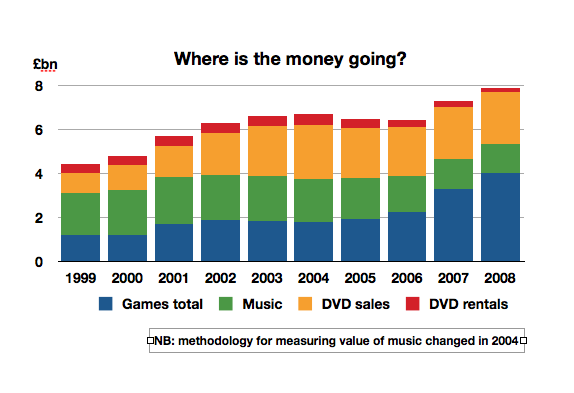
Arnie replaced textbooks with the Net
Arnold Schwarzenegger, governor of California, wants to phase out school textbooks because they are too expensive.
But somebody needs to enlighten him that believing the Net can directly and cheaply substitute for good textbooks (though from what Richard Feynman had to say about Californian textbooks might suggest I should drop the adjective there) is a solution to his problems which is simple, obvious and wrong.
Don't get me wrong, as a technophile in a university that has wholeheartedly embraced multimedia technologies as terrific educational tools and environments, I know first hand (and have the scars to prove it) that the Net can be deployed to spectacular effect (and at large scale) in this context. However, it is not simple, it is not cheap, and by and large it facilitates entirely new approaches and compliments rather than substitutes for effective pre-internet age educational tools (like texts) and practices. And somebody approaching the use of the net in education with the idea that is a cheap and easy substitute will fail, create a lot of frustration and do a lot of damage. It ranks right up there with the 'computer in every classroom will cure education' meme from the 1980s and 1990s.
"Arnold Schwarzenegger, California's Governor, announced this week that his state is about to phase out school books and substitute the internet in classrooms from the autumn, the news was presumably greeted with little more than a twitch of a baseball cap (turned backwards). Because California is close to bankruptcy, saving money is a priority, and this move will cut several hundred million dollars from the education budget. Mr Schwarzenegger also thinks that converting schools to online study will help to keep pupils more up to date, and that once textbooks are digitised they can be so easily revised that learning will always keep pace with progress."Firstly let's give the guy a pat on the back - he or his advisers think it might be a good idea to use the Net in education. Welcome to the 21st century Mr Schwarzenegger. Secondly let's tolerate his "Wayhay I've found the internet cure for our education woes" eureka moment.
But somebody needs to enlighten him that believing the Net can directly and cheaply substitute for good textbooks (though from what Richard Feynman had to say about Californian textbooks might suggest I should drop the adjective there) is a solution to his problems which is simple, obvious and wrong.
Don't get me wrong, as a technophile in a university that has wholeheartedly embraced multimedia technologies as terrific educational tools and environments, I know first hand (and have the scars to prove it) that the Net can be deployed to spectacular effect (and at large scale) in this context. However, it is not simple, it is not cheap, and by and large it facilitates entirely new approaches and compliments rather than substitutes for effective pre-internet age educational tools (like texts) and practices. And somebody approaching the use of the net in education with the idea that is a cheap and easy substitute will fail, create a lot of frustration and do a lot of damage. It ranks right up there with the 'computer in every classroom will cure education' meme from the 1980s and 1990s.
McKinnon back in court
Lawyers for Gary McKinnon, in what may be his last chance to avoid extradition to the US for alleged hacking into US defence computers, reportedly told the High Court yesterday that
"The former home secretary, Jacqui Smith, reached a "flawed decision" when she disregarded powerful medical evidence in the case of computer hacker Gary McKinnon, who is facing extradition to the US"
Monday, June 08, 2009
Pirate party election success in Sweden
I've just had a chat with Chris Edwards for a Guardian piece about the success of the Swedish Pirate Party in the EU parliament elections. I've been off the grid for a couple of weeks so wasn't aware of the news until this morning. I had a relatively wide ranging chat with Chris but a few things initially came to mind when I came across the story.
Firstly the Swedes have recently implemented the EU intellectual property rights enforcement directive, not a particularly popular measure, which coming rapidly in the wake of the Pirate Bay convictions would have helped the Pirate Party's publicity efforts in the run up to the election.
Secondly Sweden has a relatively high proportion of broadband subscribers, a substantial minority of whom may be tuned into the intellectual property debates to a higher degree than elsewhere in the EU. I have no direct evidence of this at the moment - purely speculation on my part.
Thirdly, as far as I can recall, Sweden had an electoral system based on proportional representation, which can make it possible for smaller parties to make an impact and gain seats with as little as 3 or 4% of the vote. Chris tells me they got 7% this time round which is pretty spectacular for a small single issue party.
It would be interesting to get some direct evidence, through interviewing a statistically significant sample of voters who opted for the Pirate Party, to find out the key reasons for that support. It could really significant that 7% of the electorate might actually actively have been prepared to cast their vote based on the state of the IP landscape. Of course it could equally have been a simple protest vote against established parties with the Pirate Party being the one alternative where voters knew what it stood for. Or something more nuanced between the two.
Firstly the Swedes have recently implemented the EU intellectual property rights enforcement directive, not a particularly popular measure, which coming rapidly in the wake of the Pirate Bay convictions would have helped the Pirate Party's publicity efforts in the run up to the election.
Secondly Sweden has a relatively high proportion of broadband subscribers, a substantial minority of whom may be tuned into the intellectual property debates to a higher degree than elsewhere in the EU. I have no direct evidence of this at the moment - purely speculation on my part.
Thirdly, as far as I can recall, Sweden had an electoral system based on proportional representation, which can make it possible for smaller parties to make an impact and gain seats with as little as 3 or 4% of the vote. Chris tells me they got 7% this time round which is pretty spectacular for a small single issue party.
It would be interesting to get some direct evidence, through interviewing a statistically significant sample of voters who opted for the Pirate Party, to find out the key reasons for that support. It could really significant that 7% of the electorate might actually actively have been prepared to cast their vote based on the state of the IP landscape. Of course it could equally have been a simple protest vote against established parties with the Pirate Party being the one alternative where voters knew what it stood for. Or something more nuanced between the two.
Thursday, May 28, 2009
Twittergate
The re-election of the German president was leaked on Twitter
Thanks to Michael Geist for the pointer.
"News that Hörst Köhler had been re-elected as German president on Saturday was published on the micro-blogging service almost 15 minutes before the result was officially announced."And naturally there's now the inevitable leak enquiry.
Thanks to Michael Geist for the pointer.
EU governments urge Google Books caution
Interesting - EU governments urge Google Books caution
Update: Sharebook are giving people a forum to talk about the settlement, which the Washington Post has picked up on.
Update: Sharebook are giving people a forum to talk about the settlement, which the Washington Post has picked up on.
Subscribe to:
Posts (Atom)