Friday, June 09, 2006

I've just realised something important about my book. It has a similar (though simpler and not nearly as eloquent) thesis to that of Yochai Benkler's Wealth of Networks. So now I'm wondering if I really have to scrap it and start from scratch with a new idea and a new structure. Below is a real first draft of Chapter 1. I'd be very interested in any comments you might have on it. I set up another blog, Silent Futures, for the book with the original intention of posting chapter drafts for comment. Though the book is about half done, so far only a draft of the outline and a draft of chapter 1 is available there.

Introduction

Louis Brandeis: "The greatest dangers to liberty lurk in insidious encroachment by men of zeal, well-meaning but without understanding."

Colmcille and the battle of the book

In Ireland in the mid 6th century AD, power depended on connections and access to and control of information. Not a great deal has changed in fourteen hundred years. The short story of Colmcille and the Battle of the Book[1] at Cooldrumman[2] goes something like this –

Colmcille[3] copied another monk’s manuscript. The other monk, Finnian, objected and they settled things the way they did in those days. Three thousand were killed at the resulting battle.

The political landscape at the time was in pretty much constant turmoil, with about 150 warring tribes vying for power, territory and revenge for some earlier wrongdoing perpetrated by their neighbouring foes. In the thick of these skirmishes, the factions did coalesce, occasionally, into loose transient alliances under the toughest leaders and there was a fierce rivalry for overall dominance of the land between the northern and southern branches of the strongest clan, the O’Neills.[4]

As a boy Colmcille O’Neill was a larger than life, intellectually gifted, charismatic, fiery young redhead, who thoroughly immersed himself in the teachings of the Christian church, ably cultivated[5] by his mentors, local priest, Cruithnechan, and a monk called Finnian, whose school he attended at Molville in County Down.

Colmcille’s sporting prowess and big, generous, open (if quick-tempered) nature earned him a lot of friends when he was growing up. He apparently had a booming, melodious voice and a very sharp sense of humour, which led him into many mischievous escapades. Being a devoted member of a church that was so integral to community life meant also being actively engaged in local society. He ran, chased, rode, hurled,[6] hunted, fished, sailed, and fought with great skill, energy and often savagery, as was fitting and expected of royalty. [7] He also delighted in Celtic culture and the natural environment and had a magical touch with plants and animals of all kinds.

A prolific scribe, Colmcille was made a deacon[8] before the age of twenty. He then spent some time with a Christian bard called Gemman. Over the next couple of years, he received an unparalleled education in Celtic folklore, politics and human nature, though the young deacon was already a shrewd student of all of these. Gemman taught him that learned men often lost touch with ordinary people because of their disconnected academic way of communicating. He needed to stay immersed in communities, their folklore and their lives. The idealistic, ambitious student, full of his own destiny and keen to spread his influence far and wide, learned the psychology of trading and negotiating and the mechanics of power dynamics and integrated these lessons[9] into his own ongoing observations of the world around him. He already knew of the power of the bards to make or break public figures. The importance of perceived status to the influence of each tribal chief cannot be overstated. And it was the bards that created and spread tales, myths and legends about the strength and great deeds of kings

At the age of 25, a newly ordained priest, he began travelling round the country on a missionary quest, eventually setting up 36 monasteries[10] in the space of 15 years. Colmcille was a shrewd politician, a hard nosed negotiator and a gifted administrator, without being blindly devoted to arbitrary rules.

Trailing around the country reconnoitring the latest prevailing political landscape and badgering local kings for land to build the monasteries involved significant personal risks to him and his followers. Not all of these kings were Christians, neither were they prepared to hand over hard earned territory willingly to some missionary who just happened to ask for it, especially one widely known to be a prominent member of an increasingly ambitious northern O’Neill clan. That, along with his ever growing power and reputation within a growing church, itself engaged in a struggle for dominance over hearts, minds and souls with paganism, was more than enough to get somebody killed.

Amongst the tasks he attacked most passionately was the transcribing of biblical manuscripts. A devoted scribe himself, he recognised the shortage of books as one of the critical paths restricting the growth of the scholarship of the church, as well as of his own band of followers. [11] Wherever and whenever he could get access to the materials he would copy and encourage his monks to copy, study and disperse the copies of books to spread the teachings of the church. He was one of the earliest in the tradition of Irish monks committed to such a philosophy, credited with saving the church’s literary treasures during Europe’s Dark Ages,[12] when book burning was a common practice amongst religious zealots.

When he learned that Finnian had got hold of a copy of the “Vulgate,”[13] Colmcille decided to visit his old teacher in 560AD in order to see it. Finnian, delighted to see him, willingly showed him the book, though he was generally very protective of it. Given that by then he had probably had many visitors intent on getting a glimpse of this treasure it would have been natural for him to be careful about the degree of access he allowed to the manuscript.

Whatever the circumstances of Colmcille’s initial encounter with the book and any conditions Finnian might have placed on his handling of it, it is fairly clear that Colmcille decided to make a copy surreptitiously by night. Finnian discovered what he was up to and was angry that someone he trusted so implicitly could have done such a thing behind his back. He asked that Colmcille give him the copy he had made when it was finished.

Colmcille was not impressed at his former mentor’s attitude. He was enraged that an old man should presume to act as such a reluctant gatekeeper to a book, the sharing of which, he believed, was crucially important to the future of the church in Ireland. Finnian suggested they resolve the issue by referring it for arbitration to the Diarmaid, the High King of Ireland and his court at Tara. Colmcille readily agreed, feeling he couldn’t lose both because he was in the right (acting for the greater good of the church) and because he felt the king was an ally, who also happened to be related to him.

At the High Court at Tara Finnian claimed ownership of the copy of the book based on what he believed to be legal precedent and on the moral grounds that a visitor and a friend, to whom he had extended an open welcome and hospitality, had betrayed him by secretly copying his property. He was also concerned that, if the book was to be copied and widely distributed, this had to be done carefully and through appropriate channels and procedures. He was concerned to maintain the integrity of the manuscript and ensure there were no errors introduced through hasty copying processes, the like of which Colmcille had secretly engaged in. Colmcille, by that time, had something of a manuscript production line operating at his monastery at Durrow, a group of monks transcribing manuscripts in order that these might be made widely available. It’s interesting to speculate on what Finnian’s views would have been about this activity and the quality of the work thus produced. Perhaps he felt any copying of his precious copy of the Vulgate should be done at Durrow? On the other hand, if his perception was that even a small fraction of the work there was sub standard, he would have felt completely justified in demanding that any copying of the manuscript could only be done under his personal supervision.

Colmcille, by now used to being revered in public circles, was disturbed to have his pristine reputation attacked in public at Tara. After a hearing which reportedly went on all through the night and where many questioned Colmcille’s integrity, it became clear that there was an undercurrent to the proceedings that went way beyond a dispute over a book. Part of it was to do with the perception amongst some that the monk had become too powerful and needed to be taken down a peg or two. This jealousy would have been politically motivated and could have counted on factions within the Christian church, the pagans and the political establishment who saw him as a powerful agent of change in society. Superimpose on this the increasing tensions between the church and paganism, the church’s increasing intolerance of [the High King of Ireland] Diarmaid’s accommodation of the pagans (who they perceived as a major obstacle in the path to true salvation) and the political battle lines between the most powerful tribes in the land, and this arbitration hearing takes on a much wider significance. In any case, as the dawn broke Colmcille made his closing address to the court[14]:

“My friend’s claim seeks to apply a worn out law to a new reality. Books are different to other chattels (possessions) and the law should recognise this. Learned men like us, who have received a new heritage of knowledge through books, have an obligation to spread that knowledge, by copying and distributing those books far and wide. I haven’t used up Finnian’s book by copying it. He still has the original and that original is none the worse for my having copied it. Nor has it decreased in value[15] because I made a transcript of it. The knowledge in books should be available to anybody who wants to read them and has the skills or is worthy to do so; and it is wrong to hide such knowledge away or to attempt to extinguish the divine things that books contain. It is wrong to attempt to prevent me or anyone else from copying it or reading it or making multiple copies to disperse throughout the land. In conclusion I submit that it was permissible for me to copy the book because, although I benefited from the hard work involved in the transcription, I gained no worldly profit from the process, I acted for the good of society in general and neither Finnian nor his book were harmed.”[16]

When he had finished, King Diarmaid, sought the advice of his Supreme Court counsellor Bec MacDe.[17] Then he made his famous ruling:

“I don’t know, Colmcille, where you get your fancy new ideas about people’s property. Wise men have always described the copy of a book as a child-book. This implies that someone who owns the parent-book also owns the child-book. To every cow its calf, to every book its child-book. The child-book belongs to Finnian.”[18]

Now nobody rose to the prominence of a high king’s counsellor without significant political skills and MacDe would have had his own agenda in considering how to advise Diarmaid. As a druid this included the welfare of the pagan religion and concerns at the success of missionaries like Colmcille in spreading the Christian faith. He was well acquainted with the big monk and can scarcely have believed his good fortune in having this opportunity to influence the reputation of the high profile evangelist. In addition he was simultaneously able to inhibit the distribution of copies of a book which he understood to be the purist form of the Christian doctrine available in the country.

In the immediate aftermath of the ruling, Colmcille was a man in shock. So convinced was he of the righteousness of his cause that he had never even considered he might lose the case. Furious that his integrity had not only been publicly questioned but now, in the decision, found wanting and also that these important scriptures were to be locked away from a church in desperate need of them, he cursed Diarmaid, turned his back on the king and left.

Shortly thereafter Diarmaid was responsible for the murder of a young prince, Curnan, who had been granted sanctuary by Comcille. The vengeful warrior in Colmcille took hold. He made his way to his family, the Northern O’Neills, who were already considering that they had the strength to challenge the high king. They just needed an excuse. By the time he got home he had probably rationalised his rage and considered that his cause – the defence and greater glory of the church as well as revenge for the injustice he had suffered – justified the battle he intended to catalyse. His family and their allies defeated Diarmaid’s forces at Cooldrummon the following year.

Though it came to be known as the "Battle of the Book," the carnage at Cooldrumman leading to 3000 deaths, in common with most complex events, had multiple causes, albeit that the copying of that single manuscript was one of the key triggers. Colmcille, though sorry so many men had to die for it, still felt after the battle that his cause had been just. Spreading copies of and access to the knowledge contained in the precious book was, in his view, a holy cause and a key strategy in building the power of the church.

His fellow leading churchmen, however, found his actions unconscionable, declared his behaviour unworthy of a man of God and excommunicated him for a short period at a church synod meeting. He was reinstated and penalised to exile from Ireland and the winning of 3000 converted souls for the church.[19]

Colmcille went to Iona two years later but it’s unlikely it was because of the demands of the church synod.[20] It’s not clear that he was penitent even in the wake of the synod, which he felt should have been more understanding. It does appear, however, that he may have encountered something of a midlife crisis at this stage and wandered aimlessly for a couple of years. He then became acutely aware that a branch of his family in Scotland was in crisis. Successful settlers they had been suffering heavy defeats at the hands of the pagan picts and were on the verge of being completely annihilated. The big monk now found himself a new mission – to become the saving grace of his family, the church in Scotland and the thousands of unenlightened souls amongst the picts’ tribes. So in 563, two years after the battle of the book, he set sail for Iona in Scotland,[21] with twelve followers in tow, 42 years old and heading arguably for his greatest successes and the true fulfilment of his destiny. That next chapter of his life is a story for another day.

Three ideas

The Colmcille story is about a struggle over access to information. Access to information underpins the themes of this book which is about decision making related to and involving important socio-technological information systems. For the purposes of the book I’m going to use the term ‘digital decision making’ or DDM (or ddm), purely to avoid having to repeat ‘decision making related to and involving the development, deployment and regulation of complex information and communications technologies (ICTs).’ Digital decision making is not a commonly used/recognised jargon phrase in the industry or academia; nor should it be confused with some kind of artificial intelligence or the idea of machines making decisions. It is simply, in this case, a literary device to hopefully make life easier for me and for the reader. Translating ‘decision making related to and involving the development, deployment and regulation of complex information and communications technologies (ICTs)’ as DDM, even though it might sound like a toxic chemical, also saves a few trees.

Information systems which have a considerable impact on public welfare are being created, deployed and regulated often without a fundamental understanding about what these systems are required to do or how they might actually work in practice. Electronic voting systems, childcare worker databases, terrorist and other criminal suspects databases, genetic profiling, DNA databases, national identity cards systems, national health information systems, information systems in education, air passenger profiling, motorist and mobile phone tracking and other ubiquitous surveillance like CCTV and communications data retention schemes are being deployed at a phenomenal rate and the whole area of information related laws is changing rapidly; and it is all happening in piecemeal fashion without a genuinely coherent overall view[22] or a sound understanding of what the technology can and, almost more importantly, cannot do.

That’s something which strikes me as a problem for society in response to which I offer three basic ideas:

1. Firstly, people who make decisions about the deployment and regulation of complex information systems of considerable significance to public welfare should base action upon an understanding of the systems and environment within which they operate.

2. Secondly ordinary people (who in an environmental decision making situation would be called ‘stakeholders’) and ‘experts’[23] working together can facilitate the development of this understanding. Indeed it is often ordinary people who contribute the true expertise.

3. Thirdly, in a knowledge society[24] the default rules of the road are the laws governing the flow of information and the restrictions built into the architecture of technology . These laws and technologies are shaping up to be a bottleneck, particularly for decision making and education. It might be reasonable to stick a digital lock on an electronic version of some educational material and make it a crime to bypass the lock, but people need to be aware of this.

The first idea – the simple thesis that people should understand what they are dealing with when making decisions – seems so patently obvious it hardly seems worthy of being the core idea in a book. As we shall see in chapter 2, however, there are a multitude of things which get in the way of that understanding in the context of information systems. Contrary to popular belief that it is highly sophisticated, for example, the information technology industry is actually only in its infancy and even just understanding the difference between ‘information systems’ and ‘information technology’ is not something we can be confident that decision makers are aware of. There is a tendency to focus on the computing components of an information system, rather than the multifaceted system as a whole, including importantly, the human factors. Moreover this focus on having to use the computer rather than doing what we need with the aid of a computer where it is useful, can actually blind us to the real exiting possibilities of the technology.[25]

In the context of environmental decision making, there has been a considerable and in theory at least very positive movement towards facilitating stakeholder involvement in decision making processes; as well as encouraging every individual to take an active role through considering the impact of their lifestyle choices on the environment. Contrary to prevailing fashionable theories, however, stakeholder involvement is not the holy grail of decision making on complex systems, though it is a crucial element. If stakeholders have neither access to the appropriate information to pursue informed decisions nor real influence in decision making processes, then stakeholder involvement is a mere public relations exercise. By the same token, the notion of leaving decision making about complex information systems solely to the experts[26] is not to be recommended. The reality of information systems deployment is that when no account is taken of user needs the system always fails. The second central claim in this book, therefore, is that the far-reaching implications for commerce and society, of decisions in invisible or opaque specialist fields regarding the regulation and deployment of large information systems, mean they should be matters of concern for every citizen; and that ordinary citizens[27] working together with experts (and regulators) will prove more effective than each group acting in isolation. If the reader was to take only one thing from this book this would be the most important.

As the Internet and other communications technologies become more central to our lives, alterations in their nature or functioning could have consequences for us all. Implicit in the technology, for example, is the capacity to monitor the online activity of every single user – to track every website visited, every e-mail sent (and to whom), and so on. So debates about the future of the Net, and about the legal framework within which it operates, are increasingly going to be debates about the future of society – just as, say, arguments about press freedom are inevitably arguments about liberty and democracy.

There is a strong connection between developments on and surrounding the Internet that affect something (privacy or access to education, for example) which is normally regarded as a subject for political concern and debate. Yet what we generally find is that debates about the development, regulation and deployment of the technologies tend to be regarded as technical or legal arguments about specialist subjects, rather than as matters which should concern everyone. The viewpoint implicit in this book – and one of the reasons I’m writing it – is that this is misguided.

Perhaps if we realised DDM is like environmental decision making, we would take a little more notice? If the last remaining trees and hedgerow in my neighbourhood were being ripped up to make way for a waste incinerator, I’d feel strongly enough to speak to local people about it, sign a petition or write to my MP. I’d do it because I could see the impact it would have on my family’s day to day quality of life. But we do not realise the effect of new technologies because they are not always so obvious or immediate. Neither do we know what powers we have to engage in decisions related to these new technologies. It is all too novel and we don’t know enough about them. The little we do see are warnings against pirating DVDs and CDs or high profile cases with CCTV pictures of terrorists, neither of which engages the ordinary citizen from our own perspective.

The third idea in the book is that changes in law and technology could be leading to a kind of “second enclosure movement”[28] which threatens not only our ability to make informed decisions about those complex information systems, but even something as fundamental as our access to the basic raw materials of education. This is something which has been a problem in the developing world for generations. Relative to average incomes,[29] a student paying $80 for a book in Indonesia would be the equivalent of a US student paying nearly $3200 for the same book in the US.

A vibrant information ecology is at the foundation of our knowledge society, just as a vibrant natural environment is at the heart of a healthy society. James Boyle and Larry Lessig have persuasively argued, [30] however, that we could be facing an enclosure of the “commons of the mind” where the basic raw materials of cultural, scientific and educational discourse get locked behind legal and technical toll booths, controlled by a small number of actors. At a time when we have the capacity to facilitate universal access to a virtual digital library of Alexandria for our time, we are actually increasingly moving in the opposite direction towards a pay per view society. This feature of the book is partly a synthesis of the important work of scholars like Boyle and Lessig published in the US but it is also partly an educator’s attempt to wrap some of their key ideas in a slightly different context, in the hope of making them more accessible.[31]

None of the central ideas are particularly radical. Primarily the book is a collection of stories and developments in the regulation and deployment of technology that, taken together, add up to a picture of a developing information society, which we are reacting to rather than actively shaping.

To the extent that I offer, in the final chapter, a theoretical systemic decision making framework for the development, regulation and deployment of communications technologies, it could be considered to be an attempt to extend our theoretical understanding of the subject matter and to some degree provide a “how to” practical guide for decision makers. The framework, however, is a modest proposal and should in no way be considered to be an ivory tower academic’s one-true-guide to digital decision making.

About this book

So we have 3 ideas:

  • People should understand what they’re dealing with
  • Ordinary people and experts should work together
  • The rules of the road are given by the information laws and the technology

The introduction has already described the story of Colmcille and the battle of the book and for the moment you can think of it as a kind of a historical case study in DDM.

Part 1: What’s happening?

Chapter 2 is a whistle-stop tour in how decisions happen and the reasons why the idea that people should understand what they are dealing with is not as simple as it sounds.

Chapter 3 goes on to set out a series stories that made me stop and think that perhaps we could and should be doing these some of these things differently. There has been a legal dispute over the copyright in silence for example, and we are seeing outcomes of the suing-over-silence variety, often unintended, in the case of commercially successful children’s literature, technology in education, and a huge number of other examples of the creation, regulation and deployment of information systems and information flows.

Chapter 4 looks at the central importance of intellectual property and offers a synthesis of the ideas of Boyle and Lessig. Chapter 5 then broadens the scope beyond intellectual property with stories of information systems which are set to have a considerable impact on public welfare, such as electronic voting.

Part 2: What to do about it.

Chapter 6 looks in more detail at the distinction between facts and values mentioned in Chapter 2 and explores power relationships in decision making. Many public arguments involve a mix of all of these but this is not transparent. Arguments get presented as if they are disputes only about facts, whereas they are really about conflicts in values and it is the values of the most powerful actors in the decision making process that achieve primacy.

Chapter 7 covers the importance of understanding the difference between information systems and information technology. The failure to understand information as a multi-dimensional system, including human factors, can lead to all kinds of problems. There is a common tendency to focus instead on the technology [computing] element of the information system at the expense of seeing the big picture.

Chapters 8 and 9 then go onto look in more detail at the central idea of the role of experts and the value of multiple perspectives in the context of digital decision making.

Part 3: A final modest proposal.

Chapter 10 finally provides a systemic decision making framework as one way to facilitate understanding through the coming together of experts and lay people in decision making processes involving the deployment and regulation of information and communications technologies. I’m not suggesting that this provides a magic silver bullet of the ‘consumer choice’ variety, merely that it may prove useful to some as a way of improving prevailing DDM processes.

We are all products of our background and experience and as I point out in more detail in chapters 2 and 6, have difficulty thinking outside our personal biases and values. So in the interests of full disclosure here are a few things which you might find helpful to work out my cultural biases:

I grew up in a small village in Ireland in a working class family, generations of which earned their living in the engineering and construction industries. After graduating from University College Dublin I spent about 10 years in a variety of manufacturing industries and some local government work, the greater part of which was the 7 years I worked in aerospace development engineering. Testing parts of aircraft structures to destruction can be great fun and I did an MBA at Warwick University whilst there but I never came to identify with the management and formed some strong views about what I considered to be good and bad management.

After that I had some time out of work and went back to University to study law before joining the Open University (OU) in 1985 as a ‘Staff Tutor in Technology’ (nobody outside the OU knows what one of those is but it is sort of a combined technology academic and director of studies), looking after the South Region of the UK. The OU has given me the privilege of working with some absolutely amazing people, colleagues and students, and of pursuing a diverse range of academic interests spanning the gamut of technology from environmental decision making to Internet law.[32] The people who have most influenced my thinking in the subject area of this book are my closest colleagues at the OU, most notably Dick Morris and John Naughton, plus Colm Reilly, James Boyle and Larry Lessig.


Endnotes

[1] Colmcille was brought to the attention of the popularly labelled ‘copyfighting’ community on the Internet by Seán McGrath, http://seanmcgrath.blogspot.com/2003_03_23_seanmcgrath_archive.html#200053874,

who wrote of a small story in Mary Mulville’s Ingenious Ireland: A County-By-County Exploration of the Mysteries and Marvels of the Ingenious Irish, Simon & Schuster UK , 2003, referring to the monk’s part in the Battle of the Book at Cooldrumman. To get at the detailed story, however, you can’t beat a few days digging in a good library and the 189 tomes on the saint in Oxford’s Bodleian library. There is a vast amount of myth and legend surrounding our knowledge of the saint’s life, as there is very little surviving direct evidence or records of his activities. The definitive account repeatedly referred to by scholars is Adomnán’s biography, translated by various scholars, the versions I referred to being St.Adamnán, Alan Orr Anderson (Editor), Marjorie Ogilvie Anderson (Editor), Adomnan's Life of Columba (Oxford Medieval Texts), (Clarendon Press, 1991) and Adomnán of Iona, Richard Sharpe (Translator) Life of St Columba (Penguin Classics), (Penguin Books Ltd, 1995). Adomnán, born 27 years after the death of his hero, nevertheless came to Colmcille’s monastery at Iona at a young age, so probably knew some of the Saint’s contemporaries. Mediaeval biographers tended to idolatrize their subjects and it is no accident that a lot of the miracles associated with Colmcille are similar to those connected with Jesus Christ in the bible. (Adomnán would be more accurately described as a hagiographer, rather than a biographer and many of the stories are hagiolatry and folklore rather than historical accounts). He is alleged in various accounts, for example, to have raised people from the dead (including his foster father, Cruithnechan), turned water into wine and multiplied loaves and fishes. And when he was a baby Cruitnechan came home from church one night to find his house bathed in bright light, the course of which he found was a spectacular fireball hovering over Colmcille’s cot. The more parallels the biographer could draw between Colmcille’s life and that of the founder of the church, the more important they could make him out to be. Having said all that, however, it must be noted that the provenance of Adomnán’s text is impressive. A manuscript at the Stadtbibliothek at Schaffhausen in Switzerland was transcribed by Dorbenne from Adomnán’s original. Dorbenne succeeded Adomnán as Abbot of Iona 9 years after the latter’s death. Dorbenne himself died within 5 months of ascending to that office. An earlier abbot, Cummene, who actually knew Colmcille, had also written a life of the saint and it is thought that Dorbenne added extracts from Cummene’s Life of Columba in his transcription.

[2] Also in the literature called Culdreimhne, Culdreimhe, Cul Dreimhne, Cul Dreimne, Cul Drevny, Cul Dremne, Culdreibhne

[3] Google (http://www.google.co.uk ) produces more than 30 000 links to webpages on Colmcille, at the time of writing (18 000 if you use the Columcille spelling). Using his given name, Columba, that goes up to over 800 000. He even now has an entry in the popular online encyclopaedia, Wikipedia,

http://en.wikipedia.org/wiki/Columba.

[4] Colmcille’s kinsfolk were the northern O’Neills. Ian Bradley, Columba: Pilgrim and Penitent, (Wild Goose Publications, 1996). His father headed the Donegal branch of the family. Donegal is situated in the North western corner of Ireland and geographically contains the northernmost territory of the country. It is, however, still part of the Republic of Ireland, rather than Northern Ireland which constitutes 6 northern counties that are politically part of the United Kingdom. Up until 1998, when they were amended through a referendum as part of the peace process, articles 2 and 3 of the Irish Constitution laid claim politically to the territory of Northern Ireland. The current text is available online at http://www.taoiseach.gov.ie/upload/static/256.pdf

[5] The people surrounding the young royal personage nurtured the boy’s considerable talents and also encouraged him and others to believe in and live up to his own legend.

[6] Hurling is an ancient Gaelic game, still played widely today not only in Ireland but all over the world amongst the Irish Diaspora. 15 players on each team carry wooden hurley sticks, roughly the length of a golf club but with a wider shaft, which they use to collect, carry and strike the sliotar (a small tough leathery ball, similar to a cricket or baseball ball). The object of the game is to score more points than the opposing team by putting the sliotar in their net (which earns three points) or over the opponents’ bar, between the tall goalposts (which gives you one point). It is one of the fastest and most skilful field sports in the world, when played properly.

[7] There are some stories to suggest he delighted in a good scrap, though occasionally lost control of his temper to a degree which led him to seriously injure his opponent and on one occasion to bite his mother’s hand. M.V. Woodgate, St. Columba, (St Paul Publications, 1969). It is possible he took part directly in some of the serious battles between tribes when he was a young lad, as it was the duty of a prince and a churchman to “smite any foe” that threatened but there are no records of this.

[8] An assistant priest http://en.wikipedia.org/wiki/Deacon

[9] Which we re-visit in detail in chapter 9.

[10] Iona, The Story of Saint Columba (Columcille), (M.H. Hill & Son Ltd., Dublin, 1928), p19 and Lucy Menzies, Saint Columba of Iona (J.F.M. Books, 1992, originally published in 1920). This included one at Kells on land donated by the High King, Diarmaid, who would later rule against him in the dispute over the book; and one at Durrow, which, next to Iona, was to become his most famous. In fact the monks at Durrow always considered their monastery to hold a higher standing in the church than Iona. Manus O’Donnell, Betha Colaim Chille (1532) (A. O'Kelleher, G. Schoepperle published an edited translation in Chicago in 1918, which the Dublin Institute for Advanced Studies published a version of in 1994) claims he set up as many as 300 churches during this time, though this account of the saint’s life needs to be enjoyed purely as a fireside folk tale rather a factual account. Nearly every page tells of some spectacular triumph for Colmcille and anyone that provides him with any difficulties is painted in the darkest light.

[11] By the 6th century the church had become increasingly enlightened as to the power of books and sophisticated in the use of the written word to organise and control its institutions and followers.

[12] http://en.wikipedia.org/wiki/Dark_Ages

[13] The Vulgate was the definitive Latin translation of the bible done by St Jerome about a century earlier.

[14] An address which echoes through intellectual property disputes in our modern digital age.

[15] He would have been referring here to the book’s physical integrity, as well as its spiritual, economic, social and philosophical value.

[16] Mine is something of a clumsy translation of the original argument recorded in Manus O’Donnell, Betha Colaim Chille (1532) and it relies heavily on versions in Manus O’Donnell, Betha Colaim Chille (1532) Edited and translated by A. O’ Kelleher and G. Schoepperle as Betha Colaim Chille/ Life of Columcille (University of Illinois Press, 1918), p178-179, Lucy Menzies, Saint Columba of Iona (J.F.M. Books, 1992, originally published in 1920), p.25 and Padraic Colum, The Legend of Saint Columba (Sheed and Ward, London, 1936), p76-81, but it’s meaning remains fairly clear. Colmcille was an accomplished and impressive public speaker, much more so than my efforts at getting his meaning across would make it appear.

O’Donnell’s account:

Do inneis Finden a sceila art us don righ, ass ed adubhairt ris: “Do scrib C.C. mo leabhur gan fhis damh fen,”ar se, “aderim corub lim fen mac mo leabhur.”

“Aderim-se,” ar C.C., “nach mesde lebhur Findein ar scrib me ass, nach coir na neiche diadha do bi sa lebhur ud do muchadh no a bacudh dim fein no do duine eli a scribhadh no a leghadh no a siludh fan a cinedachaib; fos aderim ma do bi tarba dam-sa ina scribhadh, corb ail lium a chur a tarba do no poiplechaibh, gan dighbail Fhindein no a lebhair do techt ass, cor cedaigthe dam a scribudh.”

Is ansin ruc Diarmaid an breth oirrdearc .i. “le gach boin a boinin” .i. laugh “le gach lebhur a leabrán.”

A. O’ Kelleher and G. Schoepperle translation:

Finnen first told the king his story and he said “Colmcille hath copied my book without my knowing,” saith he “and I contend that the son of the book belongs to me.”

“I contend,” saith Colmcille, “that the book of Finnen is none the worse for my copying it, and it is not right that the divine words in that book should perish, or that I or any other should be hindered from writing them or reading them or spreading them among the tribes. And further I declare that it was right for me to copy it, seeing there was profit to me from doing in this wise, and seeing it was my desire to give the profit thereof to all peoples, with no harm therefore to Finnen or his book.”

Then it was that Diarmaid gave the famous judgement: “To every cow her young cow, that is, her calf, and to every book its transcript. And therefore to Finnen belongeth the book thou hast written, O Colmcille.”

[17] A pagan druid and none too fond of Colmcille, though legend has it that the saint converted him to Christianity on the day MacDe died. Colum, op.cit., p31-35.

[18] Ibid.

[19] There is a dispute about whether a church council Synod meeting at Teltown or a later confessor, St Molaise, imposed the exile. Some accounts say it was Molaise that convened the synod and some even say that the Archangel Michael made the exile a condition of helping out in the battle of Cooldrummon. Manus O’Donnell who clearly intensely disliked Molaise and held him responsible for Colmcille’s exile, goes to great lengths to paint Molaise in a bad light, with stories of one-upmanship between him and Colmcille in which the latter always prevailed. So O’Donnell says Molaise was only acting vindictively in banishing Colmcille from the land he loved.

[20] Many commentators see the battle of the book and the subsequent synod at Teltown as complete red herrings in understanding the decision Colmcille took to go to Iona.

[21] Though he didn’t know when he set out that his base was going to be Iona.

[22] Or ‘systemic overview’

[23] An ‘expert’, for the purposes of the book can be considered to be someone with professional experience and training in a particular field such as a scientist, engineer, information systems specialist, academic, lawyer etc. Experts are much maligned in our anti-intellectual culture but it really is not a crime to actually know something about the subject area at the centre of a particular decision.

[24] Or “information age” if you prefer.

[25] Whilst, perversely attempting to make the technology do tasks it is not suited to.

[26] Such as the current consideration been given to abolishing jury trials in complex fraud cases in the UK.

[27] The users, as well subjects and objects of information systems.

[28]James Boyle, The Second Enclosure Movement and the Construction of the Public Domain, (2003) http://www.law.duke.edu/pd/papers/boyle.pdf

[30] James Boyle, Shamans, Software and Spleens: Law and the Construction of the Information Society, Harvard University Press (1997)

Lawrence Lessig, The Future of Ideas, Random House (2001)

Lawrence Lessig, Free Culture, Penguin Books (2004)

Boyle and Lessig have blazed a trail in explaining the potential impact of changes in intellectual property law and technology to an extent that I would say that their works should be compulsory reading for anyone with a serious interest or involvement in information systems policymaking.

[31] I’ve run a course at the Open University along these lines, Law the Internet and Society: Technology and the future of ideas which will hopefully be available openly on the Web by the time this book gets published

[32] The University’s Technology Faculty takes a possibly unique perspective, amongst UK universities, on technology and it’s impact on society.


Entertainment cos. funded Canadian heritage minister

It seems that when it became clear that the campaign against previous Canadian MP, Sam Bulte, might be successful, the entertainment companies funding her election campaign quietly siphoned significant funds to then opposition candidates. One of the beneficiaries of this was Bev Oda, the new Canadian Heritage Minister

"Conservative Party Heritage Minister Bev Oda, became the focus of the entertainment industry's funding efforts as it became clear that Bulte would not be re-elected (Bulte went crazy when her election prospects weakened, screaming in all-candidates meetings about not being "intimidated by user-rights zealots and EFF members").

Unlike the US, Canada does not have a tradition of corporate funding of Parliamentary campaigns. Indeed, Michael Geist got many of the candidates in the last election to sign onto a pledge not to take campaign funding from industries that they are likely to end up overseeing once in office. This only makes sense -- if you're taking a government paycheck to represent the public interest by overseeing an industry, that industry shouldn't be lining your pockets.

Canadian Heritage Minister Bev Oda did not take the pledge."

Tiscali open letter to Euro music industry

Mario Mariani of Tiscali has written an open letter to the European music industry, berating them for causing the Tiscali jukebox service to be closed down after just one month of operation.

"It is with great regret that today we find ourselves forced to “turn off” our Tiscali Juke Box service, launched recently on 26 April 2006 in Italy and the UK.

When we launched Tiscali Juke Box our objective was to offer users the chance to legally listen to millions of songs through p2p streaming, selecting them by artist, genre, or simply by choosing predefined playlists made available by other users. This service was developed on Mercora’s platform which, for over a year, has been enormously successful in offering users the possibility to listen legally in the United States.

The service has now been judged by the major recording labels in Europe to be “too interactive” only because it allows users of the Internet (the most interactive of mediums) to carry out searches by “artist” in addition to genre...

It is surprising that after just one month, despite the joint regular testing and fine-tuning phase carried out prior to the launch of the service, the major labels have decided to submit unexpected change requests. Even more surprising is the short-sightedness of the recording industry in not making any effort to understand either the basic needs or habits of music fans that choose to consume music via the Internet, or the acts directly benefiting from this promotion...

It is unfortunate that once again the industry has demonstrated the complete rejection of online legal music based on open systems, and is to the full advantage of the proliferation of music piracy services."

Thursday, June 08, 2006

Phil Becker's ID Fallacy's

Editor In Chief of Digital ID World, Phil Becker, has been posting a series of "Identity Fallacies" which should be read by anyone interested in ID cards.

#1 We'll Add It In Later

#2 Enterprise Identity is Hierarchical

#3 Centralized Management Means Centralized Data

Update: Kim Cameron agrees.

Some questions for ID card suppliers

William Heath is suggesting any potential suppliers of systems or components of the UK Id card system should be seriously asking themselves these questions:

"- Does the end customer want this? Do people want it? Do Departments (OGDs in govspeak) and does business want it?
- Does it all work in a way that fits natural patterns of human behaviour?
- Is there a clear business case?
- Is it a credible solution to a worthwhile problem?
- Is it consistent with Departmental responsibility and Ministerial accountability via Accounting Officers (Perm Secs)?
- Is it consistent with government policy on choice and devolution?
- Will it work on-line? Is it headed where the Internet seems to be headed, according to the best contemporary thinking available?
- Is the right bit of government in charge? Will OGDs respect the lead and fall into line?
- Is the client department competently led and managed? Are its accounts clean, its staff high-calibre and in high morale?
- Was the security risk assessment done properly? Did it come out OK?
- This looks as if it will start. But are they going to finish?"

In other words,

What's it for?
Will it work?
What happens if it doesn't work?
Is it worth the risk of being associated with it?

Children standing still arouse suspicion

From ARCH: The curious incident of the children who stood still

"Interesting lecture at the RSA last night: Daniel Neyland talking about the use of CCTV cameras. One anecdote about time he spent in a CCTV control room apalled several of the audience, to judge by the questions afterwards.

Evening in a town centre, and nothing is going on. The control-room staff pan around, and suddenly notice four children standing still. Not breaking windows or shouting abuse – just standing there. The staff get uneasy: why are they there? After much speculation, a police squad car is detailed to go and find out: screen shots of two police officers questioning the children, who are vigorously shaking their heads. They turn out their pockets. Another squad car turns up. Two more officers join in. Eventually the children are allowed to go – although there’s a brief flurry of excitement when one of the children reaches into his pocket and unwraps…a sweet.

Ah well, just another four kids who think the police are the pits. That’s life."

There in a nutshell is one of the key problems with the mass surveillance society - the damaging impact of the false positive - innocent behaviour profiled as suspicious by watchers tasked with looking for trouble.

Online collectivism: Following Mao or Friedman?

John Brockman and Clay Shirky have captured a fascinating series of responses to Jaron Lanier's thought provoking essay "Digital Maoism: The Hazards of the New Online Collectivism"

Set aside some time for some of them. Douglas Rushkoff for instance:

"While I agree with Lanier and the recent spate of articles questioning the confidence so many Internet users now place in user-created databases, these are not grounds to condemn bottom-up networking as a dangerous and headless activity — one to be equated with the doomed mass actions of former communist regimes.

Kevin's overburdened "hive mind" metaphor notwithstanding, a networked collaboration is not an absolutely level playing field inhabited by drones. It is an ecology of interdependencies. Take a look at any of these online functioning collective intelligences — from eBay to Slashdot — and you'll soon get a sense of who has gained status and influence. And in most cases, these reputations have been won through a process much closer to meritocracy, and through a fairer set of filters, than the ones through which we earn our graduate degrees...

Most of us who work in or around science and technology understand that our greatest achievements are not personal accomplishments but lucky articulations of collective realizations. Something in the air. (Though attributed to just two men, discovery of the DNA double-helix was the result of many groups working in parallel, and no less a collective effort than the Manhattan Project. ) Claiming authorship is really just a matter of ego and royalties. Even so, the collective is nowhere near being able to compose a symphony or write a novel — media whose very purpose is to explode the boundaries between the individual creator and his audience.

If you really want to get to the heart of why groups of people using a certain medium tend to behave in a certain way, you'd have to start with an exploration of biases of the medium itself. Kids with computers sample and recombine music because computers are particularly good at that — while not so very good as performance instruments. Likewise, the Web — which itself was created to foster the linking of science papers to their footnotes — is a platform biased towards drawing connections between things, not creating them. We don't blame the toaster for its inability to churn butter.

That's why it would particularly sad to dismiss the possibilities for an emergent collective intelligence based solely on the early results of one interface (the Web) on one network (the Internet) of one device (the computer). The "hive mind" metaphor was just one early, optimistic futurist's way of explaining a kind of behavior he hadn't experienced before: that of a virtual community...

Still, what you saw so clearly from the beginning is that the beauty of the Internet is its ability to connect people to one another. It's not the content, it's the contact... the true value of the collective is not its ability to go "meta" or to generate averages but rather, quite the opposite, to connect strangers. Already, new sub-classifications of diseases have been identified when enough people with seemingly unique symptoms find one another online. Craigslist's founder is a hero online not because he has gone "meta" but because of the very real and practical connections he has fostered between people looking for jobs, homes, or families to adopt their pets. And it wasn't Craig's intellectual framing that won him this reputation, but the time and energy he put into maintaining the social cohesion of his online space...

I'm troubled by American Idol and the increasingly pandering New York Times as much as anyone, but I don't blame collaboration or techno-utopianism for their ills. In these cases, we're not watching the rise of some new dangerous form of digital populism, but the replacement of key components of a cultural ecology — music and journalism — by the priorities of consumer capitalism.

In fact, the alienating effects of mass marketing are in large part what motivate today's urge toward collective activity. If anything, the rise of online collective activity is itself a check — a low-pass filter on the anti-communal effects of political corruption, market forces, and strident individualism. "

Other responses come from Quentin Hardy, Yochai Benkler, Clay Shirky, Cory Doctorow, Kevin Kelly, Esther Dyson, Larry Sanger, Fernanda Viegas & Martin Wattenberg, Jimmy Wales, George Dyson, Dan Gillmor, Howard Rheingold. Benkler most eloquently gets to the heart of the issues, in a reprise of the thesis of his recently published book, The Wealth of Networks:

"Lanier has two driving concerns. The first is deep: loss of individuality, devaluation of the unique, responsible, engaged individual as the core element of a system of information, knowledge, and culture. The second strikes me as more superficial, or at least as more time- and space-bound. That is the concern with the rise of constructs like "hive mind" and metafilters and efforts to build business models around them.

Like Lanier, I see individuals as the bearers of moral claims and the sources of innovation, creativity, and insight. Unlike Lanier, I have argued that enhanced individual practical capabilities represent the critical long term shift introduced by the networked information economy, improving on the operation of markets and governments in the preceding century and a half. This is where I think we begin to part ways. Lanier has too sanguine a view of markets and governments. To me, markets, governments (democratic or otherwise), social relations, technical platforms are all various and partly overlapping systems within which individuals exist. They exhibit diverse constraints and affordances, and enable and disable various kinds of action for the individuals who inhabit them. Because of cost constraints and organizational and legal adaptations in the last 150 years, our information, knowledge, and cultural production system has taken on an industrial form, to the exclusion of social and peer-production. Britney Spears and American Idol are the apotheosis of that industrial information economy, not of the emerging networked information economy...

Take Google's algorithm. It aggregates the distributed judgments of millions of people who have bothered to host a webpage. It doesn't take any judgment, only those that people care enough about to exert effort to insert a link in their own page to some other page. In other words, relatively "scarce" or "expensive" choices. It doesn't ask the individuals to submerge their identity, or preferences, or actions in any collective effort. No one spends their evenings in consensus-building meetings. It merely produces a snapshot of how they spend their scarce resources: time, web-page space, expectations about their readers' attention. That is what any effort to synthesize a market price does. Anyone who claims that they have found transcendent wisdom in the pattern emerging from how people spend their scarce resources is a follower of Milton Friedman, not of Chairman Mao.

At that point, Lanier's critique could be about the way in which markets of any form quash individual creativity and unique expression; it might be about how excessive layers of filtering degrade the quality of information extracted from people's behavior with their scarce resources, so that these particular implementations are poor market-replacement devices. In either case, his lot is with those of us who see the emergence of social production and peer production as an alternative to both state-based and market-based, closed, proprietary systems, which can enhance creativity, productivity, and freedom.

To conclude: The spin of Lanier's piece is wrong. Much of the substance is useful. The big substantive limitation I see is his excessively rosy view of the efficacy of the price system in information production. Networked-based, distributed, social production, both individual and cooperative, offers a new system, alongside markets, firms, governments, and traditional non-profits, within which individuals can engage in information, knowledge, and cultural production. This new modality of production offers new challenges, and new opportunities. It is the polar opposite of Maoism. It is based on enhanced individual capabilities, employing widely distributed computation, communication, and storage in the hands of individuals with insight, motivation, and time, and deployed at their initiative through technical and social networks, either individually or in loose voluntary associations."

Now how do I translate that in a such way that ordinary folk can engage with it?

Wednesday, June 07, 2006

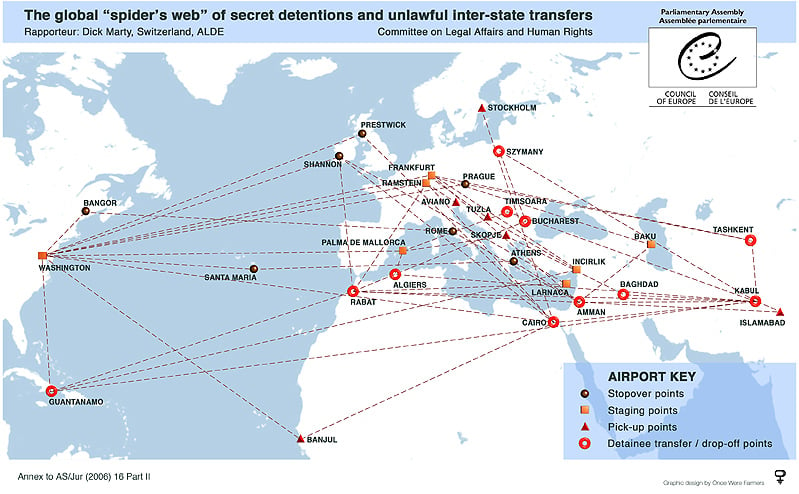
Council of Europe Extraordinary Rendition Report


The Council of Europe Committee on Legal Affairs and Human Rights has published its draft report on its investigations of US extraordinary rendition (transport of suspects to torture centres) flights in Europe. It makes gruesome reading, particularly in relation to the details of specific individual cases they have been able to investigate. They conclude:

"280. Our analysis of the CIA 'rendition' programme has revealed a network that resembles a 'spider’s web' spun across the globe. The analysis is based on official information provided by national and international air traffic control authorities, as well as on other information including from sources inside intelligence services, in particular the American. This 'web', shown in the graphic239, is composed of several landing points, which we have subdivided into different categories, and which are linked up among themselves by civilian planes used by the CIA or military aircraft.

281. These landing points are used for various purposes that range from aircraft stopovers to refuel during a mission to staging points used for the connection of different 'rendition circuits' that we have identified and where “rendition units” can rest and prepare missions...

283. Analysis of the network’s functioning and of ten individual cases allows us to make a number of conclusions both about human rights violations – some of which continue – and about the responsibilities of some Council of Europe member States.

284. It must be emphasised that this report is indeed addressed to the Council of Europe Member states. The United States, an observer state of our Organisation, actually created this reprehensible network, which we criticise in light of the values shared on both sides of the Atlantic. But we also believe to have established that it is only through the intentional or grossly negligent collusion of the European partners that this “web” was able to spread also over Europe.

285. The impression which some Governments tried to create at the beginning of this debate – that Europe was a victim of secret CIA plots – does not seem to correspond to reality. It is now clear – although we are still far from having established the whole truth - that authorities in several European countries actively participated with the CIA in these unlawful activities. Other countries ignored them knowingly, or did not want to know...

287. Whilst hard evidence, at least according to the strict meaning of the word, is still not forthcoming, a number of coherent and converging elements indicate that secret detention centres have indeed existed and unlawful inter-state transfers have taken place in Europe. I do not set myself up to act as a criminal court, because this would require evidence beyond reasonable doubt. My assessment rather reflects a conviction based upon careful examination of balance of probabilities, as well as upon logical deductions from clearly established facts. It is not intended to pronounce that the authorities of these countries are ‘guilty’ for having tolerated secret detention sites, but rather it is to hold them ‘responsible’ for failing to comply with the positive obligation to diligently investigate any serious allegation of fundamental rights violations."

They make specific allegations against a whole raft of EU states and finish up by saying

"292. With regards to these extremely serious allegations, it is urgent – that is the principal aim of this report – that all Council of Europe member states concerned finally comply with their positive obligation under the ECHR to investigate. It is also crucial that the proposals in the draft resolution and recommendation are implemented so that terrorism can be fought effectively whilst respecting human rights at the same time."

What Netflix Could Teach Hollywood

What Netflix Could Teach Hollywood NYT article by David Leonhardt. Recommended. Netflix has given a new commercial lease of life to forgotten but films. Chris Anderson's Long Tail in action. Anderson's theory:

"Forget squeezing millions from a few megahits at the top of the charts. The future of entertainment is in the millions of niche markets at the shallow end of the bitstream.

There'll be some Euro-bashing in Ireland...

In 2001 the Irish government sued the United Kingdom under Article 287 of the United Nations Convention on the Law of the Sea, complaining that Sellafield was polluting the Irish sea. It has long been believed in Ireland that nuclear waste contamination emanating from Sellafield has been responsible for unusually high clusters of childhood leukemia on various parts of the East coast.

In addition to defending the case, the UK government convinced the European Commission to launch a procedural action against Ireland to hamper the Irish case. The gist of the action was that the Irish government were using the wrong procedures in complaining to the UN about the UK. Last week the European Court of Justice agreed with the Commission (and the UK). They said Ireland should have brought the case to the ECJ and not the UN tribunal.

"the act of submitting a dispute of this nature to a judicial forum such as the Arbitral Tribunal involves the risk that a judicial forum other than the Court will rule on the scope of obligations imposed on the Member States pursuant to Community law"(para. 174 of the decision).

The families of victims of childhood cancers in Ireland campaigned for a long time to get the Irish government to pursue the issues surrounding Sellafield. I remember the controversy back as far as the 1970s. No doubt there will have been a lot of Euro-bashing in my homeland about the decision. But the ECJ can't really be blamed for confirming EU rules thereby leading to five further wasted years in this saga. The UK government and the Irish government are the real culprits, though the Commission could have found a more worthy use of the funds spent in this case too. The UK government quite naturally and self-interestedly used every possible form of defence. For the Irish government, which is after all the master manipulator of EU regulations, to get caught out on procedural grounds will be seen in the corridors of power over there as something of an own goal.

French publisher sue Google

A French publisher has decided to sue Google for scanning and publishing book exerpts online without permission.

BPI call on Apple to make iTunes compatible

The BPI chairman, Peter Jamieson, has called on Apple to make their iTunes service compatible with other manufacturers' technologies. Good for him!

Apple, hugely dominant in music download sales at the moment, will be a minor player in the market in five to ten years if Apple continue to employ proprietary drm.

Update: Cory reports that the "Norwegian ombudsman has come out in support of the Norwegian Consumer Council's complaints against iTunes and other DRM-based entertainment services. The Consumer Council complained that the iTunes pricing was discriminatory, its terms were unreasonable and its DRM was too restrictive. This is moving Norway closer to regulatory limits on the way that Apple and other DRM companies can do use the legal protections that DRM enjoys to lock users into unfair, one-sided transactions. Norway's Thomas Rieber-Mohn says that similar decisions are expected soon in Sweden and Denmark."

Tuesday, June 06, 2006

If the UK knew Ireland better the Iraq invasion might not have happened

George Monbiot is prompted by the UK media's bashing of Ken Loach's latest film (despite these critics not having seen it) to conclude that if the British "knew more about Ireland, we might never have invaded Iraq" I haven't seen it either so can't comment on the film other than to say it won the Palme d'Or at Cannes. Monbiot says:

"There is no question that the IRA also killed ruthlessly - not just police and soldiers but also people they deemed to be informers and collaborators. But Loach shows this too. (I have seen the film.) The press hates him because he admits that the people who committed these acts were not evil automata, but human beings capable of grief, anger, love and pity. So too, of course, were the British forces, whose humanity is always emphasised by the newspapers. Ken's crime is to have told the other side of the story.

The other side - whether it concerns Ireland, India, Kenya or Malaya - is always inadmissable. The torture and killing of the colonised is ignored or excused, while their violent responses to occupation are never forgotten. The only aggressors permitted to exist are those who fight back.

Does it matter what people say about a conflict that took place 85 years ago? It does. For the same one-sided story is being told about the occupation of Iraq. The execution of 24 civilians in Haditha allegedly carried out by US marines in November is being discussed as a disgraceful anomaly: the work of a few "bad apples" or "rogue elements". Donald Rumsfeld claims "we know that 99.9% of our forces conduct themselves in an exemplary manner", and most of the press seems to agree. But if it chose to look, it would find evidence of scores of such massacres...

Why should we be surprised by these events? This is what happens when one country occupies another. When troops are far away from home, exercising power over people that they don't understand, knowing that the population harbours those who would kill them if they could, their anger and fear and frustration turns into a hatred of all "micks" or "gooks" or "hajjis". Occupations brutalise both the occupiers and the occupied. It is our refusal to learn that lesson which allows new colonial adventures to take place. If we knew more about Ireland, the invasion of Iraq might never have happened."

There is an untapped well of ignorance about foreign politics in the UK (I should say this is not unique to the UK, of course) which makes the kind of ill-informed media critiques Monbiot is complaining about potentially quite dangerous, because of the kind of (anti-Irish in this case) xenophobia they can whip up. In the wake of the Birmingham pub bombings in the 1970s my aunt was paying for some goods in a shop. When she said thanks to the lady at the checkout, in her dulcet Irish tones, the man next in line spat in her face and launched into a rant about effing Irish murderers. To this day she doesn't hold a grudge against her assailant, though I wonder if he has lost his hatred of those who are different to him.

And Monbiot is correct. Authorities ignore the atrocities of war and occupation at their own peril and that of future generations. You can't send young people with guns into volatile situations where they believe their lives to be under constant threat and expect them to behave rationally and ethically in all circumstances. That's not seeking to excuse massacres of the type that happened at Haditha allegedly carried out by US marines. There are no clear good guys with white hats and bad guys with black hats in a warzone, just ordinary people who have got caught up in engaging in extraordinary violence to pursue some cause, follow orders, defend themselves and their colleagues or family, purge some hatred, engage in revenge... Soldiers and other ordinary people in such situations have a tough enough job without pretending that they are saints. Ordinary people make mistakes. Unfortunately mistakes and loss of control in a war zone mean people get badly injured or killed.

NHS trusts pay millions in fines to IT suppliers

The NHS IT system is already two years behind schedule and way over budget and to add to the farce, cash strapped NHS trusts are now having to pay the suppliers £millions in fines for failing to second scarce staff to work with the suppliers. A Tory MP, Richard Bacon, on the Public Accounts Committee discovered the situation. He said

""At a time when hard-pressed NHS trusts are having to make painful choices to reduce deficits, they are being forced to pay money they don't have and release staff they can't spare, for something they don't want and which doesn't work ... the NHS is being hit with fines running into tens of millions of pounds, which it simply cannot afford".

Mueller Book on software patents in EU

Florian Mueller has published a book, "No Lobbyists As Such - The War over Software Patents in the European Union" (2M pdf) which is available only in electronic form.

He decided that print publishing wouldn't work too well because his audience would be too geographically dispersed and it is essentially another tool in his award winning campaigning armoury.

" what matters to me more than anything else in this respect is to get my book out to a large audience, especially since the next major war over software patents in Europe will officially break out on July 12 at a hearing to be held by the European Commission in Brussels. The same forces who supported the software patent directive we successfully fought against are now trying to achieve everything they wanted the last time, and even more, by means of the European Patent Litigation Agreement (EPLA). I hope my book will motivate people to take action against the EPLA, an international treaty that would have far worse consequences than the software patent directive would have had."

The NSA Phone Call Database: The European Perspective

Professor Francesca Bignami of Duke Law School, guest blogging at Concurring Opinions, wonders "Had a European government, instead of the Bush administration, created the NSA’s call database, would that government be in violation of European privacy law?" She believes they would and goes on to explain why in a really interesting post covering the divergence in the US and EU approaches to regulating privacy since the 1970s.

Prof. Bignami follows this up with a very informative post about the ECJ decision invalidating the EU-US agreement on airline passenger data (PNR) transfers, one of the most useful facets of which is a nice explaination of the EU's constitutional structure.

"To explain the Court’s logic, I must get into some basic EU law. The European Union has a bizarre constitutional structure that comes out of the fact that it used to be an international organization, now is a quasi-federal polity. It has three “Pillars.” The First Pillar governs the regulation of the common market—things like the rules that apply when a plane takes off from Rome and lands in Munich. This is not an area that goes to the core of national sovereignty, and so the European Union (actually “European Community” when we’re talking about First Pillar) has acquired a lot of power in the First Pillar—and the Member States have lost a lot of power. In the PNR episode, the European institutions acted under the First Pillar: the Commission based its decision on the Data Protection Directive (a market-regulating, First Pillar law) and the Council based its decision on the Data Protection Directive, together with its more general First Pillar powers.

By contrast, the Second and the Third Pillars apply to matters that do go to the core of national sovereignty: defense and other types of foreign policy (Second Pillar) and fighting crime and protecting against internal security threats like terrorism (Third Pillar). The European Union has powers in these areas, but it is hamstrung in various ways by Member States anxious to preserve national sovereignty.

Since the PNR agreement involved private, commercial European air carriers, the Commission and the Council thought they could act under the First Pillar. But the Court of Justice disagreed—essentially the Court said that the European Union would have to act under the Third Pillar or not at all. Here I’m simplifying slightly."

Basically the ECJ said Commission and the Council chose the wrong rules - those dealing with markets (1st pillar) rather than those dealing with terrorism (3rd pillar) - to justify the agreement to give the US authorities the passenger data. Not surprisingly they chose the first pillar route because there were fewer procedural obstacles. Now if they are going to prolong the aggreement beyond the Court's deadline of September this year they'll have to choose an alternative route.

Monday, June 05, 2006

APIG Report on DRM Published

The All Party Internet Group inquiry into DRM has now produced a report with a number of sensible recommendations:

"Summary of Recommendations

#65 We recommend that the Government consider granting a much wider-ranging
exemption to the anti-circumvention measures in the CDPA for genuine
academic research.

#86 We recommend that when the advice from the Legal Deposit Advisory Panel has
been received, the Department for Culture, Media and Sport hold a formal
public consultation, not only on the technical details, but also on the general
principles that have been established.

#92 We recommend that the Department for Culture, Media and Sport review the
level of funding for pilot projects that address access to eBooks by those with
visual disabilities; and that action is taken if they are failing to achieve positive
results.

#105 We recommend that the Office of Fair Trading (OFT) bring forward
appropriate labelling regulations so that it will become crystal clear to
consumers what they will and will not be able to do with digital content that they
purchase.

#113 We recommend that the OFT labelling regulations we proposed, in #105 above,
should ensure that the risks are clearly spelled out, at the point of purchase,
whenever consumers could lose access to digital content if systems are
discontinued, or devices fail, or players are replaced by systems from a different
manufacturer.

#118 We recommend that OFCOM publish guidance to make it clear that companies
distributing TPM systems in the UK would, if they have features such as those in
Sony-BMG’s MediaMax and XCP systems, run a significant risk of being
prosecuted for criminal actions.

#132 We recommend that the Department of Trade and Industry investigate the
single-market issues that have been raised with us, with a view to addressing the
issue at the European level. We accept the argument that other industries may
soon find their markets distorted by DRM systems and so we recommend rapid
development of the principles by which the single market can continue to
operate effectively.

#135 We recommend that the government do NOT legislate to make DRM systems
mandatory.

#147 We recommend that the Department of Trade and Industry revisit the results of
their review into their moribund “IP Advisory Committee” and reconstitute it as
several more focused forums. One of these should be a “UK Stakeholders
Group” to be chaired by the British Library. It should specifically address the
complex issues surrounding DRM, not just from the point of view of experts on
the technology, but with a wide-ranging membership that includes
representatives of consumers, libraries and the creators of content – as well as
the ‘usual suspects’ from the rights holders and content distribution industries."

The numbers refer to the paragraphs in the report where the recommendations are originally made. The 'CDPA' is the Copyright, Designs and Patents Act, including its various amendments incorporating EU directives. A thirty page report is never going to be able to cover all the issues with DRM but this is a good start. I believe Cory Doctorow will be writing a book on drm over the next year or so and expect that will become the standard text.

Schneier on the NSA's base rate fallacy

Bruce Schneier has published another version of his perennial essay on data mining to look for terrorists and the base rate fallacy.

"Data mining works best when you're searching for a well-defined profile, a reasonable number of attacks per year, and a low cost of false alarms. Credit-card fraud is one of data mining's success stories: All credit-card companies mine their transaction databases for data for spending patterns that indicate a stolen card...

Terrorist plots are different; there is no well-defined profile and attacks are very rare. This means that data-mining systems won't uncover any terrorist plots until they are very accurate, and that even very accurate systems will be so flooded with false alarms that they will be useless."

He uses his usual example to examine the numbers. Even assuming you could build an accurate system (no modern technology comes anywhere close), it leads to the police having to investigate tens of millions of potential terrorist plots every day to have a chance of finding one real plot every month. Totally unrealistic. As Bruce says, finding terrorist plots is a needle in a haystack problem and you don't make it any easier to find the needle by throwing more hay on the stack.

Private infringer

There's a new IP blog on the scene, The Continuing Adventures of Private Infringer

"Private Infringer isn't a super hero like Captain Copyright of course. He is just a lowly private who wants to know why everybody keeps trying to tell him what to do, even in the privacy of his own home..."

My favorite character is General Intelligence.

"General Intelligence turned around and slowly started walking back to his jeep by himself. He didn't mind. He was actually getting use to being by himself. Most people, he we was beginning to think, simply did not want Intelligence. And he could live with that."

(Thanks to Seth Johnson on the A2K list for the link)

Just Calling so the NSA could listen

Via the ORG list, there's a lovely animation about the NSA wiretapping controversy at Newsday.

Sunday, June 04, 2006

Felten on wiretapping without specific suspects

Ed Felten has posted the latest in his series about 21st century wiretapping and makes the interesting point that there is a case for blanket wiretapping if human access to specific elements of those communications is only triggered by narrow algorithms that identify a specific suspect's voice pattern or

"some predetermined dialog that is extremely unlikely to occur naturally. Like this, for instance:

First Speaker: The Pirates will win the World Series this year.
Second Speaker: Yes, and Da Vinci Code is the best movie ever made.

The police ask us for permission to run automated voice recognition algorithms on all phone conversations, and to record all conversations that contain this verbal handshake. Is it reasonable to give permission?If the voice recognition is sufficiently accurate, this could be reasonable — even though the wiretapping is not based on advance suspicion of any particular individual. Suspicion is based not on the identity of the individuals speaking, but on the content of the communication...

Obviously we wouldn’t give the police carte blanche to use any kind of content-based suspicion whenever they wanted. What makes this hypothetical different is that the suspicion, though content-based, is narrowly aimed and is based on specific evidence. We have good reason to believe that we’ll be capturing some criminal conversations, and that we won’t be capturing many noncriminal ones. This, I think, is the general principle: intercepted communications may only be made known to a human based on narrowly defined triggers (whether individual-based or content-based), and those triggers must be justified based on specific evidence that they will be fruitful but not overbroad.

You might argue that if the individualized suspicion principle has been good enough for the past [insert large number] years, it should be good enough for the future too. But I think this argument misses an important consequence of changing technology.

Technology raises the possibility that automated algorithms can implement triggering rules, so that content-based triggers become possible — in theory at least.

Given that content-based triggering was infeasible in the past, the fact that traditional rules don’t make provision for it does not, in itself, end the argument. This is the kind of situation that needs to be evaluated anew, with proper respect for traditional principles, but also with an open mind about how those principles might apply to our changed circumstances."

It's what Larry Lessig might call a latent ambiguity. Ed's right - the technology does potentially offer new possibilities for law enforcement but only if the content filtering technology can be sufficiently refined. At the moment it is so crude as to be useless, offering so many false leads that the resources to chase down all of them just don't exist, not to mention the civil liberties implications of such an approach. The temptations for police and intelligence services to trawl (theoretically) legally no-go data warehouses, other than with specific narrow grounds of suspicion (unique content or individually targetted), especially under pressure of simplistic targets to produce results, would be too great to ignore. As Cardinal Richelieu said, give him six lines written by the most honest man and he'll find the evidence there to have him hanged - the data warehouses proposed will always contain enough to metaphorically hang someone. But the data smog gives the real bad guys so much more room for manoeuvre.

Baker & McKenzie's Pre-Emptive World Cup C&Ds

Baker & McKenzie have apparently been sending out blanket pre-emptive cease and desist letters to lots of websites to warn them that they will be monitoring the web for any unauthorised streaming of World Cup activity. Hilariously they've sent one to the folks at BoingBoing who don't even like sports. I detest this kind of cast-the-net-wide-and-who-cares-if-we-scare-the- innocents tactics. The theory is that it keeps honest folks honest which is baloney. It has absolutely no effect whatsoever on genuine organised commercial scale copyright infringement. And they don't really care about tweaking the noses of a few civil rights activists because they have strong PR connections to spin any responses from that direction. It's basically obnoxious behaviour. They should instead focus their considerable resources on tackling real problems in the best interests of their clients as necessary.

Friday, June 02, 2006

Rolling Stone Allege Bush Stole 2004 Election

Robert F. Kennedy Jr. in Rolling Stone magazine alleges that George W. Bush stole the 2004 election.

It's a loooong story, (possibly about 30 pages of standard A4 though I don't know how many pages it took up in the print version of the magazine), filled with statistics and analysis, focussed on anomalies in the key state of Ohio.

The gist of the allegations are that the Republican Party orchestrated a campaign to
  • purge thousands of Democrat-leaning eligible voters from the electoral rolls
  • block the processing of registrations generated by Democratic voter drives
  • provide too few voting machines to Democrat-leaning districts and more than enough to Republican areas, leading to longer waiting times for mainly Democratic voters
  • illegally fix a recount that could have given Kerry the presidency
  • illegally alter paper and electronic ballots, switching votes for Kerry to favour Bush
  • intimidate and aggressively challenge the right of Democratic voters to vote, at the polling stations on election day
  • illegally destroy "provisional ballots" of Democratic voters
"A review of the available data reveals that in Ohio alone, at least 357,000 voters, the overwhelming majority of them Democratic, were prevented from casting ballots or did not have their votes counted in 2004(12) -- more than enough to shift the results of an election decided by 118,601 votes.(13) (See Ohio's Missing Votes) In what may be the single most astounding fact from the election, one in every four Ohio citizens who registered to vote in 2004 showed up at the polls only to discover that they were not listed on the rolls, thanks to GOP efforts to stem the unprecedented flood of Democrats eager to cast ballots.(14) And that doesn't even take into account the troubling evidence of outright fraud, which indicates that upwards of 80,000 votes for Kerry were counted instead for Bush. That alone is a swing of more than 160,000 votes -- enough to have put John Kerry in the White House."

The key figure behind all this was supposedly Kenneth Blackwell, the co-chair of President Bush's re-election committee and also, as Ohio Secretary of State, the man in charge of counting the votes in Ohio. The sheer scale of the alleged fraud, the numbers of people supposedly involved in achieving it and the hundreds of thousands of Ohio voters apparently affected make it pretty unlikely that it could be covered up. Indeed Rep. John Conyers of Michigan and Democratic Members and Staff of the House Judiciary Committee published a report on some of the anomalies in Ohio in January 2005 (edited and released as a book in the Spring of 2005) but as far as I'm aware it did not lead to any further action legal or otherwise in pursuit of alleged perpetrators of fraud.

It's impossible to comment on the credibility of the story without studying it in depth but it would be interesting to find out if the learned folks at E-Voting News and Analysis, from the Experts have been looking any further into the allegations now they have re-surfaced. The key thing for me is that it cannot be right for a partisian official to be in charge of the voting. Even if Mr Blackwell or his counterpart in Florida in 2000, Katharine Harris, didn't break any rules they would not be doing their jobs as top officials in Bush's election campaigns if they didn't push the rules to their limits in order to favour their own candidate. It just does not make any sense for folks, Republican or Democrat, with divided loyalties - ensuring the voting is fair and ensuring their boy wins - to be in charge of the voting process that decides who wins.

Update: Farhad Manjoo at Salon, who has been writing about the problems with electronic voting machines for a couple of years, says Kennedy's article is "is filled with distortions and blatant omissions" and that no, Bush didn't "steal" the 2004 election.

"Whatever his aim, RFK Jr. does not appear intent on fixing the problem. He's more content to take us through a hit parade of the most popular, and the most dismissible, theories purporting to show that John Kerry won Ohio, theories that have been swirling about the blogosphere ever since the race was called. I scoured his Rolling Stone article for some novel story or statistic or theory that would prove, finally, that George W. Bush was not the true victor. But nothing here is new...

If you do read Kennedy's article, be prepared to machete your way through numerous errors of interpretation and his deliberate omission of key bits of data. The first salient omission comes in paragraph 5, when Kennedy writes, "In what may be the single most astounding fact from the election, one in every four Ohio citizens who registered to vote in 2004 showed up at the polls only to discover that they were not listed on the rolls, thanks to GOP efforts to stem the unprecedented flood of Democrats eager to cast ballots." To back up that assertion, Kennedy cites "Democracy at Risk," the report the Democrats released last June.

That report does indeed point out that many people -- 26 percent -- who first registered in 2004 did not find their names on the voter rolls at polling places. What Kennedy doesn't say, though, is that the same study found no significant difference in the share of Kerry voters and Bush voters who came to the polls and didn't find their names listed...

Such techniques are evident throughout Kennedy's article. He presents a barrage of seemingly important, apparently damning data to show that Kerry won the race. It's only when you dig into his claims that you see what thin ice he's on."

Further update (20-6-06): Majoo and Kennedy have had a follow-up discussion on Salon. They both agree that the system is in urgent need of reform but disagree about the extent of the real problems in Ohio in 2004 and therefore what the starting point of the reform should be.
Salon has been widely criticised and lauded in the blogosphere for publishing Majoo's article and have responded to the criticism here.

Kenya to provide free Aids drugs

From the BBC: Kenya to provide free Aids drugs

Intellectual Property, Education and Access to Knowledge in Southern Africa

Intellectual Property, Education and Access to Knowledge in Southern Africa is a terrific paper by Andrew Rens, legal lead of Creative Commons South Africa, Achal Prabhala, coordinator of the Access to Learning Materials Project in Southern Africa and Dick Kawooya, founding member of the Africa Access to Knowledge Alliance formerly Africa Copyright Forum. It runs to 70 pages so the full document is mainly for IP and A2K geeks but the executive summary is just a little over 2 pages long and well worth a read.

"There can be little doubt that education is a cornerstone of social and economic development, or that access to learning materials is a crucial factor in the success of any educational system. In a world which values the production and dissemination of information and knowledge, human capital growth is a serious developmental concern. We live, apparently, in a ‘knowledge economy’, and if so, two processes seem worth noting. First, societies of the global south are struggling with everyday challenges of education and literacy, while their institutions and governments perform the inevitable balancing act between scarce resources and vast needs. Second, producers of knowledge goods, heretofore located in the north, are increasingly global in scope; exporting, with their expansion, an intellectual property rights (IPR) regime that poses current and potential deterrents to learning.

...much of the changes wrought recently in IPR (in the domain of multilateral and bilateral trade negotiations)... pose a potential threat to the learning environment, and curtail opportunities – now and in the future – to institutions and individuals enabled with adequate infrastructure...

The simplest lesson, perhaps, comes from exploring the dichotomy evident in the traditional knowledge good and its alternative equivalent. Books are still largely inaccessible in the south – whether on account of high cost, unsuitability of language and format, or, even more simply, plain unavailability. The open access textbook, on the other hand, costs as much as it does to print and can be available wherever necessary. Even a visible scarcity ... could be alleviated by the permission-free translation choices presented by open access, since access to cultural goods in turn produces producers of cultural goods...

The challenges facing copyright law in relation to access to learning materials need to be prefaced by the international obligations facing the Southern African Customs Union (SACU)... A significant process currently underway in SACU, for instance, is a free trade agreement (FTA) with the US, where the conditions proposed by the US on copyright and related policy are, in general, beyond conditions imposed by obligations to the WTO, especially in the digital domain.

But a focus on global processes, necessary as it is, must also consider local circumstances. In SACU countries, as elsewhere in the global south, the informal economy – knowledge and cultural goods included – plays a key role in bridging access gaps that traditional market mechanisms overlook or exclude... any set of policy solutions that address the problem of access to learning materials in southern Africa will have to consider the informal economy in order to be comprehensive.

It is under such conditions then, local and global, that the importance of making a legitimate claim for access to learning materials becomes important. As past campaigns, such as the loosely federated access to medicines movement have shown, the challenge is not insurmountable. In this case, the current needs and potential benefits of expanding access, combined, present a credible case for serious and urgent intervention."

Swedish Police follow German lead

Just a week after German police filed criminal charges against 3,500 alledged eDonkey users, the Swedes have followed suit in funding the fight against online copyright infringement.

"Swedish police raided 10 different locations in Sweden and seized servers in a massive crackdown on torrent site Piratebay.org...

Reports from a wide range of online Swedish news sources claim that up to 50 police officers were involved in the raids in Stockholm, Gothenburg and several other locations around the country...

Swedish Antipiracy Bureau’s spokesman Henrik Ponten - which represents the music and movie industry in Sweden - applauded the police for finally targeting large scale piracy organisations such as Piratebay.

The Antipiracy Bureau is allegedly also the organisation behind the police raids.

It is unclear if Piratebay has breached the Swedish copyright laws and the charges so far consist of crimes against copyright laws and aiding crimes against copyright laws. Usually, Swedish police would not have got involved in such a direct fashion when it comes to copyright crimes in Sweden due to the relatively low charges involved, which would only merit fines...

Judging from posts on several of the large Swedish newspaper forums, many people are outraged over the raid, not because the Piratebay was closed down, but because of the waste of taxpayers money and police time, when there are other more important crimes to solve."

Yet again music executives will be dancing with glee. There are not enough details to make a judgement call about this. If it is a large scale piracy operation, fair enough. If it's not then they should not be wasting their finite law enforcement resources.

Thursday, June 01, 2006

Supreme Court reduce protections for whistleblowers

On Tuesday the Supreme Court in the US ruled to reduce protections for government workers who blow the whistle on official misconduct in a split 5-4 decision. President Bush's appointments to the court seem to have made the difference as it is likely that had Sandra Day O'Connor still been a sitting justice the decision would have gone the other way.

Justice David H. Souter's wrote a lengthy dissenting opinion saying

"Private and public interests in addressing official wrongdoing and threats to health and safety can outweigh the government's stake in the efficient implementation of policy"

Justice Anthony M. Kennedy wrote the majority opinion

"We reject, however, the notion that the First Amendment shields from discipline the expressions employees make pursuant to their professional duties...Official communications have official consequences, creating a need for substantive consistency and clarity. Supervisors must ensure that their employees' official communications are accurate, demonstrate sound judgment, and promote the employer's mission"

The theory is the government can now take disciplinary action againt employees without the risk of facing frivolous lawsuits. There is no doubting that such lawsuits exist but the vast majority of government employees are sensible, dedicated, hard working public servants. To say as Kennedy does, in the land of the first amendment, that government workers should shut up and do as they are told, pursuant to their professional duties, just doesn't ring true. Not a good day for the Bill of Rights.

Wednesday, May 31, 2006

CHINESE PIONEER HOLISTIC APPROACH TO PIRACY

IPKat is apoplectic at this.

"To keep a long story short, not content with infringing IP rights on an ad-hoc basis, one or more enterprising Chinese thieves have duplicated an entire business, setting up a counterfeit NEC operation that not only ran its own manufacturing operations but even "licensed" its IP to other local enterprises.

Left: Rest in Peace, industry as we used to know it ...

The IPKat cannot believe that, in a repressive regime in which one can scarcely visit a website without attracting the attention of the authorities, an entire operation of this nature can have been unlawfully duplicated without the knowledge, if not the blessing, of the Chinese government. Everyone seems to be so terrified of offending the Chinese, but they're not the slightest worried about offending us because, it appears, while they are happy to take our technology and our money, they respect neither us nor our culture. To save time and trouble, why don't we just hand over all our technology, all of our know-how and all of our money right now, and then go and liquidate ourselves? Merpel agrees and wants to know, are we the victims of our greed, our naivety or our plain stupidity?"

I hope IPKat doesn't mind me misappropriating his entire post but it was so beautifully done and it is nice to see someone getting passionate about intellectual property, a subject central to the future of our knowledge society, yet far removed from ordinary people's radar.

A report on the state of the National Identity Register, May 2016

A report on the state of the National Identity Register, May 2016 Charlie Stross' Diary.

"The National ID Register has been implemented, and (as No2ID are currently predicting) it was a train-wreck..."

Very clever. Worth reading in full.

Cassandra's last gasp

Action on Rights for Children (ARCH) are becoming very concerned that the chances of doing anything about the Children's Index proposed in the Children Act 2004 are fading rapidly.

"Yesterday, we stumbled across an article that we had forgotten about. Written for the LibDem ‘Liberator’ magazine in 2002, it was chiefly about the Connexions service and voiced our “…gnawing worry that those of us occupied in yelling over the ramparts about e-government, data-sharing and identity cards made one dreadful mistake: we forgot to turn around and notice what was slithering up the back stairs to the nursery.” (The original pdf is difficult to access, but you can see it on our website archives.)

Four years later, and here we are still banging on about children’s databases, except that events have moved on: the number of databases has multiplied and children are, it seems, fair game for any amount of information-sharing. The public has been lulled into accepting this situation by lurid tales of out-of-control youth and neglectful - or downright abusive - parents. The message is that bands of feral young people are prowling the streets, parents couldn’t care less, families are in moral meltdown and only the intervention of ‘experts’ can avert disaster.

The separation of children from adults has allowed the ‘modernisation’ of government to proceed largely unremarked, until the final jigsaw pieces - the Children’s Index and the National Identity Register- were slotted into place. If we accept the Children’s Index without protest, there is little point in protesting about the NIR because the best we can do is to delay the inevitable: within three decades the majority of the population will be databased beyond belief...


Looking back over the last few years, it has been an uphill struggle to get the whole issue of information-sharing about children on to anyone’s agenda: but then, one or two organisations and a small handful of journalists can’t hope to do anything much about this alone.

Please, if you haven’t done so already, take the time to look through the blog since May 2nd and tell other people to do the same. Follow up the links; get a good grasp of what has been going on. We have done our best to make it as simple, factual and accessible as we can, but ask us about anything that isn’t clear.

The public consultation is scheduled for the summer, and then the government will put final regulations before parliament to allow the Children’s Index to go ahead. Unlike most regulations, parliament has to pass a resolution to approve these. Gather enough accurate information to contribute to the consultation and to make sure your MP is well-informed. Tell anyone who will listen about it - trust us, the accusations of insanity and conspiracy-theory are like water off a duck's back after a while. It isn’t too late to halt the Index - but it soon will be."

Tuesday, May 30, 2006

ECJ blocks EU-US airline passenger data transfer

The BBC are reporting that the European Court of justice has ruled in favour of European Data Protection Supervisor and the EU Parliament in their challenge to the EU-US agreement requiring airlines to transfer passenger data to the US authorities. The EU Commission's chief spokesman, Johannes Laitenberger, has said that the Court ruled against them on a legal technicality and that there was nothing wrong with requiring EU airlines to supply this data. Now the EU parliament, the EU Data Protection Supervisor, countless legal experts and civil liberties groups and public officials behind closed doors have all said that this activity is illegal under the EU data protection regime. The ECJ now agrees and Commission and the UK Home Office have both come out in response to the ruling saying there's nothing to worry about, it's a legal techicality and implying that they will try some other mere technical process to legitimise the activity.

This is the first time the European Data Protection Supervisor has ever mounted such a challenge to the Council and the Commission as far as I know. That he should have raised the challenge through the courts is an indication that we are dealing with a potentially serious breach of the law here. That his complaint should be upheld by the ECJ is a solid vindication of his actions. That the Commission respond by saying ok we'll continue doing what we're doing but try and find an official, usable excuse is a further indictment of the Commission's and the Council's lack of respect for the legal process. The ECJ concluded:

"the Court (Grand Chamber) hereby:

1. Annuls Council Decision 2004/496/EC of 17 May 2004 on the conclusion of an Agreement between the European Community and the United States of America on the processing and transfer of PNR data by Air Carriers to the United States Department of Homeland Security, Bureau of Customs and Border Protection and Commission Decision 2004/535/EC of 14 May 2004 on the adequate protection of personal data contained in the Passenger Name Record of air passengers transferred to the United States Bureau of Customs and Border Protection;

2. Preserves the effect of Decision 2004/535 until 30 September 2006, but not beyond the date upon which that Agreement comes to an end;

3. Orders the Council of the European Union to pay the costs in Case C-317/04;

4. Orders the Commission of the European Communities to pay the costs in Case C-318/04;

5. Orders the Commission of the European Communities to bear its own costs in Case C-317/04;

6. Orders the United Kingdom of Great Britain and Northern Ireland and the European Data Protection Supervisor to bear their own costs."

The ruling follows the recommendation of the Adocate General Leger in the case made in November last year who stated that:

"I propose that the Court should:

– in Case C?318/04, annul Commission Decision 2004/535/EC of 14 May 2004 on the adequate protection of personal data contained in the Passenger Name Record of air passengers transferred to the United States Bureau of Customs and Border Protection;

– in Case C-317/04, annul Council Decision 2004/496/EC of 17 May 2004 on the conclusion of an Agreement between the European Community and the United States of America on the processing and transfer of PNR data by Air Carriers to the United States Department of Homeland Security, Bureau of Customs and Border Protection."

The reponse of the EU authorities and the UK Home Office at the time was similarly dismissive.

Update: I've just been though the decision (Case C-317/04 Judgment 2006-05-30) quickly and the Court essentially orders the Commission and the Council to terminate the agreement with the US to hand over passenger data by 30 September 2006. The Parliament and the EDPS had challenged the Commission on six grounds and the Council on four. The court looked at the first point of dispute in each case and said that was good enough for them. No need to consider the others.

As usual it is a shame that it is only legal and technical geeks who will be really interested in this decision as the wide implications for privacy in the digital age are really quite profound, just as it is the case with the NSA surveillance and ID cards. But the mass surveillance monster rolls on undeterred, damaging both the potential of the security services to do their job more effectively and society more generally.

Update 2: Some EU officials are concerned about the ruling or possibly just spinning it by predicting chaos for air pasengers and the end of the EU "open skies" policy. Privacy Intenational and the ACLU recently raised concerns about the US apparent breach of the agreement with the EU whereby teh Dept for Homeland Security had reached an agreement to to share airline passenger data with the Centers for Disease Control and Prevention (CDC). Thanks to Ian for these links.

Update 3: Comment from EU law blog: "First, the grounds of annulment are very narrow and the reasoning given is brief to the point of being terse. The European Parliament raised a whole series of pleas (on proportionality, breach of fundamental rights etc) which the Court of Justice did not examine. So it is difficult to guess what will be the next practical step taken by the Council and Commission.
Second, the Court, aware of the practical difficulties in relation to transatlantic flights that the annulment will cause has limited the effect of the annulment in time: The current arrangements can continue in force until September 30th 2006 by which time the Council and Commission must have taken steps to comply with the judgment. That's the date the arrangements between the EU and US expire anyway. As a result, there is no need to interrupt the transfer of the data to the US authorities with all the unfortunate consequences that would entail.
Third - and this is the really odd thing - the Court does not refer to Article 13 of the Directive. "

IPKat says
"Given the choice, the IPKat would prefer to know his flight was terrorist-free,even if it meant him ending up on a mailing list which delivered him unwanted advertisements." That smart folks like IPKat should swallow the line that handing flight data to the US authorities automatically makes the flight safer concerns me. But then it is only the tech and legal/privacy geeks that are interested in this... though in fairness to Jeremy he does take a step back from this in the comments.

Update 4: Spy Blog has the list of data items that the airlines provide to the US authorities.

This pernicious mix of big business and busybodies

Henry Porter was spot on as usual about the government's ID card scheme in the Observer on Sunday.

"The British state presents a menace to individual privacy in the 21st century in two ways, as the Information Commissioner, Richard Thomas, demonstrates in his commendably clear report, 'What Price Privacy?'. The first is that under Tony Blair's 'transformational government', the Civil Service is moving to merge all its databases into one network with single entry points, so that someone with the right access could, for example, surf between the tax and customs database, criminal records, vehicle registrations and health and education records in their search for information on an individual.

If you add to this unified system the new National Identity Register (NIR) which, as Thomas points out, will include 'identifying information, residential status, personal reference numbers, registration and ID card history, as well as records of when, what and to whom information from the register has been provided', we will end up with an awesome apparatus of control and surveillance...

The threat of illicit use is as nothing compared to the misuse that it will offer government agencies. For one thing, there will be no knowing when and by whom your personal records are being inspected, so intrusion by the state is likely to become the norm. The other big problem is the phenomenal incompetence of the government when it comes to databases. Remember the fiascos in the Child Support Agency, the immigration service records, the old passport agency and with the benefits card. Only last week, the Criminal Records Bureau admitted that it had wrongly labelled 1,500 innocent people as pornographers, thieves and violent criminals. As a result, some failed in their job applications, which must surely mean they have a very good claim for damages against the government, based on the loss of reputation and earnings.

The Home Office refused to apologise and, instead, excused itself by saying that it had erred on the side of caution when making the checks against criminal records. That reaction is not good enough and it underlines the lack of accountability in government and the arrogance of officialdom when it comes to the reputations of ordinary people. It also raises the question of what might happen if a similar error were to infect the unified system...

I find myself wishing a hearty damnation to Courtney and her business plans, to the unified database of 'transformational government', to the incompetence and arrogance of the Home Office, to any bureaucrat who seeks to define an individual's identity with compulsory biometric measurement backed up by threats. If one thing has become clear in the last few weeks, it is that the government is not fit to be trusted with either setting up the National Identity Register or running it."

(Katherine Courtney is head of business development at the new Identity and Passport Service and was previously head of the ID card programme. She is a US citizen though the UK government have not been prepared to say whether she has taken out UK citizenship).

Sunday, May 28, 2006

US support R&D in areas of public health priority

James Love is giving credit where it is due to the Bush administration.

"Something very good happened today, at a UN agency, and much of the credit goes to the Bush Administration.

The World Health Organization's main governing body just approved a resolution that will set in motion an ambitious new effort to stimulate R&D in areas of public health priority, with access to new medical inventions.

This has been a highly controversial topic. Pfizer and other big pharmaceutical companies lobbied very aggressively against any move by the WHO to create global norms for setting R&D priorities, to identify mechanisms for sustainable funding for R&D, or to design R&D mechanisms that don't create barriers for access. The pharmaceutical industry wants US trade negotiators to focus only on measures the raise drug prices.

Public health groups (including my own), scientists, and a number of others have been arguing that we need something else for globalization -- we need treaties or trade agreements that focus on funding R&D, and we need new R&D incentive mechanisms that are not tied to high drug prices.

Until this week, big PhRMA could count on the Bush Administration to block serious global discussions to consider this new paradigm. But the Bush Administration flipped this week, and backed an ambitious and serious effort to create a new global framework to support R&D in areas of priority...

The feeling here today is somewhat magical."

That's won't be the end of the battle as there are too many powerful interests, the big drug companies prime amongst them, rallying against this initiative, but it does indicate the battle can be won. There are huge numbers of smart, highly dedicated people engaged in public services all over the world, including in the much criticised Bush administration. Those people are prepared to listen if people with powerful arguments, like the lack of market focus on devastating but neglected diseases such as tuberculosis and sleeping sickness, can get a hearing in the complex, messy environments that constitute these public officials professional lives. It's a pity the European Commission officials showed up with a position drafted by the pharmaceutical industry and its a pity the industry should feel the need to oppose such an initiative but congratulations to all of those involved in ensuring this first small step has been taken.

Apple lost to Does, EFF and the 1st Amendment

Apple have lost their fight to unmask online reporters who leaked product information in advance of a company launch. The court was very clear on the constitutional position

"A California appeals court ruled Friday that online reporters are protected by the same confidentiality laws that protect traditional journalists, striking a blow to efforts by Apple Computer to identify people who leaked confidential company data.

The three-judge panel in San Jose overturned a trial court's ruling last year that to protect its trade secrets, Apple was entitled to know the source of leaked data published online. The appeals court also ruled that a subpoena issued by Apple to obtain electronic communications and materials from an Internet service provider was unenforceable.

In its ruling, the appeals court said online and offline journalists are equally protected under the First Amendment. "We can think of no workable test or principle that would distinguish 'legitimate' from 'illegitimate' news," the opinion states. "Any attempt by courts to draw such a distinction would imperil a fundamental purpose of the First Amendment." "

It's worth repeating that: "We can think of no workable test or principle that would distinguish 'legitimate' from 'illegitimate' news. Any attempt by courts to draw such a distinction would imperil a fundamental purpose of the First Amendment."

There are way too many "this is the Internet so it's different" excuses made by the courts. There is no such thing as e-speech, e-commerce, e-learning or e-anything else and in time most people will come to realise that just as the telephone, car, radio and all kinds of other technologies have been absorbed by society, the Net will be too. It's a fantastic tool that can be exploited for good and ill and it's down to those of us with the good fortune to have access to it to ensure the former pursuit far outstrips the latter. Free speech online is one of the key foundation stones in that endeavour.

Amnesty launch digital rights campaign


Amnesty International and the Observer have launched a campaign to defend freedom of expression on the Net.

"The campaign, which Amnesty has called irrepressible.info, demands freedom of expression over the internet. People are continuing to be persecuted - sometimes thrown in prison for years on end - for having a political opinion. But this time the method of communication is online. The campaign calls for governments to stop censoring websites, blocking emails and shutting down blogs - and for big corporations to stop helping them.

In an article to launch the campaign, Kate Allen, UK director of Amnesty International, criticises technology companies for allowing censorship and providing information to governments used to convict political dissidents."