Wednesday, June 10, 2009

Genewatch: take care with our genetic privacy

Dr Helen Wallace, director of Genewatch UK, who has proven to be consistently clear and articulate in explaining complex subject matter to a lay audience, has an interesting letter in today's Times. She explains the dangers genetic research underpinned by an oversimplied faith in genetic determinism may pose for personal privacy. I hope she will not mind me quoting a substantive proportion of it here
"Your genetic make-up can be used to tag you like a fingerprint, identify your children and categorise you according to your claimed genetic risk. The questions are: can you trust the genetic information you are given, is it good for health, and do the benefits outweigh the loss of privacy for individuals and their families?

Tests that link your genetic make-up to your risk of future illness are unregulated and many companies are making claims about genetic risk that are completely false. Even valid claims are largely meaningless because genes are poor predictors of most diseases in most people, and not useful to decide who should give up smoking or eat a healthy diet. Testing healthy people’s genes suits commercial interests because rich, healthy people make a better market for health products than poor, sick people do. Personalised marketing of medicines, supplements and health scans to the worried well is the commercial aim. It also suits a wide range of industries to blame your genes, not their products or pollution, for your risk of cancer or obesity.

Handing over our DNA to governments or companies may be good for them, but is it really good for us? There is no evidence that it will be good for health to medicate swaths of the healthy population based on misleading claims about genetic risk. Further, there is a real danger that this will divert precious NHS resources from treating people who are sick."

We need more scientists with Dr Wallace's communication skills to engage in public debate in these areas to facilitate far wider understanding of the development of these kinds of technologies.

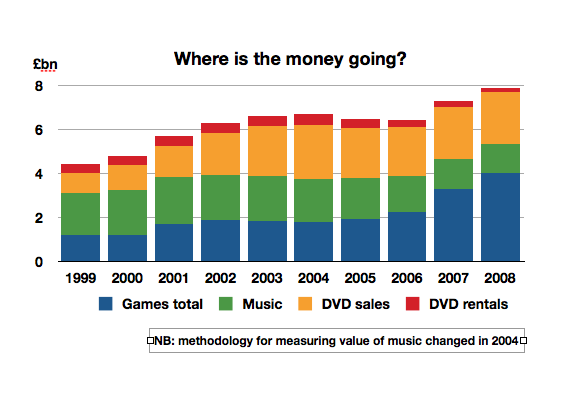
Are illegal downloads killing the music industry or is it games?

Charles Arthur at the Guardian is wondering if illegal downloading is killing the music industry or are consumers spending their disposable income on some other forms of entertainment instead?
"

The music industry does like to insist that filesharing - aka illegal downloading - is killing the industry: that every one of the millions of music files downloaded each day counts as a "lost" sale, which if only it could somehow have been prevented would put stunning amounts of money into impoverished artists' hands. And, of course, music industry bosses' wallets...

...I think they're spending the money on something else.

What else, I mused, might they be buying? Hmm... young.. like the entertainment industry... ah, how about computer games and DVDs? "
See also Illegal downloads and dodgy figures by Ben Goldacre in last Saturday's Guardian for some further analysis of the piracy by downloading figures.

Arnie replaced textbooks with the Net

Arnold Schwarzenegger, governor of California, wants to phase out school textbooks because they are too expensive.
"Arnold Schwarzenegger, California's Governor, announced this week that his state is about to phase out school books and substitute the internet in classrooms from the autumn, the news was presumably greeted with little more than a twitch of a baseball cap (turned backwards). Because California is close to bankruptcy, saving money is a priority, and this move will cut several hundred million dollars from the education budget. Mr Schwarzenegger also thinks that converting schools to online study will help to keep pupils more up to date, and that once textbooks are digitised they can be so easily revised that learning will always keep pace with progress."
Firstly let's give the guy a pat on the back - he or his advisers think it might be a good idea to use the Net in education. Welcome to the 21st century Mr Schwarzenegger. Secondly let's tolerate his "Wayhay I've found the internet cure for our education woes" eureka moment.

But somebody needs to enlighten him that believing the Net can directly and cheaply substitute for good textbooks (though from what Richard Feynman had to say about Californian textbooks might suggest I should drop the adjective there) is a solution to his problems which is simple, obvious and wrong.

Don't get me wrong, as a technophile in a university that has wholeheartedly embraced multimedia technologies as terrific educational tools and environments, I know first hand (and have the scars to prove it) that the Net can be deployed to spectacular effect (and at large scale) in this context. However, it is not simple, it is not cheap, and by and large it facilitates entirely new approaches and compliments rather than substitutes for effective pre-internet age educational tools (like texts) and practices. And somebody approaching the use of the net in education with the idea that is a cheap and easy substitute will fail, create a lot of frustration and do a lot of damage. It ranks right up there with the 'computer in every classroom will cure education' meme from the 1980s and 1990s.

McKinnon back in court

Lawyers for Gary McKinnon, in what may be his last chance to avoid extradition to the US for alleged hacking into US defence computers, reportedly told the High Court yesterday that
"The former home secretary, Jacqui Smith, reached a "flawed decision" when she disregarded powerful medical evidence in the case of computer hacker Gary McKinnon, who is facing extradition to the US"

Monday, June 08, 2009

Pirate party election success in Sweden

I've just had a chat with Chris Edwards for a Guardian piece about the success of the Swedish Pirate Party in the EU parliament elections. I've been off the grid for a couple of weeks so wasn't aware of the news until this morning. I had a relatively wide ranging chat with Chris but a few things initially came to mind when I came across the story.

Firstly the Swedes have recently implemented the EU intellectual property rights enforcement directive, not a particularly popular measure, which coming rapidly in the wake of the Pirate Bay convictions would have helped the Pirate Party's publicity efforts in the run up to the election.

Secondly Sweden has a relatively high proportion of broadband subscribers, a substantial minority of whom may be tuned into the intellectual property debates to a higher degree than elsewhere in the EU. I have no direct evidence of this at the moment - purely speculation on my part.

Thirdly, as far as I can recall, Sweden had an electoral system based on proportional representation, which can make it possible for smaller parties to make an impact and gain seats with as little as 3 or 4% of the vote. Chris tells me they got 7% this time round which is pretty spectacular for a small single issue party.

It would be interesting to get some direct evidence, through interviewing a statistically significant sample of voters who opted for the Pirate Party, to find out the key reasons for that support. It could really significant that 7% of the electorate might actually actively have been prepared to cast their vote based on the state of the IP landscape. Of course it could equally have been a simple protest vote against established parties with the Pirate Party being the one alternative where voters knew what it stood for. Or something more nuanced between the two.

Thursday, May 28, 2009

Twittergate

The re-election of the German president was leaked on Twitter
"News that Hörst Köhler had been re-elected as German president on Saturday was published on the micro-blogging service almost 15 minutes before the result was officially announced."
And naturally there's now the inevitable leak enquiry.

Thanks to Michael Geist for the pointer.

EU governments urge Google Books caution

Interesting - EU governments urge Google Books caution

Update: Sharebook are giving people a forum to talk about the settlement, which the Washington Post has picked up on.

Friday, May 22, 2009

French 3 strikes law worries EU neighbours

The Washington Post is reporting that the French 3 strikes law is causing concern around Europe.
"A thousand French Internet users a day could be taken off-line following approval of President Nicolas Sarkozy's pet project _ an unprecedented law to cut the Internet connections of people who repeatedly pirate music and movies...

But many in Europe have denounced it, saying government controls needed to enforce the law could open the way for invasive state monitoring that violate privacy. And legal challenges at home could derail it: The opposition is trying to get the law declared unconstitutional."

Thursday, May 21, 2009

Microsoft apply for patent on a magic wand

I've been reading a draft introduction to our forthcoming Open University post graduate IT law course this afternoon. In the process of suggesting to the author that we might include a section on some of the Microsoft patent cases I came across one of the more interesting recent claims by the Redmond corporation. A magic wand no less, United States Patent Application number 20090121894:
"The claimed subject matter relates to an architecture that can facilitate rich interaction with and/or management of environmental components included in an environment. The architecture can exist in whole or in part in a housing that can resemble a wand or similar object. The architecture can utilize one or more sensor from a collection of sensors to determine an orientation or gesture in connection with the wand, and can further issue an instruction to update a state of an environmental component based upon the orientation. In addition, the architecture can include an advisor component to provide contextual and/or comprehensive guidance in an intuitive manner."
I expect the latest Harry Potter game on the Xbox is imminent or at least in advanced development with the latest movie due out in July. Coincidence that this patent comes to light now?

Looking around of course Slashdot has picked it up and no doubt the tech news circuit will be doing likewise soon enough. Yup. In fact I'm a week behind the times - the application was published last Thursday and that news story the following day.

Lessig on read write culture

In spite of retiring from the IP wars in order to concentrate on changing congress Larry Lessig is still doing talks about IP

Microsoft lose another big patent case

From Cnet:
"A federal jury in Tyler, Texas, on Wednesday ordered Microsoft to pay $200 million in a patent infringement case.

The jury ruled that the custom XML tagging features of Word 2003 and Word 2007 infringed on a patent from Toronto-based i4i."

Spielberg, King and copyright

It seems that the deal Steven Spielberg has just signed to produce a film about Martin Luther King is to be challenged by two of King's children.
"The offspring of the late civil rights leader, who won the Nobel Peace Prize for his contribution to the struggle against racial segregation, are embroiled in an ugly dispute over plans for a Steven Spielberg film celebrating his life, times and legacy as a modern American icon.

In a deal announced this week, the famous director's production company, Dreamworks, became the first film-makers to acquire rights to King's speeches, books and back catalogue of intellectual property, including the famous speech delivered from the steps of the Lincoln Memorial during the 1963 "march on Washington"...

The news sparked huge excitement since, despite the fact that King is one of the greatest public speakers of the 20th century, no Hollywood film-maker has ever been granted permission to being his famous speeches to the big screen...

That was then. Unfortunately, less than 24 hours after the Oscar-winning director made his bullish statement, it emerged that two of King's three surviving children are threatening to sue because the lucrative film deal was brokered without either their knowledge or blessing."

It is a real shame that King's teachings don't get much wider distribution due to the long running saga of disputes over the rights to his speeches and writings. A hugely valuable documentary series on the US civil rights movement, Eyes on the Prize, was pulled from circulation for many years because the complex collection of rights for photographs, music and film clips, and writings had expired. It has got to be seriously damaging to our understanding of important historical developments if we cannot tell the story without getting hopelessly entangled in intellectual property rights issues. That one fact alone should be enough to convince us that the term of copyright is just too long. 14 years renewable for another 14 anyone...? I'd even go for a nice round 25 if we couldn't do a deal on the 14 but either way King's teachings would be in the public domain; although the Eyes on the Prize producers might have to wait a few more years to clear the rights hurdles.

Wednesday, May 20, 2009

Code of best practices in fair use

Michael Madison at Concurring Opinions notes:
"Yesterday, the Program on Information Justice and Intellectual Property at American University’s Washington College of Law and the Center for Social Media at AU’s School of Communication released “Remix Culture: Fair Use Is Your Friend,” a video that accompanies and explains the Code of Best Practices in Fair Use for Online Video, released jointly by the two centers last July. The video was underwritten by Google and was produced in collaboration with Stanford Law School’s Fair Use Project.

The Code itself is one of four recent ”best practices” statements supported by AU (in particular, by Pat Aufderheide at the CSM and Peter Jaszi at the law school) and/or inspired by the “best practices” model.

The first is the “Documentary Filmmakers’ Statement of Best Practices in Fair Use,” released in late 2005.

The others are the Code of Best Practices in Fair Use for Online Video, the Code of Best Practices in Fair Use in Media Literacy Education, and the recently-released “Statement of Best Practices in Fair Use of Dance-related Materials: Recommendations for Librarians, Archivists, Curators, and Other Collections Staff,” produced by the Dance Heritage Coalition. Full disclosure: Law faculty and practicing lawyers who specialize in copyright law vetted each of these publications, and I was one of vetters."

Now where is the UK equivalent on fair dealing...?

Friday, May 15, 2009

IOC approve Olympic blogs

From the Sports Journalists' Association:
"The International Olympic Committee has issued a four-page guide to competitors which acknowledges the realities of 21st century communications by allowing “athletes’ blogs” at the 2010 Vancouver Winter Games, in a move which could make athlete-authored columns much easier to arrange for newspaper websites than at previous Olympics...

Rule 49 of the Olympic Charter states that, “Only those persons accredited as media may act as journalists, reporters or in any other media capacity.”

Athlete blogs remain subject to the IOC’s strict copyright rules and broadcasting rights agreements, and therefore are not allowed to use sound clips or video. Even photographs on the blogs are restricted, preventing any images from Olympic action or medal ceremonies. Interviews and news about other athletes are also prohibited. Blogs may not include Olympic symbols, such as the five rings. The word “Olympic” is allowed, as long as it is not associated with a third party or its products or services. Emblems of an National Olympic Committee or Vancouver organising committee are allowed if the blogger has obtained written permission."


Thursday, May 14, 2009

Legal challenge to patent on breast cancer genes

The Chronicle is reporting that:
"The American Civil Liberties Union and the Public Patent Foundation filed suit on Tuesday to challenge the constitutionality and validity of patents on two human genes linked to breast and ovarian cancer.

The patents on the BRCA1 and BRCA2 genes belong to the University of Utah and a company called Myriad Genetics, in Salt Lake City, which pays the university for the right to use them commercially in a test it sells to patients who want to know if they have hereditary risks of developing those cancers.

The lawsuit, filed in the U.S. District Court in New York on behalf of thousands of breast-cancer and women’s health groups and a number of medical societies and academic researchers, accuses the University of Utah Research Foundation, which owns the patents, Myriad, and the U.S. Patent and Trademark Office of stifling scientific research."

The formal announcement of the lawsuit is available at the Public Patent Foundation website. This one has been building for some time and given the number of prestigious plaintiffs involved, organising the lawsuit will have been non-trivial exercise. It's also potentially something of a blockbuster since not only are they challenging the BRCA1 and BRCA2 patents but the whole practice of patenting human genes:
"1. Every person's body contains human genes, passed down to each individual by his or her parents. These genes determine, in part, the structure and function of every human body. This case challenges the legality and constitutionality of granting patents over this most basic element of every person's individuality."
So opens a lawsuit that has the potential to completely alter the landscape of medical science and the genetics and pharmaceutical industries. The specific patent claims challenged are outlined in paragraph 32:
"Plaintiffs challenge the legality and constitutionality of four categories of claims in these patents:

a. Patent Claims Over Natural Human Genes: Claims 1,2,5, and 6 of patent 5,747,282 ('282) and claim 1 of patent 5,837,492 ('492)

b. Patent Claims Over Natural Human Genes With Natural Mutations: Claim 1 of patent 5,693,473 ('473), claim 7 of patent '282, and claims 6 and 7 of patent '492.

c. Patent Claims Over Any Method, Including Non-Patented Methods, Of Looking For Mutations in Natural Human Genes: Claim 1 of patent 5,709,999 ('999).

d. Patent Claims Over the Thought That Two Genes Are Different or Have Different Effects, Including But Not Limited To The Thought That The Differences Correlate With An Increased Risk Of Breast And/Or Ovarian Cancer: Claim 1 of patent 5,710,001 ('001), claim 1 of patent 5,753,441 ('441), claims 1 and 2 of patent 6,033,857 ('857) and claim 20 of patent '282."
Paragraph's 102 and 103 sum up the causes of action stating that the patent claims identified are invalid under Article 1, section 8, clause 8 of the US Consitution, and 35 U.S.C. 101. In addition the plaintiffs submit that all the claims challenged are unconstitutional under the 1st and 14th amendments to the US Constitution. They are asking the court to declare the claims invalid and/or unenforceable, to issue an injunction against pursuing legal action to enforce the patent claims and for costs to be awarded against the respondents. Certainly one to follow closely.

Mashing up MPs expenses with transparency

Tony's been playing with Google maps and IBM's Many Eyes visualisation system again and this time he's going to make himself very popular with our elected representatives in parliament by generating easy-to-read comparative maps of MPs expenses. Wonderful. Charles Arthur at the Guardian explains.
"


Link to Tony Hirst's map

MPs and travel: now it's laid bare. Tony Hirst - to whom we referred yesterday - has been busy again with our data, this time creating a Google Map showing MPs, their constituencies, and their travel claims. A word of explanation on how it's done: take the travel expenses, which are coded by MP; remove the bedevilling £ sign and commas from the damn thing; then create a table of the MPs' names and travel expenses. Now comes the clever part. Get the MPs' names and postcodes from theyworkforyou.com, which has an API for precisely this task. Next, match the MPs' names to their postcodes. And now feed that into a Google Map, in which the colour of the pin depends on the level of expense: : Red: > £25,000; Pink: £20,000- £24,999; Yellow: £15,000- £19,999; Green: £10,000- £14,999; Blue: £5,000- £9,999; Purple: < £4,999.

You can see the map in its original form (or just click on the picture above)."

And today:
"But while MPs' attempts to excuse themselves plumb new depths ("we're not as corrupt as other countries" from Harriet Harman is my favourite so far), something more important is being ­temporarily ignored, namely, how are we going to police this in future?

The answer I'd offer: put it all into an XML feed. Let us watch our MPs at work, and let us police their expenses. It should be quite simple for parliament's fees office – which already seems to have a fully functional CD burner – to join the 21st century and get an internet connection. Then, when an MP's expense claim is approved, it goes into the feed. Leave the rest to us; we'll start to mash it up against mapping systems, against other MPs, against other countries. We'll rapidly find out whose numbers don't seem to be stacking up correctly compared to the other ones.

We've already started this at the Guardian with the help of Tony Hirst of the Open University with the first, less-detailed wave of MPs' expenses , which almost immediately showed those MPs whose travel expenses seemed out of line. Sure, you have to push aside a few of the pushpins (by zooming in) but you'll quickly spot the odd ones out.

And then we can ask them why their expenses are so odd, rather than having to rely on newspapers relying in turn on public-­spirited whistleblowers motivated by outrage. It would work like this: no expense claim, no reimbursement. Expense claim and reimbursement? Then output on the XML feed. Simple.

This is open source as it could, and perhaps really should, be applied to politics. Forget quibbles about Linux; this is about our elected representatives realising that their insistence that they can keep DNA, approve 21-day detention, and nod through CCTV carries its own element of the panopticon, the Victorian concept of the prison where everything could be seen. If you want to watch us, then we want to be able to see you, and what you're doing.

After all, it's not as if you are claiming for the cleaning of your moat, or clearing moles, or flipping home addresses in a manner that would otherwise attract the attention of HM Revenue & Customs over unpaid capital gains tax ... is it?"

Felten's 3 strikes for print

It's not often Ed Felten is driven to satire - he's usually a model of calm rationality even in the face of some absurd policymaking - but his response to the French parliament passing 3 strikes legislation is a classic illustration that even the most rational thinkers can be driven to exasperation when it comes to IP law making:
" Yesterday the French parliament adopted a proposal to create a "three-strikes" system that would kick people off the Internet if they are accused of copyright infringement three times.

This is such a good idea that it should be applied to other media as well. Here is my modest proposal to extend three-strikes to the medium of print, that is, to words on paper.

My proposed system is simplicity itself. The government sets up a registry of accused infringers. Anybody can send a complaint to the registry, asserting that someone is infringing their copyright in the print medium. If the government registry receives three complaints about a person, that person is banned for a year from using print.

As in the Internet case, the ban applies to both reading and writing, and to all uses of print, including informal ones. In short, a banned person may not write or read anything for a year.

A few naysayers may argue that print bans might be hard to enforce, and that banning communication based on mere accusations of wrongdoing raises some minor issues of due process and free speech. But if those issues don't trouble us in the Internet setting, why should they trouble us here?

Yes, if banned from using print, some students will be unable to do their school work, some adults will face minor inconvenience in their daily lives, and a few troublemakers will not be allowed to participate in -- or even listen to -- political debate. Maybe they'll think more carefully the next time, before allowing themselves to be accused of copyright infringement."

Jonathan Swift would have been amused.

Wednesday, May 13, 2009

New ContactPoint trials imminent

The Telegraph has found some space amidst its MPs expenses revelations to note that the government is starting more trials on the ContactPoint children's database with 17 councils next week.
"From next week, 800 people in 17 council areas will be trained to use it. The trial covers local authorities in the North West, as well as officials working for two charities - Barnardo's and KIDS.

Earlier trials of the system have already uncovered a series of errors. The latest setback emerged in March when council officers were asked to search the database for vulnerable children who needed to be "shielded''. They discovered that adopted children were listed both by their original and adopted surnames, leaving them at greater risk of being tracked down."

French pass 3 strikes bill at second attempt

The San Francisco Chronicle reports that the French government has passed 3 strikes legislation at the second attempt.
"French lawmakers in the lower house on Tuesday passed a bill that would cut the Internet connections of those who repeatedly download music and films illegally, creating what may be the first government agency to track and punish online pirates.

The bill passed 296 to 233 in a show of force by President Nicolas Sarkozy's governing conservatives after an initial failure last month.

The Senate was likely to definitively pass the measure Wednesday. But even then, the battle will be far from over.

The bill defies a European Parliament measure passed last week prohibiting EU governments from cutting off a user's Internet connection without first passing through a court of law. That still needs a final stamp after negotiations with the European Council."

The Economist copyright debate

The Economist has been hosting a debate on the rights and wrongs of copyright this past week and the closing statements are posted today.

William Fisher at Harvard opened for and Justin Hughes at Cardozo opened against the motion that this house believes that existing copyright laws do more harm than good.

There are lots of interesting and informed comments from readers and a guest contributions from other copyright scholars such as Jessica Litman at the University of Michigan Jennifer Urban of USC and industry representatives such as John Kennedy, the CEO of the IFPI.

Professor Litman is particularly scathing about the energy and resources copyright intermediaries pour into protectionism:
"Anglo-American copyright law is designed to encourage authors to create new works and to encourage readers, listeners and viewers to enjoy them. Traditionally, the law has approached those goals by offering profits to intermediaries... For most of copyright law's history, wide public dissemination has required large capital investments... Authors saw few of the proceeds of their works unless they were unusually successful. Readers... had to put up with annoying limitations... that publishers employed to assure that their investments secured the largest returns...

The behaviour of the legacy distributors of books, recordings and films suggests that current copyright law offers them incentives that are too generous, large enough to inspire them to engage in unproductive and uncompetitive behaviour in their attempt to preserve them. Perhaps the most effective way to reform current copyright laws is to significantly reduce the control conferred upon copyright-owner intermediaries, and redistribute that control to creators and to readers, listeners and viewers. If copyright incentives actually work the way that they are said to, that change would encourage authors to create more works, and encourage readers, listeners and viewers to enjoy more works (or enjoy works more), while encouraging copyright owners to lobby and litigate less. That seems like a win-win solution."
John Kennedy, on the other hand, laments "terrible losses from internet piracy" the music industry has suffered ("a market down from US$40 billion in 1999 to US$28 billion today") and "the impossible task of competing with free."

Professor Urban eloquently makes the case that copyright terms are excessive.

Tuesday, May 12, 2009

Lessig on continuing the work of Code

I haven't done a Lessig post in a while but would recommend his latest essay.
"

I wrote Code to explain an academic insight. Writing Code launched me on an activist project.

The insight was a reminder (for as I said in the book, of course the point had been made throughout history): More than law regulates. And that if we find ourselves in a particularly happy moment — when the liberty and prosperity of the time make us wish that things as they are might always be — we need to remember that it’s not just law that can muck things up. John Stuart Mill was not just worried about Parliament in On Liberty. He was more worried about British norms that stifled dissent. Stanford Professor — and Reagan’s Assistant Attorney General for Antitrust — William Baxter was not just worried about backward regulation at the FCC. When he launched his effort to break up AT&T, he was also worried about market power that was stifling competition in telecommunications. French revolutionaries in the mid-19th century were not just worried about stupid edicts from a failing emperor — indeed, they thrived on such silliness. What worried them more was that Napoleon III had rebuilt Paris with wide boulevards and multiple passages, making it very difficult for them to bring the city to a standstill. What each of these actors recognized was the first point of Code: Again, that more than law regulates.

That point led to a second: That if we’re to preserve a state of liberty, we need to worry about much more than bad law. No doubt, laws might be changed to take away a liberty (think: the USA-PATRIOT Act). But so too, norms might change to make dissent costly (think: the Dixie Chicks). Markets could become concentrated, reducing the opportunity for innovation (think about the extraordinary re-concentration in telecom access to the Internet). And architecture, or “code” could change, to take away a freedom that too many had taken for granted (think: do you really know who knows what about where you go on the Internet?).

Point two then led to a final point three: That for the Internet, we (circa 1999) were paying plenty of attention to changes in law. We were not paying enough attention to changes in code. And indeed, for obvious reasons, those who controlled much of the code (what I unhelpfully called “commerce”) circa 1999 had plenty of reasons to change that code in ways that better enabled their own control, and as a byproduct (whether intended or not), control by the government. As I wrote, “Commerce, like government, fares better in a well-regulated world. Commerce would, whether directly or indirectly, help supply resources to build a well-regulated world.” (p. xiii)"

Entertainment industry's latest PR push for 3 strikes

The BBC has been giving the entertainment industry's latest PR drive for 3 strikes legislation a lot of free airtime and webspace today.

I would simply refer the honourable ladies and gentlemen to Lilian Edwards who has pointed out in great detail why a 3 strikes approach to tackling copyright infringement on the Net is inappropriate from all kinds of legal perspectives. As Lilian also said at the OII's Musicians, fans and online copyright event at LSE last spring (and as I paraphrased at the time):
"If we withdraw access to the Net from a large number of people in the UK (and 6 million plus are considered to be engaged in copyright infringement via the Net in the UK alone), should such withdrawal be by a closed industry procedure? Practical considerations mean that for the scheme to be workable on the part of the ISPs it would have to be automated and internal to the ISPs. No impartial process or judge would be overseeing it (as is happening in the French case). But we have to realise that ISPs are not Net police but service providers. They are not set up for policing. In court copyright infringement would have to be increased to the standard of a criminal infringement because withdrawal of access to the Internet feels very much like a criminal sanction.

In addition there is a presumption of guilt not innocence. The person linked to the IP address identified as an alleged source of infringement is automatically assumed to be guilty and has the burden of proving their innocence. There are a large number of ways that people might be wrongly accused - there are a lot of reasons why the person linked to the IP address - i.e. the formal ISP subscriber - might not be the infringer. It could be other family members or their friends or others accessing open wireless access points (wifi piggybacking), or trojans enabling remote control of that machine.

There should be an absolute commitment to starting with a presumption of innocence rather than a presumption of guilt by an industry with an economic stake in an outcome whereby someone is held responsible.

Will legal access be available to the accused? Or does someone have to be cut off first? Article 6.1 of the European Convention on Human Rights (ECHR) and every substantive international human rights instrument guarantees the right to due process. Is access to the Net itself a basic human right? Article 36 of the ECHR would suggest so or at least it is very close. The French scheme is better than an unmediated scheme since it allows for the access to an independent tribunal with the oversight of a judge.

Even if we could overcome these problems, there is a serious legal question about whether a 3 strikes law is a proportionate response to the specific problem. According to the recent Promusicae case in the European Court of Justice the rights of the music labels to protect their copyrights must be balanced with the basic human rights of users of the Net. Having access to the Net is now a basic part of nearly everyone's life in the developed world and it relates to basic rights to
  • free expression
  • freedom of association
  • education
  • and employment
and the ECHR and every other serious international charter of rights says that if a law is not proportionate it is not legal. As Lilian said in the immediate aftermath of the Promusicae decision:
"the Court finally held that, turning to fundamental rights in the EC Charter, if the fundamental rights to property, and to privacy (which appear therein, as well as in the ECHR) appear to come into conflict when EC Directived are implemented in national laws , well, then , IP does not take precedence over privacy (or vice versa): instead, national courts must "make sure that they do not rely on an interpretation of [national laws] which which would be in conflict with these rights." (para 68) Put it plainly: IP rights do not trump DP rights, says the ECJ.

In other words also - my interpretation purely, now - although the ECJ have not said that laws requiring automatic disclosure of personal data to rights holders to protect IP rights would be illegal under the PECD, a serious warning has been issued to national legislatures not to be pushed into passing such laws, without considering first if rights of protection of personal data are being taken properly into account."
In other words, even with the legitimate aim of defending or protecting copyrights, the ECJ clearly instructed member state governments that they are not to endanger human rights or proportionality. Lilian actually thinks that this part of the decision was a clear dicta from the court aimed directly at the kind of 3 strikes notice and disconnect schemes the French have implemented and others are considering."

Monday, May 11, 2009

Looking for terrorists? Try brain scans.

The latest terrorist detection idea, according to one Guardian journalist, is routine brain scanning...
"Distinctive brain patterns could become the latest subject of biometric scanning after EU researchers successfully tested technology to verify ­identities for security checks.

The experiments, which also examined the potential of heart rhythms to authenticate individuals, were conducted under an EU-funded inquiry into biometric systems that could be deployed at airports, borders and in sensitive locations to screen out terrorist suspects."

He's been reading about the EU-funded Humabio Project in Greece. From what I can tell from the Humabio newsletter the "EEG and ECG physiological measures" were tested on 15 volunteers in the Lab Innovation Centre (LIC) of Fraunhofer IAO and Fraunhofer IGB in Stuttgart, in Germany. The volunteers rated the brain scanning as an "acceptable" but slow authentication technique compared to other existing security checks.

Overlooking the massive discontinuity that what has been loosely tested as an authentication device is being proposed as an identification device* I can just hear the security announcements at airports now:
"Could all passengers ensure that all liquids, keys, electronic and metallic items are placed in a transparent plastic bag; in addition we ask that all passengers remove coats, jackets and shoes for passing through the X-ray machine; finally we would also ask you to remove all headgear so we can fit the scanner to scan for terrorist brain waves;

Passengers failing to remove headgear and cooperate with the brain scanning process will automatically be detained as suspected terrorists. Please be assured we operate an equal opportunities scanning policy - no excuses for anyone regardless of religion, age, gender, race, disability, sex or sexual orientation - you will be detained if you refuse to cooperate.

Would all passengers travelling with young children please ensure babies are removed from pushchairs and older children are kept calm for the fitting of the cranial apparatus and their brain scans; over-active, anxious or insufficiently controlled children do upset the calibration of the scanner and will, therefore, be subject to extra security screening and may be detained for more detailed questioning. This has been known to result in passengers failing to reach their departure gates on time and consequently missing their flights. The airport authority can accept no liability for missed flights."
Not, of course, that this will stop some politician buying into the notion faster than Bruce Schneier can cough: "security theatre".

*Technically speaking authentication is an easier thing to do than identification. Authentication (assuming we’re not trying to do it remotely) with biometrics merely asks whether a biometric belongs to the person presenting themselves for authentication. It compares their proffered biometric with the one on file under their name and determines whether there is a match.

Identification is much harder to do and is what all these security theatre systems at airports or busy shopping areas or sports stadiums attempt to do – measure the biometrics of everyone passing through and attempt to check whether there is a match with a large (and not necessarily particularly reliable) database of biometrics.

The difference appears pedantic but is very important. In the authentication case one biometric is checked against one specific biometric on the database. In the identification case, millions of biometrics are checked against millions (potentially) of biometrics on the database. Even with highly reliable technologies – say 99.9% accurate and none of the modern systems approach that yet – these millions of checks searching for matching pairs generate huge numbers of false positives (innocents flagged as malcontents) and dangerous levels of false negatives (real bad guys flagged as innocents and it only takes one to get through to cause serious security problems). The police and security services then spend so much time, energy and resources dealing with innocent people they don’t have the time to deal with the real criminals.

The standard probability of getting DNA match is often cited as 1 in 13 billion. But more than a 100 felons in an Arizona database of 65000 were found to have DNA samples with a significant degree of similarity. That's a 1 in 2000 chance of a match not 1 in 13 billion. This does not mean that DNA is not unique. Nor does it negate DNA profiling and matching as a very useful crime prevention and detection technique when used appropriately. But the numbers are counter-intuitive and turn out to have a similar explanation to the matching birthdays in a class of 30 sum used in introductory probability theory - the number of pairs checked turns out to be significantly more than people intuitively think. { For the mathematically inclined the birthday problem works as follows: the probability two people don't share a birthday is 364/365; the probability 3 people don't share a birthday, under that rule of conditional probabilities, is (
364/365)x(363/365); the probability that 30 people don't share a birthday is (364/365)x(363/365)x...x(336/365) which works out at approximately 3/10. So the probability 2 people in a room of 30 do share a birthday is 7/10 or 0.7 or 70%.}

Apologies folks - I hadn't intended to invest quite so much energy in a short Guardian report but it tripped over some issues I'd been discussing with colleagues in a course writing session recently.

Is Google too big to infringe copyright?

Robert Kunstadt, an IP trial attorney in New York, is formally opposing the Google Book settlement. He briefly explains why here.
"Nimmer used to say "Ownership of a physical object [a book] is not ownership of the copyright in it." That is Copyright Law 101. But Google thought, "We can." The author's fundamental right is to control his or her work. Google's verbatim reproduction of scanned pages exceeds all bounds of "fair use" by abstracts or summaries. That the entire work is not reproduced is an aggravation, not a mitigation, since it violates the author's moral right under the Berne Convention to bar truncation of the work...

Authors should not be forced to comply with the proposed settlement's nonstatutory formalities to protect the author's rights. The author need only comply with U.S. copyright law. The parties may not amend the copyright law, creating an ad hoc alternative regime. The copyright law needs to be enforced, the settlement rejected and Google's willful infringement enjoined. Google, as a willful actor for profit, is punishable for copyright infringement the same as any software-pirating street peddler. To overcome the public perception that infringers are "Robin Hood" benefactors, IP law needs to be applied even-handedly to litigants large and small so that the public will see it in their own interest to support IP enforcement.

Google pursued its copying project in calculated disregard of authors' rights. Its business plan was: "So, sue me." To approve the proposed settlement would vindicate Google's street ethics: that the law is whatever you can grab and get away with. Google's added twist—its update on the Dickensian street pickpocket—is that if you take very little property from very many people, with a technological efficiency unimaginable to Fagin, you have some real money.

The settlement would reward Google's massive unauthorized online reproduction of copyrighted works, by making Google a "shadow copyright office" with a revenue percentage—unlike the real Copyright Office, which collects a flat fee.

Google took from the authors first—and belatedly now seeks to legitimize its misconduct by this settlement."


Friday, May 08, 2009

50th anniversary of C.P.Snow's "The Two Cultures"

John Brockman is celebrating the 50th anniversary of the publication of C.P. Snow's Rede Lecture, "The Two Cultures".
"Today, May 7, 2009, marks the 50th Anniversary of the publication of C.P. Snow's Rede Lecture, "The Two Cultures". In a second edition of The Two Cultures, published in 1963, Snow added a new essay, "The Two Cultures: A Second Look," in which he optimistically suggested that a new culture, a "third culture," would emerge and close the communications gap between the literary intellectuals and the scientists. In Snow's third culture, the literary intellectuals would be on speaking terms with the scientists. This never happened. Although I borrowed Snow's phrase in my 1991 essay "The Third Culture", it does not describe the third culture he predicted.

The third culture consists of those scientists and other thinkers in the empirical world who, through their work and expository writing, are taking the place of the traditional intellectual in rendering visible the deeper meanings of our lives, redefining who and what we are. Increasingly, The Third Culture has moved into the mainstream and the questions it is asking are those that inform us about ourselves and the world around us.

I am pleased to honor the memory of C.P. Snow and his "Two Cultures" by presenting "The Third Culture" on Edge, from 1997 to today."

Genewatch UK on DNA retention

The Home Office consultation on the retention of the DNA of innocents is now available at the Home Office website.

By chance I heard the Executive Director of Genewatch UK, Dr Helen Wallace, on the Richard Bacon show whilst coming home from a late night meeting last night. Dr Wallace proved to be a paragon of clarity on the complexities of the retention of DNA, the circumstances in which it should be retained and when it should not, and made a very clear and rational case against the systematic retention of innocent people's DNA and the uncontrolled expansion of the database.

Naturally being the BBC they had to have an advocate in favor of the retention of innocents' DNA and the expansion of the database. This was a victims' campaigner who I think Richard Bacon called Gill Saywood (or possibly 'Sayward' I didn't quite catch the appropriate articulation on the occasions the presenter referred to her by name. So apologies to Ms Saywood/ward if I've got that wrong).

The presenter opened with Dr Wallace, misrepresenting Genewatch's stance by saying they don't believe DNA samples should be retained at all and asking why not. Dr Wallace quickly put him right that they don't believe samples shouldn't be kept at all but they were against the massive expansion of the database and the retention of DNA of people who have not been convicted of any crime. Then Richard Bacon bounced back with the standard loaded question - why should we worry about DNA retention if we have nothing to hide... it's not going to affect your day to day life. Dr Wallace very calmly batted it back "Well if you're going to allow the government to keep this kind of data there is always going to be a danger of misuse..."

But rather than me outlining the discussion I'd suggest you go and listen to it if you have a spare 10 to 15 minutes in the next few days. (The discussion starts 1 hour and 41 minutes into the programme.) It's a pity the BBC doesn't produce transcripts of the discussions with really articulate guests on these shows to be made available in perpetuity. Dr Wallace's explanation of the issues, the meaning of the statistics and the general case against blanket retention (very formally made by the Grand Chamber of the European Court of Human Rights) was one of the clearest and most accessible I have heard in the public debates on the subject. It's a shame that the contribution had to be made at midnight to a small audience and will be lost from the BBC iPlayer within a week.

Having failed to provoke an emotional reaction from Dr Wallace, Richard Bacon was more successful in his attempts to do so with Ms Saywood. Through leading questions he got her to appear to suggest DNA samples should be taken from the whole population and forcably taken from anyone and everyone who refused to cooperate. Having created this straw man he proceeded to take it apart. Ms Saywood generally was trying to make the case that criminals had too many rights and victims had none and that victims had the right not to live in fear. I can't help feeling it would have been much more useful if Richard Bacon had asked her to explain her reasons for holding those beliefs. She did, unfortunately, seem buy into the government's "this magic database will point the finger at criminals" rhetoric.

Genewatch is one of a number of organisations which have produced very enlightening reports on the value of UK's DNA database. The Genewatch report, Would 114 Murderers have walked away if innocent people's records were removed from the National DNA Database, from 2006, the Nuffield Council on Bioethics report, The forensic use of bioinformation: ethical issues, published in September 2007 and the report of the Human Genetics Commission in July 2008, A Citizens’ Inquiry into the Forensic Use of DNA and the National DNA Database, all systematically deconstructed and undermined ministers' repeated and superficially impressive claims about the use of the DNA database in crime detection.

Genewatch's reaction to the government's latest plans on retention in the face of the ECHR S and Marper case, is available at their website. But I hope they won't mind me reporducing it in full here.
"

GeneWatch PR: Home Office drags its feet on DNA database removals (7th May 2009)

GeneWatch UK today questioned the Home Office's proposed delay in deleting innocent people's DNA profiles from the police National DNA Database, following last year's decision by the European Court of Human Rights. The Government has announced a consultation on proposals to delete innocent people's computerised DNA records and fingerprints after 12 years if they have been accused of a serious violent or sexual offence, or six years for a lesser offence (1)

"This is a long time for innocent people to wait to have their records wiped", said Dr Helen Wallace, Director of GeneWatch UK. "DNA profiles can be used to track an individual or their relatives. Where are the weighty reasons that the European Court demanded to justify retention of this data?"

In Scotland, only people who have been prosecuted for serious violent or sexual offences can have their DNA profiles retained after acquittal. After three years, the police must apply to a court to retain such people's DNA profiles for a further two years, if this is deemed necessary, and the individual can appeal.

GeneWatch urged people who considered their DNA records to be held unfairly to continue to contact the police to seek removal from the database, and to have their say by responding to the consultation (2). The organisation also criticised continued misinformation about the supposed benefits of the database expansion (3).

"As long as the Home Office drags its feet on Database removals, people need to stand up for their rights", said Dr Wallace. "It is unacceptable to treat everyone who is arrested as if they are a rapist or a murderer".

However, GeneWatch welcomed Home Office plans to destroy the spare DNA samples which are usually taken by the police from arrested people using a mouth swab. One of the samples is analysed to produce the string of numbers known as a DNA profile that is stored on the computer database. But until now, a second spare sample has been stored indefinitely by the commercial laboratories that analyse DNA for the police. The samples are not needed for identification purposes and are already destroyed in some countries, such as Germany.

"DNA samples contain unlimited genetic information, including some sensitive personal information about people's health. We strongly welcome the proposal to destroy the samples to prevent misuse", said Dr Wallace.

In 2006, GeneWatch revealed that stored DNA samples had been used for genetic research without the consent of the individuals involved, including controversial research to try to predict ethnicity from DNA (4). There is a strong racial bias in the database, which is estimated to contain DNA profiles from more than a third of the black male population, rising to 3 out of 4 young black men (aged between 15 and 34).

[...]

Notes for Editors:

(1) The Home Office consultation 'Keeping the right people on the DNA database' was launched today by Home Secretary Jacqui Smith. In the S. and Marper case, the European Court of Human Rights ruled that the UK Government was acting unlawfully by retaining the DNA profiles, samples and fingerprints of innocent people indefinitely. The judgment noted that: "Weighty reasons would have to be put forward by the Government before the Court could regard as justified such a difference in treatment of the applicants' private data compared to that of other unconvicted people".

(2) The website www.reclaimyourdna.org was launched on 27th April by GeneWatch UK, NO2ID and the Open Rights Group. It is also supported by Action on Rights for Children (ARCH), Black Mental Health UK, Liberty and Privacy International.

(3) The Home Office cites many examples where DNA has been useful in investigating crimes, but these examples are mostly misleading because they do not rely on retaining DNA profiles from innocent people. The number of crimes detected using DNA has not increased despite the database more than doubling in size. With more than 5 million records, Britain's DNA database is by far the largest in Europe, yet Britain has one of the lowest conviction rates for rape. The DNA database is not used or needed to exonerate innocent people, who carry their DNA with them at all times.

(4) More information is available on: http://www.genewatch.org/sub-539491"


Irish government lay evoting to rest

The official announcement from the Irish government on the end of electronic voting:
"

Minister Gormley announces Government decision to end electronic voting and counting project

23/04/09


The Minister for the Environment, Heritage and Local Government, Mr. John Gormley T.D., today (23 April 2009) announced that the Government has decided not to proceed with the implementation of electronic voting in Ireland. A process will now be put in place, including discussions with the supplier, to address the disposal of the electronic voting and counting equipment and termination of storage arrangements.

“It is clear from consideration of the Report of the Commission on Electronic Voting that significant additional costs would arise to advance electronic voting in Ireland. This decision has been taken to avoid such costs, especially at a time of more challenging economic conditions. The financial and other resources that would be involved in modifying the machines in advance of implementation could not be justified in present circumstances”, Minister Gormley said.

The Minister noted that “the public in broad terms appear to be satisfied with the present paper-based system and we must recognise this in deciding on the future steps to be taken with the electronic voting system.” The Minister also acknowledged that “the assurance of public confidence in the democratic system is of paramount importance and it is vital to bring clarity to the present situation”.

Some €51 million has been spent to date on the system, and there have also been associated storage costs.

The Minister added that, while the electronic voting project has now been brought to a conclusion, there is still a considerable need for electoral reform which can best be pursued by bringing forward proposals to establish an Independent Electoral Commission in Ireland.

In February 2009, the Minister published a report on the establishment of an Electoral Commission, commissioned from University College Dublin. A consultation process on that report is currently underway, with submissions to be made to his Department by 26 June 2009.

The Agreed Programme for Government contains a commitment to the establishment of an independent Electoral Commission which will take responsibility for electoral administration and oversight, implement modern and efficient electoral practices, revise constituency boundaries, take charge of compiling a new national rolling electoral register, take over the functions of the Standards in Public Office Commission relating to election spending, and examine the issue of financing the political system."

Thursday, May 07, 2009

Ministers keep innocent on DNA database after all

Well I have to admit to underestimating Home Secretary Jacqui Smith's determination to find loopholes in the law on the retention of fingerprints and DNA of innocent people.
"The genetic profiles of hundreds of ­thousands of innocent people are to be kept on the national DNA database for up to 12 years in a decision critics claim is designed to sidestep a European human rights ruling that the "blanket" retention of suspects' data is unlawful.

The proposed new rules for the national DNA database to be put forward tomorrow by the home secretary, Jacqui Smith, include plans to keep the DNA profiles of innocent people who are arrested but not convicted of minor offences for six years.

The proposal would also apply to children from age 10 who are arrested but never successfully prosecuted."

I haven't seen the Home Office consultation paper - not due to be officially published until tomorrow - so this is still second hand from journalists who have seen it. Alan Travis at the Guardian reports:
"The package includes:

DNA samples

This is the physical sample of individual DNA material from a mouth swab, hair root or blood sample taken on arrest for a recordable offence. There are DNA ­samples held by the police on more than 4.5 million people as of 31 March. Ministers now propose to destroy samples for all existing and future cases for the unconvicted and convicted. Samples are to be retained for a maximum of six months to allow their profile to be loaded on to the database.

DNA profiles

Adults: serious sexual and violent offences For the most serious offences, the Home Office proposes the profiles of those arrested but not convicted should be kept for 12 years. For the convicted the period will be indefinite.

Adults: minor offences For less serious crimes the period for the unconvicted will be six years for a "recordable" offence, ie carrying a potential prison sentence and more serious than littering. Those convicted but also those given a caution, warning or reprimand will have their DNA retained indefinitely.

Legacy cases Existing 850,000 profiles on the database of innocent people who have been arrested but not convicted of any offence are to be re-examined by the police over the next two years to see if they have since been convicted of another crime. The Home Office says it has been ­established that 350,000 of these 850,000 DNA profiles are already linked to entries on the police national computer and so have a criminal record.

Dealing with the other 500,000 is the "biggest challenge and has the greatest resource implication", says the Home Office. It says that those who are linked to an entry on the police national computer will be kept for between six to 12 years ­depending on the seriousness of the offence. They say they can't estimate how many will be deleted.

Children The Home Office proposes a "one-strike" policy for those 11 to 18 with the profile of a child deleted at 18 if they have only one minor conviction.

Those convicted of a serious crime or two minor offences will have profiles retained for life. For those arrested but not convicted of minor offences the profile will be deleted after six years or when they are 18, whichever is earlier. For serious offences the 12-year rule will apply.

Exceptions Members of the public may request immediately removal of their DNA profile in cases of wrongful arrest, mistaken identity or where it turns out no crime has been committed."

All of these proposals are disproportionate to varying degrees in a country where a fundamental principle of law used to be that people were innocent until proved guilty. But the most objectionable has got to be the two strikes and you're out proposal for children. How many under 18s who do find themselves on the wrong end of a minor conviction only face those circumstances once? To stigmatise someone for life for indiscretions in childhood is just plain wrong. But this government's obsessive desperation to win over the average Daily Mail editor/reader, through passing multiple draconian laws superficially aimed at being tough on crime, seems to have left them unable to tell the difference between right and wrong.

I would just hope that there is a fast-track process and those with the means and determination to issue contempt of court proceedings before the Grand Chamber of the European Court of Human Rights. That's what these proposals, if Mr Travis's reporting of them is accurate, represent - contempt of the Court, contempt for the rule of law, contempt for the wrongly accused, contempt for the public and contempt for the historical tradition of the (albeit, in practice, imperfect) British justice system.

Wednesday, May 06, 2009

Broadband without Internet ain't worth squat

From David Isenberg, insightful as ever, Broadband without Internet ain't worth squat.
"We communications professionals risk forgetting why the
networks we build and run are valuable. We forget what we're
connecting to what. We get so close to the ducts and splices
and boxes and protocols that we lose the big picture.

Somewhere in the back of our mind, we know that we're
building something big and new and fundamental. We know, at
some level, there's more than business and economics at
stake.

This talk is a 30,000-foot view of why our work is important.
I'm going to argue that the Internet is the main value
creator here - not our ability to digitize everything, not
high speed networking, not massive storage - the Internet.
With this perspective, maybe you'll you go back to work with
a slight attitude adjustment, and maybe one or two concrete
things to do.

In the big picture, We're building interconnectedness. We're
connecting every person on this planet with every other
person. We're creating new ways to share experience. We're
building new ways for buyers to find sellers, for
manufacturers to find raw materials, for innovators to rub up
against new ideas. We're creating a new means to distribute
our small planet's limited resources.

Let's take a step back from the ducts and splices and boxes
and protocols. Let's go on an armchair voyage in the opposite
direction -- to a strange land . . . to right here, right
now, but without the Internet.

In this world we have all the technology of today, but no
Internet Protocol, that is, there's no packet protocol that
all proprietary networks can understand.

In this alternate reality, every form of information can be
digitized, BUT there's not necessarily a connection between
all this information and all the users and services that
might discover it and use it to their advantage."

Durham Statement on Open Access to Legal Scholarship

Just because I haven't highlighted it here before and should have done, can I draw your attention to the Durham Statement on Open Access to Legal Scholarship. And thanks to Michael Carroll for reminding me.
"

About

On 7 November 2008, the directors of the law libraries at the University of Chicago, Columbia University, Cornell University, Duke University, Georgetown University, Harvard University, New York University, Northwestern University, the University of Pennsylvania, Stanford University, the University of Texas, and Yale University met in Durham, North Carolina at the Duke Law School. That meeting resulted in the "Durham Statement on Open Access to Legal Scholarship," which calls for all law schools to stop publishing their journals in print format and to rely instead on electronic publication coupled with a commitment to keep the electronic versions available in stable, open, digital formats.

Particularly now, with growing financial pressures on law school budgets, ending print publication of law journals deserves serious consideration. Very few law journals receive enough in subscription income and royalties to cover their costs of operation. The Statement anticipates both that the costs for printing and mailing can be eliminated, and that law libraries can reduce their costs for subscribing to, processing, and preserving print journals. There are additional benefits in improving access to journals that are not now published in open access formats and in reducing paper consumption.

Each of the directors who signed the Statement agreed to take it to the dean of their school for discussion and signature. It has also been signed by the chief information officers at top U.S. law schools. The Statement is being posted and publicized in hopes that more signatures can be gathered and that all law schools will begin to moving toward accomplishing its goals.

We hope that you too will agree that this is a worthwhile endeavor, and will sign the Statement, help us gain more support for it, and work to effect its goals.

For further information, please read our answers to these Frequently Asked Questions or contact:

Richard Danner
Rufty Resesarch Professor of Law
Senior Associate Dean for Information Services
Duke Law School

Statement

February 11, 2009

Objective: The undersigned believe that it will benefit legal education and improve the dissemination of legal scholarly information if law schools commit to making the legal scholarship they publish available in stable, open, digital formats in place of print. To accomplish this end, law schools should commit to making agreed-upon stable, open, digital formats, rather than print, the preferable formats for legal scholarship. If stable, open, digital formats are available, law schools should stop publishing law journals in print and law libraries should stop acquiring print law journals. We believe that, in addition to their other benefits, these changes are particularly timely in light of the financial challenges currently facing many law schools.

Rationale: Researchers – whether students, faculty, or practitioners – now access legal information of all sorts through digital formats much more frequently than in printed formats. Print copies of law journals and other forms of legal scholarship are slower to arrive than the online digital versions and lack the flexibility needed by 21st century scholars. Yet, most law libraries perceive a continuing need also to acquire legal scholarship in print formats for citation and archiving. (Some libraries are canceling print editions if commercial digital versions are available; others continue to acquire print copies but throw them away after a period of time.)

It is increasingly uneconomical to keep two systems afloat simultaneously. The presumption of need for redundant printed journals adds costs to library budgets, takes up physical space in libraries pressed for space, and has a deleterious effect on the environment; if articles are uniformly available in stable digital formats, they can still be printed on demand. Some libraries may still choose to subscribe to certain journals in multiple formats if they are available. In general, however, we believe that, if law schools are willing to commit to stable and open digital storage for the journals they publish, there are no longer good reasons for individual libraries to rely on paper copies as the archival format. Agreed-upon stable, open, digital formats will ensure that legal scholarship will be preserved in the long-term.

In a time of extreme pressures on law school budgets, moving to all electronic publication of law journals will also eliminate the substantial costs borne by law schools for printing and mailing print editions of their school’s journals, and the costs borne by their libraries to purchase, process and preserve print versions.

Additionally, and potentially most importantly, a move toward digital files as the preferred format for legal scholarship will increase access to legal information and knowledge not only to those inside the legal academy and in practice, but to scholars in other disciplines and to international audiences, many of whom do not now have access either to print journals or to commercial databases.

Call to Action: We therefore urge every U.S. law school to commit to ending print publication of its journals and to making definitive versions of journals and other scholarship produced at the school immediately available upon publication in stable, open, digital formats, rather than in print.

We also urge every law school to commit to keeping a repository of the scholarship published at the school in a stable, open, digital format. Some law schools may choose to use a shared regional online repository or to offer their own repositories as places for other law schools to archive the scholarship published at their school.

Repositories should rely upon open standards for the archiving of works, as well as on redundant formats, such as PDF copies. We also urge law schools and law libraries to agree to and use a standard set of metadata to catalog each article to ensure easy online public indexing of legal scholarship.

As a measure of redundancy, we also urge faculty members to reserve their copyrights to ensure that they too can make their own scholarship available in stable, open, digital formats. All law journals should rely upon the AALS model publishing agreement as a default and should respect author requests to retain copyrights in their scholarship."

UK to destroy DNA profiles retained on innocents

It seems the Home Secretary's efforts to find a way round a European Court of Human Rights judgement last December have faltered. The full Grand Chamber of the court declared, in S. and Marper v the UK, that the UK's routine systematic retention of fingerprints and DNA of innocent people was in breach of Article 8 of the European Convention for the Protection of Human Rights and Fundamental Freedoms, which covers the right to respect for private life. (Note that the court website issues transient IDs for access to the decisions, so you may just need to type 'Marper' into the hudoc search engine to locate the decision in full).

The Home Secretary Jacqui Smith and various other members of the government have routinely, since the heavy defeat in the case, declared their intentions to continue to retain the fingerprint and DNA data in their (non-sequitur-ial) determination to "maintain robust powers to tackle crime and disorder". It looks like Ms Smith's committee set up to review the case, however, finally convinced her that the judgment was so damning it left no room for manoeuvre and she had no choice other than to comply. And so the Guardian reports:
"DNA profiles of almost a million innocent people are to be destroyed as part of a major overhaul of the police national database. They include people who have been arrested and never charged, and those taken to court but found not guilty.

Civil rights groups gave a cautious welcome to the proposals - which will be announced by the home secretary, Jacqui Smith, this week - but said more needed to be done.

An estimated 800,000 of the 5.1m DNA profiles on the database belong to people in England and Wales who have no criminal conviction."

I said at the time of the decision that it should have significant implications for the UK in terms of the practice of retaining the DNA and fingerprints of suspects not charged or convicted of a criminal offence. Perhaps from Ms Smith's (and possibly even significant numbers of law enforcement folks's perspective the 800,000 innocents, as characterised by the Guardian, would be 800,000 not yet proven to have participated in criminal activity but suspicion should be enough to give them 'worthy of special attention' status.

Yet the DNA and fingerprints databases are too important as crime detention and prevention tools to pollute with the data-noise of millions of innocent people. Counter-intuitively significantly more 'DNA matches' get thrown up in large databases than might be commonly believed. One crime laboratory analyst found 122 subtantively similar DNA data pairs in an Arizona database of 65000 convicted felons. That's a roughly 1 in 2000 chance of a match compared to the standard 1 in 13 billion chance of a DNA match generally quoted ever since Alec Jeffreys developed the technique in the 1980s. That doesn't mean DNA profiling is a poor authentication technique but it does mean that the statistics surrounding this stuff are non-trivial and we should be careful about jumping to selective conclusions, something the European Court, the Nuffield Council on Bioethics, the Human Genetics Commission and several NGOs have accused the UK government of doing on the retention of DNA. The court said:
"115. ...the Government argue that their retention has been shown to be indispensable in the fight against crime. Certainly, the statistical and other evidence... appears impressive, indicating that DNA profiles that would have been previously destroyed were linked with crime-scene stains in a high number of cases."
They then go on to accept an interpretation of these statistics offered in the Nuffield Council on Bioethics report, a report which had systematically and forensically demonstrated that the government's claims were false. So though the Court did not directly accuse the government of lying they did say the government made claims about statistics that appeared impressive but the Court preferred to accept an interpretation of the numbers outlined in a report that said the government's claims were false and misleading.

It all remains a tangled tale and it will be interesting to see the details of how the government is proposing to destroy the 800,000 data sets and samples. It will have to be handled carefully. I wonder if Mark Thomas has had his details deleted yet?

Tuesday, May 05, 2009

Canada on US intellectual property watch list

Canada has joined the usual suspects, China and Russia et al, on the USTR section 301 intellectual property priority watch list.

Michael Geist comments as astutely as ever.

Sports statistics sense?

SiliconValley.com reports:
"CBS's Internet unit won the right to use National Football League players' names and statistics for free in fantasy sports leagues it sponsors after a judge ruled the information is in the public domain.

A federal appeals court decision in 2007 that companies operating fantasy leagues have a First Amendment right to use names and data of baseball players without paying a licensing fee applies to football as well, U.S. District Judge Ann Montgomery said in Minneapolis."

Well done Judge Montgomery. A small victory for common sense in one particularly crackpot outpost of the copyright landscape.

Wednesday, April 29, 2009

EFF sue after Apple threaten open source project

From the EFF:
" EFF filed suit against Apple Inc. to defend the First Amendment rights of an operator of a noncommercial, public Internet "wiki" site known as Bluwiki.

EFF and the San Francisco law firm of Keker & Van Nest represent OdioWorks LLC, which runs the BluWiki website. Like many “wiki” platforms, such as Wikipedia, it is open to the public for collaborative authoring and editing on any topic. The site is entirely noncommercial, operated by OdioWorks as a public service.

Late last year, after BluWiki users began a discussion about making some Apple iPods and iPhones interoperate with software other than Apple’s own iTunes, Apple lawyers demanded removal of the content. In a letter to OdioWorks, the attorneys alleged that the discussions constituted copyright infringement and a violation of the Digital Millennium Copyright Act’s (DMCA's) prohibition on circumventing copy protection measures. Fearing legal action by Apple, OdioWorks took down the discussions from the Bluwiki site.

OdioWorks filed the lawsuit in order to vindicate its right to restore those discussions. Filed in federal court in San Francisco, the suit seeks a declaratory judgment that the discussions do not violate any of the DMCA's anti-circumvention provisions, and do not infringe any copyrights owned by Apple."

Update: PC World has a report.

YouTube get takedown notice on Lessig talk

Larry Lessig on Twitter:
"Warner Music has issued a takedown of one of my presos on YouTube. Someone send them a copy of §107 ("fair use")."

Monday, April 27, 2009

Cellan-Jones YouTube football video takedown

Rory Cellan-Jones has been on the receiving end of a YouTube takedown and warning notice.
"For the second time in a year, I'm in trouble with YouTube - and finding out just how closely the video-sharing service is now policed for any whiff of copyright infringement.

Last year I received a warning that a video I had uploaded of my family playing in the park featured copyrighted material in the form of a Cat Stevens song, used as a backing track.

In that case it was allowed to remain on the site, although advertising appeared alongside my video, as a result of an agreement between Google and the record labels on "monetising" music videos.

But now a video I uploaded at the weekend has been deleted - and I've received a stiff warning that my whole account could be closed down if I fail to behave myself.

This time the copyright issue involved not music, but football. I'd visited one of the big matches of the weekend - Brentford v Exeter City - and uploaded exactly 37 seconds of action...

I'd somehow forgotten that the Football League are policing YouTube closely - and also assumed that they were looking out for material grabbed from the television, not a few frames of video shot from the crowd.

It looks as though my camera doesn't belong to me once I go through the turnstiles at a football ground. Maybe they should have the same signs that you get at cinemas, warning against the use of a video camera."