"The first thing I will be looking for Blackboard to do is to drop the patent suit...It's too early to tell yet (at least from the outside) whether he's made any difference but interestingly enough Ray Henderson has just started a blog, another I'll be adding to my newsreader.
The second sign I will be looking for that Blackboard is learning from Ray and the ANGEL team is that they implement IMS Common Cartridge—including export—in the main Bb Learn product. Open educational resources is a coming (albeit slow) revolution in education. Enabling teachers to export content in an open, sharable format will enable the LMS (including Blackboard’s) to become a platform that facilitates this revolution. An enlightened businessperson would understand that being viewed by your customers as a facilitator of positive industry change is worth the risk of making it a little easier for customers to leave your product. This is probably one reason why ANGEL, under Ray’s leadership, became the first platform in the industry to support Common Cartridge import and export. Blackboard, on the other hand, does not make open content export easy...
The third test of whether whether Blackboard is serious about learning to be more open is whether they implement IMS LIS across all their LMS products. This is actually an area where neither company has delivered the goods yet (although, to be fair, both have publicly committed to doing so). LIS will make customers able to get higher quaility integration between LMS and SIS at lower cost. It will enable them to pay less to vendors in consulting fees and be more able to migrate from one platform to another."
Friday, June 12, 2009
All change at Blackboard?
In mid May Blackboard appointed Ray Henderson as the new President of the Blackboard Learn division, one of the most respected people in the ed tech field and someone totally committed to openness. At the time Michael Feldstein set down three tests for the new Blackboard as an indicator of whether Henderson's appointment did mean real change in the company.


Canada rules against business method patents
Michaell Geist reported last week that "the Canadian Patent Appeal Board recently denied an appeal by Amazon.com over a "one-click" ordering system patent with strong language that challenged the notion that business method patents are patentable under Canadian law."
Move to have "climate friendly" tech excluded from patenting
According to the folk at the Third World Network (TWN), at the UN climate change talks in Bonn,
"The Group of 77 and China as well as several developing countries in their individual capacity have made proposals calling for climate-friendly technologies to be excluded from patenting.The greater proportion of such patents are currently held by commerical organizations in developed countries and the move is another indication that China really is getting serious about renewable energy. Thanks to Sangeeta Shashikant of TWN via the A2K list for the pointer.
In their text submitted Wednesday, the G77 and China proposed that "All necessary steps shall be immediately taken in all relevant fora to mandatorily exclude from patenting climate-friendly technologies held by Annex II countries which can be used to adapt to or mitigate climate change". [Annex II of the Convention contains a list of 24 developed countries with financial obligations].
The "no patents" proposal is one of several other ambitious proposals put forward by developing countries to address the intellectual property barrier to the transfer of and access to environmentally-sound technologies for climate mitigation and adaptation (ESTs)."
SABIP notes rise in economic loses due to downloading
A study commissioned by the Strategic Advisory Board for Intellectual Property and conducted by UCL's Centre for Information Behaviour and the Evaluation of Research (CIBER) has suggested that "huge economic losses are being sustained due to large-scale unauthorised downloading, generated by widespread confusion about copyright law in the online world."
Ben Goldacre was a little skeptical about the figures in the report when he reviewed it in the Guardian last Saturday but I still haven't had the chance to read the report in detail, so just noting it for the moment again.
Update: Executive summary of the report available here.
Ben Goldacre was a little skeptical about the figures in the report when he reviewed it in the Guardian last Saturday but I still haven't had the chance to read the report in detail, so just noting it for the moment again.
Update: Executive summary of the report available here.
MPAA losing the public battle on copyright?
Fritz Attaway of the MPAA seems to think they are losing the "public consciousness" battle on copyright.
"”The enemies of copyright have really done a good job at creating the false premise that the interest of copyright holders and the interest of society as a whole are antagonistic, and they always talk about the need for balance,” said Fritz Attaway, executive vice president and senior policy adviser for the Motion Picture Association of America. “We have got to do a better job” at attempting approaches at copyright protection “in a way that we get paid but also that consumers can access our works,” he added."You have to admit they are very good at the PR game. He did have some positives:
"”We’ve got to do more of that. We live in an age where we cannot block access to our content,” he said. “People are going to get it one way or the other. We would like them to pay for it and we need to seek out ways where they can pay for it. But just saying ‘no’ isn’t the answer.”"It's a real pity the RIAA didn't realise this when they put so much energy into trying to ban technologies like the Rio and p2p. If the music industry had worked with the technology industry maybe they and not Apple would be monetizing whatever the equivalent of iTunes would have turned out to be - a cheap, legitimate, open standard, clean, reliable, convenient and easy to use online music retail service.
Thursday, June 11, 2009
Innovative pharmaceutical antitrust sentence
I really like this - a former pharmaceutical executive, convicted of engaging in antitrust practices and lying about it to federal authorities, has been sentenced to write a book about it! The judge reckons it might be inspirational.
"What happens to you when you lie to federal regulators about a secret deal you struck to prevent competition on medication used by tens of millions of people? Evidently, you get sent to the blackboard. Former Bristol-Myers Squibb executive Andrew Bodnar didn't get any jail time, but was ordered by a federal judge to write a book...Finding ways to extend the monopoly on commercially valuable drugs as they reach the end of their patent term is standard practice in the pharmaceutical industry, so it might be really interesting to read Dr Bodnar's book when it eventually does get published.
His charges result from a deal cut between Bristol-Myers and a company called Apotex over the blood-thinning drug Plavix. Bristol-Myers makes Plavix, which 48 million Americans reportedly take everyday......with generic maker Apotex poised to offer a generic Plavix, the two companies struck a deal in which Apotex agreed to hold off on launching its generic in exchange for Bristol-Myers not selling a competing generic of its own down the road. Basically Bristol-Myers would get 6 more months to sell Plavix at pumped-up brand name prices (without generic competition) and Apotex could later sell generics without competition from Bristol-Myers.
Sound fishy? The FTC thought so and rejected the deal out of antitrust concerns. So the two companies cut that part out of the written portion of their agreement, but Dr. Bodnar made an oral agreement with Apotex along the same lines. Still sound fishy? That's probably why Bristol-Myers didn't disclose the unwritten part of the deal to the FTC. When stories being told to the FTC didn't match up, Bodnar signed a statement indicating that no such side deal existed."
Pirate Party success in EU elections in Sweden
Chris Edwards article Sweden's Pirate party sails to success in European elections is in this morning's Guardian.
I've emailed Chris about this separately but the final quote attributed to me wasn’t entirely accurate. I can’t recall my exact words but what I was trying to say when we spoke – and I apologise to Chris and his readers if I wasn’t entirely clear - was that if people started to get cut off the Net for allegedly infringing copyright and if it started to affect thousands then it would get noticed; and because people now depend on the internet for everything from education and entertainment to employment, there might be a significant reaction.
For the record, from my perspective it is highly unlikely we will ever get to the stage where tens of thousands of people get thrown off the net for alleged copyright infringement, certainly not in the UK. Lord Carter is threatening include provisions in his final draft of his Digital Britain report to "do something" about peer to peer infringement but the detail is pretty vague so far and in the UK we're nowhere near just one person getting permanently excluded from the Net for such activity.
Update: Even in France it's looking like that possibility might be a step further away than we thought, as according to Ars Technica, the French Constitutional Council has struck down the 3 strikes law:
I've emailed Chris about this separately but the final quote attributed to me wasn’t entirely accurate. I can’t recall my exact words but what I was trying to say when we spoke – and I apologise to Chris and his readers if I wasn’t entirely clear - was that if people started to get cut off the Net for allegedly infringing copyright and if it started to affect thousands then it would get noticed; and because people now depend on the internet for everything from education and entertainment to employment, there might be a significant reaction.
For the record, from my perspective it is highly unlikely we will ever get to the stage where tens of thousands of people get thrown off the net for alleged copyright infringement, certainly not in the UK. Lord Carter is threatening include provisions in his final draft of his Digital Britain report to "do something" about peer to peer infringement but the detail is pretty vague so far and in the UK we're nowhere near just one person getting permanently excluded from the Net for such activity.
Update: Even in France it's looking like that possibility might be a step further away than we thought, as according to Ars Technica, the French Constitutional Council has struck down the 3 strikes law:
"The French Constitutional Council has ripped into the newUpdate 2: The Council of Europe has reportedly again declared access to the Internet to be a fundamental right.Création et Internet law which would disconnect repeat online copyright infringers, calling the basic premise unconstitutional. "Innocent until proven guilty" remains a central principle of French law, and it cannot be bypassed simply by creating a new nonjudicial authority."
Wednesday, June 10, 2009
Genewatch: take care with our genetic privacy
Dr Helen Wallace, director of Genewatch UK, who has proven to be consistently clear and articulate in explaining complex subject matter to a lay audience, has an interesting letter in today's Times. She explains the dangers genetic research underpinned by an oversimplied faith in genetic determinism may pose for personal privacy. I hope she will not mind me quoting a substantive proportion of it here
"Your genetic make-up can be used to tag you like a fingerprint, identify your children and categorise you according to your claimed genetic risk. The questions are: can you trust the genetic information you are given, is it good for health, and do the benefits outweigh the loss of privacy for individuals and their families?We need more scientists with Dr Wallace's communication skills to engage in public debate in these areas to facilitate far wider understanding of the development of these kinds of technologies.Tests that link your genetic make-up to your risk of future illness are unregulated and many companies are making claims about genetic risk that are completely false. Even valid claims are largely meaningless because genes are poor predictors of most diseases in most people, and not useful to decide who should give up smoking or eat a healthy diet. Testing healthy people’s genes suits commercial interests because rich, healthy people make a better market for health products than poor, sick people do. Personalised marketing of medicines, supplements and health scans to the worried well is the commercial aim. It also suits a wide range of industries to blame your genes, not their products or pollution, for your risk of cancer or obesity.
Handing over our DNA to governments or companies may be good for them, but is it really good for us? There is no evidence that it will be good for health to medicate swaths of the healthy population based on misleading claims about genetic risk. Further, there is a real danger that this will divert precious NHS resources from treating people who are sick."
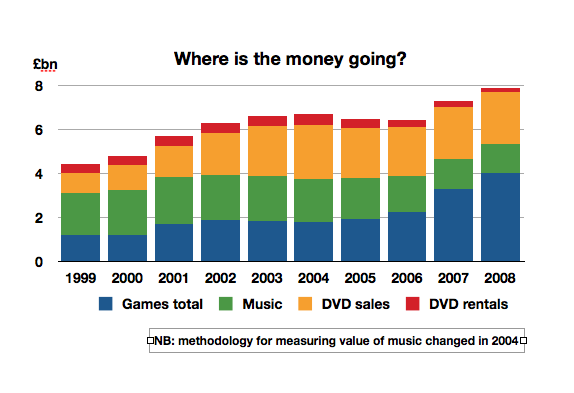
Are illegal downloads killing the music industry or is it games?
Charles Arthur at the Guardian is wondering if illegal downloading is killing the music industry or are consumers spending their disposable income on some other forms of entertainment instead?
"See also Illegal downloads and dodgy figures by Ben Goldacre in last Saturday's Guardian for some further analysis of the piracy by downloading figures.
The music industry does like to insist that filesharing - aka illegal downloading - is killing the industry: that every one of the millions of music files downloaded each day counts as a "lost" sale, which if only it could somehow have been prevented would put stunning amounts of money into impoverished artists' hands. And, of course, music industry bosses' wallets...
...I think they're spending the money on something else.
What else, I mused, might they be buying? Hmm... young.. like the entertainment industry... ah, how about computer games and DVDs? "
Arnie replaced textbooks with the Net
Arnold Schwarzenegger, governor of California, wants to phase out school textbooks because they are too expensive.
But somebody needs to enlighten him that believing the Net can directly and cheaply substitute for good textbooks (though from what Richard Feynman had to say about Californian textbooks might suggest I should drop the adjective there) is a solution to his problems which is simple, obvious and wrong.
Don't get me wrong, as a technophile in a university that has wholeheartedly embraced multimedia technologies as terrific educational tools and environments, I know first hand (and have the scars to prove it) that the Net can be deployed to spectacular effect (and at large scale) in this context. However, it is not simple, it is not cheap, and by and large it facilitates entirely new approaches and compliments rather than substitutes for effective pre-internet age educational tools (like texts) and practices. And somebody approaching the use of the net in education with the idea that is a cheap and easy substitute will fail, create a lot of frustration and do a lot of damage. It ranks right up there with the 'computer in every classroom will cure education' meme from the 1980s and 1990s.
"Arnold Schwarzenegger, California's Governor, announced this week that his state is about to phase out school books and substitute the internet in classrooms from the autumn, the news was presumably greeted with little more than a twitch of a baseball cap (turned backwards). Because California is close to bankruptcy, saving money is a priority, and this move will cut several hundred million dollars from the education budget. Mr Schwarzenegger also thinks that converting schools to online study will help to keep pupils more up to date, and that once textbooks are digitised they can be so easily revised that learning will always keep pace with progress."Firstly let's give the guy a pat on the back - he or his advisers think it might be a good idea to use the Net in education. Welcome to the 21st century Mr Schwarzenegger. Secondly let's tolerate his "Wayhay I've found the internet cure for our education woes" eureka moment.
But somebody needs to enlighten him that believing the Net can directly and cheaply substitute for good textbooks (though from what Richard Feynman had to say about Californian textbooks might suggest I should drop the adjective there) is a solution to his problems which is simple, obvious and wrong.
Don't get me wrong, as a technophile in a university that has wholeheartedly embraced multimedia technologies as terrific educational tools and environments, I know first hand (and have the scars to prove it) that the Net can be deployed to spectacular effect (and at large scale) in this context. However, it is not simple, it is not cheap, and by and large it facilitates entirely new approaches and compliments rather than substitutes for effective pre-internet age educational tools (like texts) and practices. And somebody approaching the use of the net in education with the idea that is a cheap and easy substitute will fail, create a lot of frustration and do a lot of damage. It ranks right up there with the 'computer in every classroom will cure education' meme from the 1980s and 1990s.
McKinnon back in court
Lawyers for Gary McKinnon, in what may be his last chance to avoid extradition to the US for alleged hacking into US defence computers, reportedly told the High Court yesterday that
"The former home secretary, Jacqui Smith, reached a "flawed decision" when she disregarded powerful medical evidence in the case of computer hacker Gary McKinnon, who is facing extradition to the US"
Monday, June 08, 2009
Pirate party election success in Sweden
I've just had a chat with Chris Edwards for a Guardian piece about the success of the Swedish Pirate Party in the EU parliament elections. I've been off the grid for a couple of weeks so wasn't aware of the news until this morning. I had a relatively wide ranging chat with Chris but a few things initially came to mind when I came across the story.
Firstly the Swedes have recently implemented the EU intellectual property rights enforcement directive, not a particularly popular measure, which coming rapidly in the wake of the Pirate Bay convictions would have helped the Pirate Party's publicity efforts in the run up to the election.
Secondly Sweden has a relatively high proportion of broadband subscribers, a substantial minority of whom may be tuned into the intellectual property debates to a higher degree than elsewhere in the EU. I have no direct evidence of this at the moment - purely speculation on my part.
Thirdly, as far as I can recall, Sweden had an electoral system based on proportional representation, which can make it possible for smaller parties to make an impact and gain seats with as little as 3 or 4% of the vote. Chris tells me they got 7% this time round which is pretty spectacular for a small single issue party.
It would be interesting to get some direct evidence, through interviewing a statistically significant sample of voters who opted for the Pirate Party, to find out the key reasons for that support. It could really significant that 7% of the electorate might actually actively have been prepared to cast their vote based on the state of the IP landscape. Of course it could equally have been a simple protest vote against established parties with the Pirate Party being the one alternative where voters knew what it stood for. Or something more nuanced between the two.
Firstly the Swedes have recently implemented the EU intellectual property rights enforcement directive, not a particularly popular measure, which coming rapidly in the wake of the Pirate Bay convictions would have helped the Pirate Party's publicity efforts in the run up to the election.
Secondly Sweden has a relatively high proportion of broadband subscribers, a substantial minority of whom may be tuned into the intellectual property debates to a higher degree than elsewhere in the EU. I have no direct evidence of this at the moment - purely speculation on my part.
Thirdly, as far as I can recall, Sweden had an electoral system based on proportional representation, which can make it possible for smaller parties to make an impact and gain seats with as little as 3 or 4% of the vote. Chris tells me they got 7% this time round which is pretty spectacular for a small single issue party.
It would be interesting to get some direct evidence, through interviewing a statistically significant sample of voters who opted for the Pirate Party, to find out the key reasons for that support. It could really significant that 7% of the electorate might actually actively have been prepared to cast their vote based on the state of the IP landscape. Of course it could equally have been a simple protest vote against established parties with the Pirate Party being the one alternative where voters knew what it stood for. Or something more nuanced between the two.
Thursday, May 28, 2009
Twittergate
The re-election of the German president was leaked on Twitter
Thanks to Michael Geist for the pointer.
"News that Hörst Köhler had been re-elected as German president on Saturday was published on the micro-blogging service almost 15 minutes before the result was officially announced."And naturally there's now the inevitable leak enquiry.
Thanks to Michael Geist for the pointer.
EU governments urge Google Books caution
Interesting - EU governments urge Google Books caution
Update: Sharebook are giving people a forum to talk about the settlement, which the Washington Post has picked up on.
Update: Sharebook are giving people a forum to talk about the settlement, which the Washington Post has picked up on.
Friday, May 22, 2009
French 3 strikes law worries EU neighbours
The Washington Post is reporting that the French 3 strikes law is causing concern around Europe.
"A thousand French Internet users a day could be taken off-line following approval of President Nicolas Sarkozy's pet project _ an unprecedented law to cut the Internet connections of people who repeatedly pirate music and movies...But many in Europe have denounced it, saying government controls needed to enforce the law could open the way for invasive state monitoring that violate privacy. And legal challenges at home could derail it: The opposition is trying to get the law declared unconstitutional."
Thursday, May 21, 2009
Microsoft apply for patent on a magic wand
I've been reading a draft introduction to our forthcoming Open University post graduate IT law course this afternoon. In the process of suggesting to the author that we might include a section on some of the Microsoft patent cases I came across one of the more interesting recent claims by the Redmond corporation. A magic wand no less, United States Patent Application number 20090121894:
Looking around of course Slashdot has picked it up and no doubt the tech news circuit will be doing likewise soon enough. Yup. In fact I'm a week behind the times - the application was published last Thursday and that news story the following day.
"The claimed subject matter relates to an architecture that can facilitate rich interaction with and/or management of environmental components included in an environment. The architecture can exist in whole or in part in a housing that can resemble a wand or similar object. The architecture can utilize one or more sensor from a collection of sensors to determine an orientation or gesture in connection with the wand, and can further issue an instruction to update a state of an environmental component based upon the orientation. In addition, the architecture can include an advisor component to provide contextual and/or comprehensive guidance in an intuitive manner."I expect the latest Harry Potter game on the Xbox is imminent or at least in advanced development with the latest movie due out in July. Coincidence that this patent comes to light now?
Looking around of course Slashdot has picked it up and no doubt the tech news circuit will be doing likewise soon enough. Yup. In fact I'm a week behind the times - the application was published last Thursday and that news story the following day.
Lessig on read write culture
In spite of retiring from the IP wars in order to concentrate on changing congress Larry Lessig is still doing talks about IP
Microsoft lose another big patent case
From Cnet:
"A federal jury in Tyler, Texas, on Wednesday ordered Microsoft to pay $200 million in a patent infringement case.The jury ruled that the custom XML tagging features of Word 2003 and Word 2007 infringed on a patent from Toronto-based i4i."
Spielberg, King and copyright
It seems that the deal Steven Spielberg has just signed to produce a film about Martin Luther King is to be challenged by two of King's children.
"The offspring of the late civil rights leader, who won the Nobel Peace Prize for his contribution to the struggle against racial segregation, are embroiled in an ugly dispute over plans for a Steven Spielberg film celebrating his life, times and legacy as a modern American icon.It is a real shame that King's teachings don't get much wider distribution due to the long running saga of disputes over the rights to his speeches and writings. A hugely valuable documentary series on the US civil rights movement, Eyes on the Prize, was pulled from circulation for many years because the complex collection of rights for photographs, music and film clips, and writings had expired. It has got to be seriously damaging to our understanding of important historical developments if we cannot tell the story without getting hopelessly entangled in intellectual property rights issues. That one fact alone should be enough to convince us that the term of copyright is just too long. 14 years renewable for another 14 anyone...? I'd even go for a nice round 25 if we couldn't do a deal on the 14 but either way King's teachings would be in the public domain; although the Eyes on the Prize producers might have to wait a few more years to clear the rights hurdles.In a deal announced this week, the famous director's production company, Dreamworks, became the first film-makers to acquire rights to King's speeches, books and back catalogue of intellectual property, including the famous speech delivered from the steps of the Lincoln Memorial during the 1963 "march on Washington"...
The news sparked huge excitement since, despite the fact that King is one of the greatest public speakers of the 20th century, no Hollywood film-maker has ever been granted permission to being his famous speeches to the big screen...
That was then. Unfortunately, less than 24 hours after the Oscar-winning director made his bullish statement, it emerged that two of King's three surviving children are threatening to sue because the lucrative film deal was brokered without either their knowledge or blessing."
Wednesday, May 20, 2009
Code of best practices in fair use
Michael Madison at Concurring Opinions notes:
"Yesterday, the Program on Information Justice and Intellectual Property at American University’s Washington College of Law and the Center for Social Media at AU’s School of Communication released “Remix Culture: Fair Use Is Your Friend,” a video that accompanies and explains the Code of Best Practices in Fair Use for Online Video, released jointly by the two centers last July. The video was underwritten by Google and was produced in collaboration with Stanford Law School’s Fair Use Project.Now where is the UK equivalent on fair dealing...?The Code itself is one of four recent ”best practices” statements supported by AU (in particular, by Pat Aufderheide at the CSM and Peter Jaszi at the law school) and/or inspired by the “best practices” model.
The first is the “Documentary Filmmakers’ Statement of Best Practices in Fair Use,” released in late 2005.
The others are the Code of Best Practices in Fair Use for Online Video, the Code of Best Practices in Fair Use in Media Literacy Education, and the recently-released “Statement of Best Practices in Fair Use of Dance-related Materials: Recommendations for Librarians, Archivists, Curators, and Other Collections Staff,” produced by the Dance Heritage Coalition. Full disclosure: Law faculty and practicing lawyers who specialize in copyright law vetted each of these publications, and I was one of vetters."
Subscribe to:
Posts (Atom)