Tim Wu had an excellent article in Slate last week about the Google Print dispute.
"The idea that there is no tradeoff between authorial control and exposure is attractive. But it is also wrong. Individually, more control may always seem appealing—who wouldn't want more control? But collectively, it can be a disaster. Consider what it would mean, by analogy, if map-makers needed the permission of landowners to create maps. As a property owner, your point would be clear: How can you put my property on your map without my permission? Map-makers, we might say, are clearly exploiting property owners, for profit, when they publish an atlas. And as an individual property owner, you might want more control over how your property appears on a map, and whether it appears at all, as well as the right to demand payment.
But the law would be stupid to give property owners that right. Imagine how terrible maps would be if you had to negotiate with every landowner in the United States to publish the Rand McNally Road Atlas. Maps might still exist, but they'd be expensive and incomplete. Property owners might think they'd individually benefit, but collectively they would lose out—a classic collective action problem. There just wouldn't really be maps in the sense we think of today.
The critical point is this: Just as maps do not compete with or replace property, neither do book searches replace books. Both are just tools for finding what is otherwise hard to find. And if we really want to have true, comprehensive book searches, we cannot require that every author's permission be individually sought out. The book search engines that emerge would be a shadow of the real thing, just as a negotiated map would be a lousy one."
Monday, October 24, 2005


Content communists
Lawgeek Jason Schultz thinks it is the IP maximalists who are the content communists.
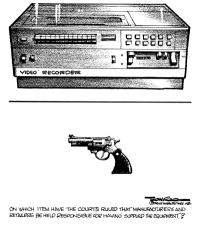
Should we outlaw the gun or the VCR?
A Paul Conrad cartoon from 1981 suggests we haven't progressed too far in the past 24 years (the caption reads "On which item have the courts ruled that manufacturers and retailers be held responsible for having supplied the equipment?"):

ScienTOMogy spoof site gets nastygram
A website, hosted in New Zealand, which ridicules Tom Cruise and his connections with Scientology has attracted the attention of institution's lawyers. Thanks to IPKat for the link.
History on a digital loop
John is on good form on the battle of the super-DVD formats and how it reflects the Betamax v VHS story of the late 1970s.
Durant drops landmark data protection case
From Out-law,
"Michael Durant, who lost a landmark Court of Appeal ruling on the meaning of "personal data" two years ago, has withdrawn his petition to the House of Lords. This means the House of Lords will no longer review the Court of Appeal's narrow interpretation of the definition.
The focus of attention now turns to the European Commission which has used the Durant decision as evidence that the UK's Data Protection Act of 1998 is a defective implementation of the Data Protection Directive of 1995."
ID Cards to unlease bullies
Carol Sarler, writing in the Sunday Observer, sees the latest anti terrorism proposals and the ID card scheme as a boon for bureaucratic bullies.
"The act, like the suss laws before it and the ID cards to come, are all toys in the playbox of wannabe bullies and nothing that I have seen, either here or anywhere else, suggests that such people will ever learn to play nicely. Shortly after the fall of Ceausescu, I had Romanian friends to stay. En route to the theatre, one of them began to weep; they wouldn't let her in. She had left her passport at home. Passport? For the doorman at Cats? It can happen. That's all I'm saying.
In a land of ID cards I would be very afraid for my personal liberty. But only because Sod's law says if I were to be confronted one time too many by an officious twat, I'd be the one banged up. For slapping him."
A classic example of how clueless top down regulation can facilitate societal poisoning from the bottom up.
US drug group fund drug import scare novel
Apparently the Pharmaceutical Research and Manufacturers of America (PhRMA), a powerful lobbying group in the US, through a "rogue employee" funded the development of a novel, where the story involved terrorists poisoning cheap drug imports from Canada. Or so says the Globe and Mail, a Canadian newspaper. Hardly a major conspiracy but you could see how the PR would work.
£30 ID card guarantee not all it seems
It looks like the £30 price touted by the government for our forthcoming ID cards is not the water tight promise it has been sold as, according to John Lettice.
" If Charles Clarke is announcing that ID cards are only going to cost £30, then the ID Cards Bill must be due back in Parliament any day now (yup, Tuesday), and Labour Party MPs must be looking for some threadbare justification for continuing to support it. And if that's not quite enough ('Isn't £30 pretty much what they said last time we bravely gave in?') then Clarke also has a report demonstrating "strong public support for the scheme" and an "independent analysis" from KPMG backing him up on the scheme costs.
We now propose to demonstrate how Clarke, who announced the £30, the report and the KPMG analysis in a written answer to a parliamentary question on 13th October, was to all intents and purposes misleading the House. We should however note that he was not lying as such - he was merely giving his target audience on the Labour benches the tools to believe what they desperately want to believe..."
Read two biometrics get worse results
John Lettice at the Register has been going over some of John Daugman's calculations about the effects of combining multiple biometrics to authenticate an individual. The results are actually quite straightforward when you stop to think about it, though not necessarily intuitive.
"On the one hand, a combination of different tests should improve performance, because more information is better than less information. But on the other, the combination of a strong test with a weak test to an extent averages the result, so the result should be less reliable than if one were relying solely on the strong test...
If the two biometric tests differ significantly in their power, and each operates at its own cross-over point, then combining them gives significantly worse performance than relying solely on the stronger biometric...
Daugman produces the calculations governing the use of two hypothetical biometrics, one with both false accept and false reject rates of one in 100, and the second with the two rates at one in 1,000. On its own, biometric one would produce 2,000 errors in 100,000 tests, while biometric two would produce 200. You can treat the use of two biometrics in one of two ways - the subject must be required to pass both (the 'AND' rule) or the subject need only pass one (the 'OR' rule). Daugman finds that under either rule there would be 1,100 errors, i.e. 5.5 times more errors than if the stronger test were used alone.
He concludes that a stronger biometric is therefore better used alone than in combination, but only when both are operating at their crossover points...
Which suggests to us that simply regarding a second or third biometric as a fall back to be used only if earlier tests fail constructs a scenario where the combined results will be worse than use of the single stronger test..."
Mitchigan University President on Google Print
Mary Sue Coleman, president of the University of Michigan, sees the Google Print project as "Riches We Must Share..." in the Washington Post.
An author in the WP on the same day had a different perspective. The author, Nick Taylor, is president of the Authors Guild, the representative body which has sued Google for copyright infringement.
Friday, October 21, 2005
Does Google Print violate copyright
Peter Suber has taken a detailed look at the Google Print issues and whether the company is infringing on copyright.
"First we have to get clear on two terms. "Google Publisher" is the name of the project to scan books that publishers voluntarily offer Google to scan. "Google Library" is the name of the project to scan books in certain libraries, with the consent of the libraries but not necessarily the consent of the publishers. Both are parts of the larger "Google Print" project, which is to scan full-text print materials for adding to the Google search index. For publishers, Google Publisher is opt-in, while Google Library is opt-out. Google Library covers books under copyright as well as books in the public domain. The Authors Guild lawsuit is about the copyrighted portion of Google Library...
I've seen a plausible case for copyright infringement by Google Library --which, by the way, is opposed by a plausible case against copyright infringement (more below). But I haven't yet seen a plausible case that the authors or publishers will be injured by Google Library. On the contrary, publishing groups who address this, like the ALPSP, tend to concede that the program will benefit them but insist that the rules be followed anyway. The AG press release doesn't mention harm or injury. Deep within the complaint that it filed in court, however, it alleges the members of the class-action suit have suffered "depreciation in the value and ability to license and sell their Works [and] lost profits and/or opportunities" (p. 10). The complaint seeks to collect damages for these losses.
If the AG mentions losses merely as a formality --which is how it looks-- and covertly concedes that Google Library will increase book sales, then the suit might still make sense. But instead of trying to stop a continuing injury, the AG would be trying to extract a settlement. It may want a cut of Google's ad revenue on top of increased sales. If so, then (as I said last month) we're watching a shakedown...
If the case goes to trial, some of these arguments are likely to be more central than others. If I had to boil down this summary to the most essential elements, I'd put it this way. The authors --and the publishers who share the same grievance-- are getting far too much mileage from the claim that Google's opt-out policy turns the usual copyright rule on its head. This claim has a deceptive strength. It's strong because it would be valid for most full-text copying. It's deceptive because it assumes without proof that the Google copying is not fair use. Hence it begs the question at the heart of the lawsuit. If the Google copying is fair use, then no prior permission is needed and the opt-out policy is justified. Moreover, Google has several good arguments that its copying really is fair use, most notably its argument that its indexing will enhance rather than diminish book sales and its analogy to long-accepted opt-out policies for search-engine indexing of other copyrighted content.
On the merits, it's an important question to settle. But I admit that I'm not very comfortable having any important copyright question settled in today's legal climate of piracy hysteria and maximalist protection --a new world order getting old fast."
WSJ v DRM
Walter S. Mossberg at the Wall Street Journal is not overly enamoured with the use of DRM.
"For some activists, the very idea of Digital Rights Management is anathema. They believe that once a consumer legally buys a song or a video clip, the companies that sold them have no right to limit how the consumer uses them, any more than a car company should be able to limit what you can do with a car you've bought.
But DRM is seen as a lifesaver by the music, television and movie industries. The companies believe they need DRM technology to block the possibility that a song or video can be copied in large quantities and distributed over the Internet, thus robbing them of legitimate sales.
In my view, both sides have a point, but the real issue isn't DRM itself -- it's the manner in which DRM is used by copyright holders. Companies have a right to protect their property, and DRM is one means to do so. But treating all consumers as potential criminals by using DRM to overly limit their activities is just plain wrong."
Update: Ed Felten has a useful follow up to Mossberg's column.
Blackboard and WebCT to merge
The two biggest electronic learning platform vendors for higher education have agreed on a merger/takeover deal. Blackboard are to acquire WebCT by early 2006 in a deal that will give the new company about two thirds of the world market in learning management system (LMS) or virtual learning environments (VLEs), as we have come to call them in the university sector.
This gives me some concern, not because my own university uses either of these platforms (we don't yet), but because Blackboard have demonstrated a will to censor inconvenient research. In the Spring of 2003 they rolled out the lawyers to prevent two students presenting a research paper on security flaws in the Blackboard campus ID card system.
The two, Billy Hoffman of the Georgia Institute of Technology and Virgil Griffith of the University of Alabama had decided to publish a paper on the problem at a security conference in Georgia but Blackboard’s lawyers stepped in and got a court to issue an injunction preventing the disclosure of the details of the problem.
The students eventually reached an out of court settlement with Blackboard apologising to the company for their actions and agreeing to "refrain from any further unauthorized access to or use of the System," including "any transaction designed to better understand or determine how the System works." They also agreed to do 40 hours community service.
Now Blackboard got their injunction preventing these students from presenting their research, so they had an arguable legal case. However, the builders of one of the widest deployed platforms for the creation and delivery of higher education digital content were prepared to go to court to block the publication of inconvenient research and extract a settlement whereby a couple of techie students agreed to refrain from “any transaction designed to better understand or determine how the System works."
Blackboard is a business and has a duty to protect the interests of the company’s shareholders. These interests, however, may not necessarily coincide with those of their education institution customers.
So, universities should think carefully before locking themselves into propriety VLEs. The corollary of that is that the architecture of higher education VLEs should be:
• based on open standards
• modular
• flexible
• expansible
• interoperable with other systems
If a small number of players with closed systems come to dominate the HE market for VLEs in the long term we could face restrictions on information development and distribution which we take for granted today. Restrictions built into the architecture of the systems we use, backed up by force of law.
Latest EDRI-gram
The latest EDRi-gram has been published with, as usual, many notable stories. The one that caught my eye was the European Ombudsman Mr Diamandouros' call for EU Councils of Ministers to legislate in a more transparent manner.
He basically said the Council have failed to provide valid reasons for meeting behind closed doors and recommended:
"The Council of the European Union should review its refusal to decide to meet publicly whenever it is acting in its legislative capacity."
Lessig on drm, cc and interoperability
Larry Lessig's latest newsletter is on drm and interoperability.
"Interoperability. Perhaps the most important thing that the Internet has given us is a platform upon which experience is interoperable. At first, the aim of the computer and network geniuses was simply to find a way to make computers talk to each other. Then application geniuses found ways to make the content that runs on these different devices interoperate on a single digital platform. We are close to a world where any format of sound can be mixed with any format of video, and then supplemented with any format of text or images. There are exceptions; there are some who don't play in this interoperability game. But the push of the network has been to produce a world where anyone can clip and combine just about anything to make something new...
The Internet was not built with permissions in mind. Free access was the rule.
That free access creates many problems for many – indeed in principle, it might create problems for us all. Record and film companies are notorious for complaining about this Internet feature. Given its original design, you could "share" your complete record and film collection with your 100,000 "best friends." It's not surprising that they view this feature rather as a bug. But I suggest any of us might regret this feature of the net in certain circumstances. Do you really like it that someone can take a personal email you sent him and forward it to his 100 best friends?
The point is that however good free access is, sometimes, at least some think its not very good, at least for them. And the most powerful of these some have therefore pushed for technologies that would be layered onto the Internet and enable them, or content owners generally, to control how digital content gets used."
Adelphi Charter
John had a nice piece on the RSA Adelphi Charter on his blog last week.
Since then Google have been sued again over their Google Print project which aims to make all the worlds's books searchable online. ZDNet had a report earlier in the week suggesting the American Association of Publishers were behind the lawsuit. The names on the actual complaint, though, are those of some of the major publishers, McGraw-Hill, Pearson, Penguin Group, Simon & Schuster, and John Wiley & Sons.
The AAP president, Patricia Schroeder, said
"The publishing industry is united behind this lawsuit against Google and united in the fight to defend their rights. While authors and publishers know how useful Google's search engine can be and think the Print Library could be an excellent resource, the bottom line is that under its current plan, Google is seeking to make millions of dollars by freeloading on the talent and property of authors and publishers."
Which in translation reads - publishers want a bigger slice of the earnings.
Google spokesman, David Drummond said
"Google Print is a historic effort to make millions of books easier for people to find and buy. Creating an easy-to-use index of books is fair use under copyright law and supports the purpose of copyright: to increase the awareness and sales of books directly benefiting copyright holders. This short-sighted attempt to block Google Print works counter to the interests of not just the world's readers, but also the world's authors and publishers."
Which in translation reads - don't be stupid, we're doing you a favour sending loads more customers your way with no effort on your part; and you want to cash in on our business too?!
Wednesday, October 19, 2005
Google Print moves on Europe
From the NYT, "Google said Monday that it had begun operating local-language sites in eight European countries for its Google Print program, its closely watched effort to make all of the world's books searchable online, expanding into territories where it has drawn fierce criticism."
Tuesday, October 18, 2005
Universities and the new terrorism act
I accidentally happened across an interesting discussion on this afternoon's BBC Radio 4's "The Learning Curve", where Libby Purves interviewed Dr Steve Wharton, President of the Association of University Teachers and Professor Les Ebdon, Vice Chancellor of Luton University, who is updating guidance on terror and intolerance for Universities UK. (The relevant interview starts about 16 minutes into the programme).
Both Wharton and Ebdon raised serious and legitimate concerns about the potential impact of the "glorifying terrorism" provisions of the new anti-terrorism bill, Education Secretary Ruth Kelly's recent call for academics to play an active part in "cracking down on campus extremists" and the government's use of a report (the Gleeson report) published by a think tank known as the Social Affairs Unit, which if it is to be believed, Purves says, "paints a disturbing picture" of extremism in universities.
Wharton runs courses in political discourse and persuasion propaganda and could theoretically be directly targetted by law enforcement authorities if the bill were to become law in its present form. He expects his students to engage with difficult subjects and to acquire the tools to critically analyse propaganda and had been planning to introduce a course specifically on the discourse of terrorism.
Ebdon dismissed, as "widely discredited," the Gleeson report which claims UK universities are riddled with terrorists. He was particularly keen to point out that claims in the report about the so called "4th bomber" being associated with Luton were based purely on a story in the Daily Mail that the paper had withdrawn and apologised for.
Wharton also rejected Ruth Kelly's call for vigilance amongst academics in the cause of anti-terrorism as an effort at turning academics into "a kind of 21st century stasi by the back door." The notion that academics should be "obliged to hunt out people in the classroom" was ridiculous.
I doubt the interview will get much exposure but at least it gets it's 15 minutes here on b2f. :-)
Microsoft CTO condemns UK ID card plan
Microsoft's UK technology chief, Jerry Fishenden, has condemned the UK government's ID card plans.
"Mr Fishenden, national technology officer for the computing giant, said it could lead to "massive identity fraud".
"Putting a comprehensive set of personal data in one place produces a honeypot effect - a highly attractive and richly rewarding target for criminals," he told The Scotsman.
The system was "something that no technologist would ever recommend", he said."
Good for him.
Subscribe to:
Posts (Atom)