Wednesday, July 18, 2012

Commission on Bill of Rights 2nd consultation

Just appeared in my inbox are two emails from Marie Colton of the Commission on a Bill of Rights Secretariat, attached to which is a message from Sir Leigh Lewis, Chair of the Commission and a copy of the Commission’s recently published second consultation paper. The Chairman says:
"I am writing to provide you with a copy of a second consultation paper that the Commission on a Bill of Rights is making public today.

As you may be aware, the Commission was established by the UK Government in March 2011 primarily to investigate the creation of a UK Bill of Rights. Over the last 15 months, we have consulted widely on the issues which form part of our mandate. In particular, we published a discussion paper in August of last year which attracted over 900 responses. We have also met with numerous groups and individuals from around the UK and held a series of seminars to enable us to seek and receive views. Further details about our work, terms of reference and consultation programme can be found on the Commission’s website (www.justice.gov.uk/about/cbr/index.htm). Our thanks go to all those who have already contributed to our work and deliberations – whether by meeting with us, participating at one of our events, and/or submitting a response to our first discussion paper.

With less than six months to go until we must report, our Commission is now at a significant stage in its work. In particular, we have to decide whether or not to recommend a UK Bill of Rights and, if so, what form and content any such Bill might have. We have therefore decided to publish a second consultation paper to provide a further opportunity for you to tell us your views on a number of the key issues covered by our terms of reference and I am very pleased to attach a copy. If you responded to our first consultation last summer or have otherwise already conveyed your views to us, you do not need to repeat what you have already said which we have already taken very carefully into account. We would, however, very much like to hear from you again both on the further questions set out in this paper or if your views have developed or changed since you first responded. Equally, if you did not respond to our first consultation, that is no bar whatsoever to giving us your views now which we would greatly welcome.  

The deadline for responding to the consultation paper is 30 September 2012.

We greatly look forward to hearing your views.

Yours sincerely,

Sir Leigh Lewis KCB
Chair"
In the thick of a multitude of battles with zombie bureaucrats over entirely unrelated matters, I did draft and send a response to the original consultation in August last year. I realised, sadly after submitting, that my clumsy legal terminological inexactitudes and inadvertent misuse of legal and constitutional terms probably led to my submission being filed under whatever euphemism the Commission were then using for 'clueless'. It was a classic example of importance of not writing at the margins of your time and sending off (what you, at least, consider to be) significant papers, in a hurry, without first giving them your full attention and running the draft past informed friends and colleagues.

The questions in this second consultation are as below.
"Q1: What do you think would be the advantages or disadvantages of a UK Bill of Rights? Do you think that there are alternatives to either our existing arrangements or to a UK Bill of Rights that would achieve the same benefits? If you think that there are disadvantages to a UK Bill of Rights, do you think that the benefits outweigh them? Whether or not you favour a UK Bill of Rights, do you think that the Human Rights Act ought to be retained or repealed?
Q2: In considering the arguments for and against a UK Bill of Rights, to what extent do you believe that the European Convention on Human Rights should or should not remain incorporated into our domestic law?
Q3: If there were to be a UK Bill of Rights, should it replace or sit alongside the Human Rights Act 1998?
Q4: Should the rights and freedoms in any UK Bill of Rights be expressed in the same or different language from that currently used in the Human Rights Act and the European Convention on Human Rights? If different, in what ways should the rights and freedoms be differently expressed?
Q5: What advantages or disadvantages do you think there would be, if any, if the rights and freedoms in any UK Bill of Rights were expressed in different language from that used in the European Convention on Human Rights and the Human Rights Act 1998?
Q6: Do you think any UK Bill of Rights should include additional rights and, if so, which? Do you have views on the possible wording of such additional rights as you believe should be included in any UK Bill of Rights?
Q7: What in your view would be the advantages, disadvantages or challenges of the inclusion of such additional rights?
Q8: Should any UK Bill of Rights seek to give guidance to our courts on the balance to be struck between qualified and competing Convention rights? If so, in what way?
Q9: Presuming any UK Bill of Rights contained a duty on public authorities similar to that in section 6 of the Human Rights Act 1998, is there a need to amend the definition of ‘public authority’? If so, how?
Q10: Should there be a role for responsibilities in any UK Bill of Rights? If so, in which of the ways set out above might it be included?
Q11: Should the duty on courts to take relevant Strasbourg case law ‘into account’ be maintained or modified? If modified, how and with what aim?
Q12: Should any UK Bill of Rights seek to change the balance currently set out under the Human Rights Act between the courts and Parliament?
Q13: To what extent should current constitutional and political circumstances in Northern Ireland, Scotland, Wales and/or the UK as a whole be a factor in deciding whether (i) to maintain existing arrangements on the protection of human rights in the UK, or (ii) to introduce a UK Bill of Rights in some form?
Q14: What are your views on the possible models outlined in paragraphs 80-81 above for a UK Bill of Rights?
Q15: Do you have any other views on whether, and if so, how any UK Bill of Rights should be formulated to take account of the position in Northern Ireland, Scotland or Wales?"
 Paragraphs 80-81 referred to in Q14 are as follows:
"80.
One possible model for a UK Bill of Rights in this context is a Bill that might sit alongside the existing Human Rights Act and contain substantially similar provisions and rights to those currently found in Schedule 1 to the Act. Under this model these rights might apply UK wide but be exercisable in respect of reserved matters only. Such an instrument might also include a separate chapter containing rights that applied only to England, as
well as a statement that acknowledged the competence of the Northern Ireland Assembly, the Scottish Parliament and the National Assembly for Wales to enact legislation conferring additional rights to meet the particular needs of those countries. Any additional rights passed by the devolved legislatures would, by virtue of the existing devolution statutes, relate to devolved matters only. In the view of some such a model might simply reflect what already happens in practice in respect of rights protection under the devolution statutes.8
81.
Another possible model might be a UK Bill of Rights that contained additional rights in respect of Northern Ireland, Scotland and Wales but which would not enter into force in respect of those countries without the consent of the respective devolved legislature."
I would highly encourage engagement with the consultation. I wouldn't put it past the political digerati to stoke up some public mischief using the possible Bill of Rights and Human Rights Act as political footballs, in order to divert attention from their endless woes and pathological ineptitude. So the importance of this Commission cannot be overstated.

Saturday, July 14, 2012

Olympics rights and wrongs

An old friend of the family, James Grote, hugely deserving of the honour, carried the Olympic torch through Oxford early on Tuesday morning.  My wife and younger son got up early to watch it pass a couple of hundred yards from our house, as the crow flies. They both came back buzzing with the excitement of it all.

Before I became a modern day curmudgeon about the political and corporate pollution and exploitation of it all, I shared that sense of awe and magic surrounding major sporting events like the Olympics, world cup & European championship finals, FA cup final, various athletics events, Gaelic games, Tour de France and even Wimbledon.

However, the government are turning London and the Olympic venues into a police state for the duration of the games. Visitors from totalitarian states won't see any difference in their treatment around the venues than that they receive from authorities at home; as they watch the VIPs being ferried, in official Olympic vehicles, rapidly and smoothly down Olympic designated lanes, whilst they wait to be processed by security with the rest of us ordinary plebs .

Special laws, like the London Olympic Games and Paralympic Games Act 2006 and the Olympic Symbol (Protection) Act of 1995, relating to the protection of corporate sponsors of the games are probably the most restrictive ever, in their scope and potential penalties should they be deliberately or inadvertently transgressed. The former law gives LOCOG the power to prevent unauthorised associations with the Olympics.  Officially sanctioned associations are called "London Olympic Association rights".  Businesses along the torch route in Oxford have been told to cover their signs as they are not entitled to any publicity that might be remotely associated with the Olympics.

The intellectual property, promotional and economic rights of the sponsors are more important than the civil rights of people attending or even linking to the website of the games or just watching the torch relay. The IOC, LOCOG and the big companies involved defend their intellectual property vigorously and some would say viciously. Never forget, for example that within the confines of the Olympic Park McDonalds is watching you.
"Due to sponsorship obligations with McDonalds LOCOG have instructed the Catering team that they are no longer able to serve chips on their own within the Olympic Park.
The only loophole to this is if they are served with fish."

I've got two tickets for a quarter final football match at Wembley and amongst the items I'm banned from bringing are musical instruments, "professional style cameras", containers with a capacity greater than 100ml. Oh but I can bring essential medication if I also bring a letter from a doctor saying I need it.

Then there is the catch all no "items with corporate or inappropriate branding, sponsorship, promotional or marketing material or literature, except for official Games merchandise and/or other football related clothing worn in good faith, any unofficial or counterfeit merchandise".

The job of the general public is to quietly acquiesce to over-reaching, abusive security theatre and consume and cheer the Olympics bread and circuses.  I love sport and like my family really want to enjoy the games. The Olympics are supposed to be about building a better world through sport - better, higher, faster, stronger - excellence, respect, friendship built on ethical values; development through sport, education through sport, peace through sport.  That idealism sadly gets lost in the real world.

I will use my tickets and hope that kids in particular can revel in and remember the excitement of the occasion. But it's really difficult to set aside the industrial scale political and corporate malfeasance surrounding it all.  Let's face it, if we all decided to engage exclusively with ethical political, public, social, economic, private and civil society actors/agents/individuals/institutions and hold them to those ethical values, the world would be a much better place.

Perhaps those of us lucky enough to have got tickets for Olympic events might start by wearing T-shirts with the insignia 'UK taxpayer: Official Sponsor of London 2012'.  After all we are paying the biggest part of the multi billion pound bill. Or would LOCOG and the IOC consider that ambush marketing?

Friday, July 13, 2012

Terry: he said it but not proven racially aggravated insult

The John Terry judgment is very readable and clear. The short version:

Did John Terry use threatening, abusive/insulting words.. within.. hearing/sight of a person likely to be caused.. distress? Yes.

Was it a racially aggravated abuse/insult under S28 of the Crime and Disorder Act (CDA) 1998, S5 of Public Order Act 1986 & S31(1)(c) & (5) of CDA there's a doubt, so...not guilty.

From the judgment:
"John Terry faces one allegation. It is said that on the 23rd October 2011 at
Loftus Road Stadium London, W12 he used threatening, abusive or insulting
words or behaviour or disorderly behaviour within the hearing or sight of a
person likely to be caused harassment, alarm or distress and the offence was
racially aggravated in accordance with section 28 of the Crime and Disorder
Act 1998, contrary to Section 5 of the Public Order Act 1986 and section
31(1)(c) and (5) of the Crime and Disorder Act 1998.

To summarize:
     There is no doubt the words “Fucking black cunt” were directed at Mr
Ferdinand.
     Overall I found Anton Ferdinand to be a believable witness on the
central issue.
     It is inherently unlikely that he should firstly accuse John Terry of
calling him a black cunt, then shortly after the match completely deny
that he had made such a comment, and then maintain that false
account throughout the police investigation and throughout this trial.
There is no history of animosity between the two men. The supposed
motivation is slight.
     Mr Terry’s explanation is, certainly under the cold light of forensic
examination, unlikely. It is not the most obvious response. It is
sandwiched between other undoubted insults.
     I believe that he is an unwilling witness, and would have preferred that
this matter not come to court.
There were discrepancies in his evidence. To a large extent this is what
you would expect from a truthful witness. Much of what happened;
happened in a brief period of time, in circumstances where the result of
the game was more important than any individual argument between
two players. I will return later to the discrepancies.
[...]
So the question for me now is whether there is a doubt that the offence is
made out. In all criminal courts in this country a defendant is found guilty
only if the court, be it a jury, magistrate, or a judge, is sure of guilt. If there
is a reasonable doubt then the defendant is entitled to be acquitted.
[...]
Conclusion 
The prosecution has presented a strong case. There is no doubt that John
Terry uttered the words “fucking black cunt” at Anton Ferdinand. When he
did so he was angry. Mr Ferdinand says that he did not precipitate this
comment by himself accusing Mr Terry of calling him a black cunt.
Even with all the help the court has received from television footage,
expert lip readers, witnesses and indeed counsel, it is impossible to be  
sure exactly what were the words spoken by Mr Terry at the relevant time. It is
impossible to be sure exactly what was said to him at the relevant time by
Mr Ferdinand.

[...]
Weighing all the evidence together, I think it is highly unlikely that Mr
Ferdinand accused Mr Terry on the pitch of calling him a black cunt.
However I accept that it is possible that Mr Terry believed at the time, and
believes now, that such an accusation was made. The prosecution evidence
as to what was said by Mr Ferdinand at this point is not strong. Mr Cole
gives corroborating (although far from compelling corroborating)  
evidence on this point. It is therefore possible that what he said was not intended as
an insult, but rather as a challenge to what he believed had been said to
him.  
In those circumstances, there being a doubt, the only verdict the court can
record is one of not guilty." 
John Terry was on trial for using racially aggravated "threatening, abusive or insulting words or behaviour or disorderly behaviour within the hearing or sight of a person likely to be caused harassment, alarm or distress" as set out in section 28 of the Crime & Disorder Act 1998, Section 5 of the Public Order Act 1986 and section 31(1)(c) and (5) of the Crime and Disorder Act 1998.

The case was not proven beyond doubt, so he was found not guilty.


None of the actors in this little drama have come out of it looking too good. The footballers behaved badly.  They also seem to believe that vicious verbal abuse and offensive language is ok as long as there is no reference to colour?

The law (s5) determines that engaging in insulting words or behaviour is a criminal offence. That's pretty offensive itself in a modern democracy.

So I guess there are three remaining questions on the case.

Was it ok for the court to postpone the case until after the European championship finals for John Terry's convenience?

Do the FA now follow up by charging Mr Terry with misconduct as per the Suarez case last year?

More importantly, does the case help or hinder the campaign to get section 5 of the Public Order Act 1986 repealed or updated?

Monday, July 09, 2012

New laptop set up: just switch on and go...?

I've been setting up a new computer today.  Am I getting slower or is setting up a new laptop computer getting more tortuous? Maybe it's just that this is an infrequently used skill?  Anyway it took most of the morning and part of the afternoon.
  • Sorted battery out.
  • Did new computer Windows 7 rigmarole
  • Ignoring McAfee advice that I needed to register a McAfee account before removal, I removed McAfee first via the Windows uninstaller; then rebooted and downloaded McAfee removal tool; ran this as an administrator and rebooted again
  • Installed Sophos via remote user disk (the Open University has a licence covering home users). Not as smooth as it should have been; again had to run as an administrator and of course Windows 7 doesn't facilitate the easy set up from starting of an administrator account; (for OU readers run it from the OUlocal.bat file in the main folder rather than the sophos-install.bat file in the sophos folder - for some reason trying to install from the latter file gets part way through and then tries to connect to a network printer and fails)
  • Next installed Firefox
  • Revise to personal preference the privacy and proxy and security Firefox settings
  • Install Skype; find user's lost Skype password; set preferred privacy settings
  • Install Thunderbird
  • Set up email account on Thunderbird; again this took a little longer than expected because I made a series of simple errors when entering the IMAP and smtp server settings
  • Next step should be installing Enigmail GPG extension for Thunderbird
  • Next and most importantly installed Linux, Ubuntu 12.04 in this case
  • Couple of reboots later and Ubuntu is running smoothly
  • Needed language support update
  • Needed about 230MB of other updates via the Software Updater
  • Install Synaptic package manager
  • Install Thunderbird for Linux and set up account
  • Install Enigmail GPG extension
  • Install Skype for Linux; set privacy settings etc
  • Install recordMyDesktop
  • Install Chrome and Flash for Linux (there are going to be no further Flash updates for Linux but Google are taking over and will integrate to Chrome)
  • Install audio/video codecs
  • Set Ubuntu privacy settings to suit
  • Set Firefox proxies, security, privacy settings
  • Install LibreOffice Global Menu
Then you're pretty much ready to go.  Now that wasn't too difficult was it? Though why is it I still think I've missed something obvious?

Just on the Ubuntu 12.04, it's worth checking out Joey Sneddon's 10 things to do after installing Ubuntu 12.04. and Sean from novelldesktop's 5 things to do after installing Ubuntu 12.04.

Thursday, July 05, 2012

ECJ upholds first sale doctrine for software

Little noticed on a busy newsweek the Court of Justice of the European Union (CJEU) (also known as the European Court of Justice, ECJ), on Tuesday, emphatically upheld the first sale doctrine for software in the EU. So when you purchase software in the EU, regardless of what the small print in the licence says, you are purchasing something which you can sell on second hand, without the copyright owner's permission or interference. The original copyright owner's exclusive right of reproduction, however, is not exhausted by the first sale. In other words, software companies still control the copyright just not the right to resell copies of the software they have already sold.

Oracle had sued a German company, UsedSoft which has been selling second hand copies of its software. And cheekily, some might believe, some UsedSoft's customers have been getting their copy of the Oracle software from Oracle's own website and are entitled to have any updates and bug fixes the original user had.

The case will now go back to the German Federal Court of Justice for a final decision.

The 2009 directive on the legal protection of computer programs theoretically implements a first sale doctrine for software in the EU - first sale in the EU of a copy of a computer program exhausts the right of distribution of that copy in the EU. The bottom line theoretically is that when you purchase software in the EU you are not just licensing the use of the software as every commercial software licence says, you have bought a copy which you're entitled to sell on.

Oracle thought they could bypass the directive through get out clauses in their licences, as is standard practice in the software industry. So it's nice to see the ECJ stand by the letter and spirit of the directive.

Contract pretty much trumps everything in the US courts so this will have been a surprise to Oracle but not necessarily totally unexpected, since the ECJ Advocate General, Yves Bot, issued his advisory opinion along the same lines in April.

The Court issued a very accessible 2 page statement on the decision on Tuesday.
"An author of software cannot oppose the resale of his ‘used’ licences allowing the use of his programs downloaded from the internet
The exclusive right of distribution of a copy of a computer program covered by such a licence is exhausted on its first sale
UsedSoft is a German undertaking which markets licences acquired from customers of Oracle. Customers of UsedSoft who are not yet in possession of the software download it directly from Oracle’s website after acquiring a ‘used’ licence. Customers who already have that software can purchase a further licence or part of a licence for additional users...
Oracle brought proceedings against UsedSoft in the German courts, seeking an order for it to cease those practices. The Bundesgerichtshof (Federal Court of Justice, Germany) ... made a reference to the Court of Justice for it to interpret, in this context, the directive on the legal protection of computer programs.1.
Under that directive, the first sale in the EU of a copy of a computer program by the copyright holder or with his consent exhausts the right of distribution of that copy in the EU.
By its judgment delivered today, the Court explains that the principle of exhaustion of the distribution right applies not only where the copyright holder markets copies of his software on a material medium (CD-ROM or DVD) but also where he distributes them by means of downloads from his website.
Where the copyright holder makes available to his customer a copy – tangible or intangible – and at the same time concludes, in return form payment of a fee, a licence agreement granting the customer the right to use that copy for an unlimited period, that rightholder sells the copy to the customer and thus exhausts his exclusive distribution right. Such a transaction involves a transfer of the right of ownership of the copy. Therefore, even if the licence agreement prohibits a further transfer, the rightholder can no longer oppose the resale of that copy.
The Court observes in particular that limiting the application of the principle of the exhaustion of the distribution right solely to copies of computer programs that are sold on a material medium would allow the copyright holder to control the resale of copies downloaded from the internet and to demand further remuneration on the occasion of each new sale, even though the first sale of the copy had already enabled the rightholder to obtain appropriate remuneration...
Moreover, the exhaustion of the distribution right extends to the copy of the computer program sold as corrected and updated by the copyright holder...
The Court points out, however, that if the licence acquired by the first acquirer relates to a greater number of users than he needs, that acquirer is not authorised by the effect of the exhaustion of the distribution right to divide the licence and resell only part of it.
Furthermore, the Court states that an original acquirer of a tangible or intangible copy of a computer program for which the copyright holder’s right of distribution is exhausted must make the copy downloaded onto his own computer unusable at the time of resale. If he continued to use it, he would infringe the copyright holder’s exclusive right of reproduction of his computer program. In contrast to the exclusive right of distribution, the exclusive right of reproduction is not exhausted by the first sale. However, the directive authorises any reproduction that is necessary for the use of the computer program by the lawful acquirer in accordance with its intended purpose. Such reproduction may not be prohibited by contract.
 In this context, the Court’s answer is that any subsequent acquirer of a copy for which the copyright holder’s distribution right is exhausted constitutes such a lawful acquirer. He can therefore download onto his computer the copy sold to him by the first acquirer. Such a download must be regarded as a reproduction of a computer program that is necessary to enable the new acquirer to use the program in accordance with its intended purpose.
Therefore the new acquirer of the user licence, such as a customer of UsedSoft, may, as a lawful acquirer of the corrected and updated copy of the computer program concerned, download that copy from the copyright holder’s website."
I find it interesting that the UsedSoft v Oracle decision protects the ability of UsedSoft's customers to get their 'used' copy of the software from Oracle's website.  I can't see that that protection would have been upheld by any US court.

Another key element was the Court's decision to specifically neutralise the relative distribution channels as a material factor. Software is software whether you get it on a physical medium or through the Net.

I wish I could share the prevailing optimism on the wider impact of the decision but I suspect the software and games cos. et al will continue to use restrictive licences and make it difficult through drm etc to pass on second hand games through sales, borrowings or donations. Though the legal departments of those same companies will even now be working on a form of words to insert in the licences to address the 'problems' thrown up by the ECJ.

The real breakthrough on end user licence agreements (or EULAs) will come when there's a successful challenge in a supreme court on the basis of unfair contract terms.

Notes
1. Directive 2009/24/EC of the European Parliament and of the Council of 23 April 2009 on the legal protection of computer programs (OJ 2009 L 111, p. 16).

Wednesday, July 04, 2012

EU Parliament reject ACTA; Commission say NO!

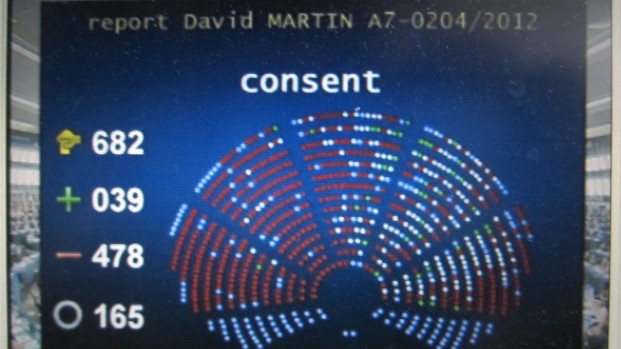
Well I missed watching it live because I forgot that Brussels is an hour ahead of us here in the UK but the EU Parliament has declined the opportunity to postpone their vote on ACTA today. The European People’s Party, as they promised, called for a postponement of the vote. This was rejected by 420 MEPs. 255 voted to postpone and there were 9 abstentions.

The Parliament then decided to reject the ACTA agreement itself (478 votes to 39, with 165 abstentions) based on ACTA rapporteur, David Martin's recommendations.
"on the draft Council decision on the conclusion of the Anti-Counterfeiting Trade Agreement between the European Union and its Member States, Australia, Canada, Japan, the Republic of Korea, the United Mexican States, the Kingdom of Morocco, New Zealand, the Republic of Singapore, the Swiss Confederation and the United States of America
(12195/2011 – C7-0027/2012 – 2011/0167(NLE))
(Consent)
The European Parliament,
–   having regard to the draft Council decision (12195/2011),
–   having regard to the draft Anti-Counterfeiting Trade Agreement between the European Union and its Member States, Australia, Canada, Japan, the Republic of Korea, the United Mexican States, the Kingdom of Morocco, New Zealand, the Republic of Singapore, the Swiss Confederation and the United States of America (12196/2011),
–   having regard to the request for consent submitted by the Council in accordance with Article 207(4) and Article 218(6), second subparagraph, point (a) (v), of the Treaty on the Functioning of the European Union (C7-0027/2012),
–   having regard to Rules 81 and 90(7) of its Rules of Procedure,
–   having regard to the recommendation of the Committee on International Trade and the opinions of the Committee on Development, the Committee on Industry, Research and Energy, the Committee on Legal Affairs and the Committee on Civil Liberties, Justice and Home Affairs(A7-0204/2012),
1.  Declines to consent to conclusion of the agreement;
2.  Instructs its President to notify the Council that the agreement cannot be concluded;
3.  Instructs its President to forward its position to the Council, the Commission and the governments and parliaments of the Member States and of Australia, Canada, Japan, the Republic of Korea, the United Mexican States, the Kingdom of Morocco, New Zealand, the Republic of Singapore, the Swiss Confederation and the United States of America."
The BBC and ZDNet have short reports as do lots of other outlets now, including the Parliament press office.

The voting process itself was remarkable and courtesy of modern technology you can see it for yourself in glorious technicolour via the EU Parliament website. The ACTA discussion starts at 12.51.30 local time but it's worth watching the run up to it if only for the incredible speed at which votes get done on important agricultural issues. The ACTA bit takes only 6 and half minutes in total.  Honestly if you were to blink you'd miss a vote.  Or if you lost concentration you could find yourself voting for one thing thinking it was something else.

On ACTA Christofer Fjellner of the EPP opens proceedings at 12.51.46. To applause in the chamber he asked for a postponement of the ACTA vote since the European Court of Justice was scheduled to consider the agreement.  This was supported by Klaus-Heiner Lehne, again to a spattering of applause, rounding off with the old classic "I don't think that people on the internet should be making up our minds for us." (In fairness to Mr Lehne that was a translation of what he said rather than a precise quote from his native tongue).

The vice president in the chair, Alejo Vidal-Quadras, then asked for any speakers against the motion to postpone the vote.  David Martin indicated his readiness and Mr Vidal-Quadras invited him to speak. Mr Martin, to laughter and applause, in his lilting Scottish brogue, said:
"ACTA has been rejected by 5 parliamentary commitees.  It has been killed off so many times that it now only exists thanks to the EPP life support machine. No emergency surgery, no transplant, no large period of recuperation is going to save ACTA.
It's time to give it its last rites.  Time to allow its friends to mourn and for the rest of us to get on with our lives.  Thank you Mr President."
The vice president then moved to the vote on the motion to postpone. 255 in favour, 420 against, 9 abstentions. He quickly moved then to the substantive vote on ACTA making clear that those who wanted to reject ACTA should vote against it. The vote went 478 to 39 to reject.

There was immediately huge applause in approval of the decision and a demonstration from multiple MEPs, standing up with posters reading "Hello Democracy Goodbye ACTA".


Their revelry brought disapproval from the vice president, who like a teacher reprimanding a naughty child, told them to sit down and put their posters away. There was then a sting in the tail for the celebrating MEPs. Mr Vidal-Quadras said "The agreement has not been accepted by parliament and so I shall give the floor to the Commission.  You have the floor Commissioner."

Maroš Šefčovič, Vice President of the Commission and Commissioner for Inter-Institutional Relations and Administration (bet you didn't know we had one of those!), stood up to make a brief statement.  He referred to what had been said by Commissioner De Gucht earlier in the plenary (ACTA was coming whether they liked it or not) to "underline the importance of ACTA for creativity, innovation and the economic potential inthe EU. How important the agreement is for the external competitiveness of the EU economy." He was, therefore, "informing the honorable members that the Commission will maintain its request to the European Court of Justice for an opinion on whether ACTA is compatible with the treaties and in particular with the Charter of the fundamental rights of the European Union."

He was loudly heckled at this point and the camera cut to David Martin shaking his head. There was also some applause.  He went on to state that they would study the opinion of the Court and discuss it with the other signatories of ACTA and with the EU Parliament and "would then consider further steps to take."

I caught the last few minutes of David Martin's press conference after the vote.  Surprisingly, given the furore surrounding ACTA, it only lasted a little under 17 minutes (possibly because it is a busy news day elsewhere?). Mr Martin emphasised his concerns that ACTA is too vague, open to misinterpretation and could endanger fundamental freedoms. He spoke of the need for a wide ranging debate about the Internet and appropriate methods for rewarding creators whilst protecting fundamental freedoms.  He believes we have spent 20 years dealing with the internet as if it was a physical world which it is not.

To be pedantic, the Net has a very substantive physical layer. However, I absolutely agree with the underlying point that regulators should make an effort to understand the technology they are trying to regulate.

He was asked a question about the other countries that have signed ACTA.  Mr Martin responded that the agreement has 11 signatories.  To come into force it needs 6 of those to ratify.  But his considered view is that ACTA is dead, not just in the EU but elsewhere. He has information to suggest Australia will follow the EU lead and reject ACTA in parliament next week.  It is not clear now if Canada will ratify the agreement and he thinks it will now struggle to get the 6 ratifications it needs.

In a none-too-oblique retort to Commissioners De Gucht and Šefčovič that ACTA was alive and kicking whatever the EU Parliament said, Mr Martin also said that he believed that the agreement could not be put before the Parliament again. There might be some legal or procedural loopholes that he was not aware of but as far as he understood ACTA has now been permanently killed off in the EU.

The post vote explanations, from the few MEPs who were prepared to hang around, of their stance in Parliament covered all the old ground -
  • IP rights have to be respected
  • We need a debate and effective protection for rights holders
  • ACTA was a step too far
  • The EU would now have to look seriously at how to protect IP
  • ACTA disproportionate 
  • 3 strikes disproportionate
  • Criminal sanctions were draconian 
  • Copyright infringement was inappropriately conflated with counterfeiting medicines
  • Undermined privacy, democracy, freedom of speech and human rights
  • Negotiation process lacked transparency
  • Coated in secrecy
  • ISPs would be inappropriately turned into network police
Irish MEP Seán Kelly had apparently asked why India and China were not signed up for ACTA and the response was ACTA was a "coalition of the willing".  More like "a coalition of the innocent" thought Mr Kelly since most of the IP infringement came from China and India in his opinion.

And the final speaker was rather amusing too, if unintentionally. Eija-Riitta Korhola from Finland launched into an angry rant about how we must protect intellectual property, how "we've made ourselves laughable", how MEPs had let themselves be misled on ACTA by false information from the media, that ACTA was fair and the Parliament should have waited for the ECJ decision which would have been evidence based before deciding whether ACTA was a good thing or not. ACTA seems to have been an emotional issue for her.

So where does this all leave us with ACTA?  Well the EU Parliament has now firmly rejected the agreement by a large majority.  The Commission, however, Ian Paisley style, says NO! They're not having tin pot democratic institutions like the EU Parliament getting in the way of them ACTAing (sorry, couldn't help it) in the economic interests of the EU by implementing ACTA, so they're promising it will be back, like the Terminator.

ACTA may be temporarily on ice but I don't share David Martin's confidence that it is dead.  It will return again once the ECJ has considered it and its provisions are likely to re-surface in any case as part of the EU's ongoing discussions on IPR enforcement. But for now those opposed to the agreement can give themselves a pat on the back for winning one significant battle.

Update: IPWatch, KEI and Michael Geist are worth reading.

7th Gikii 2012 - call for papers

Lilian Edwards and Daithí Mac Síthigh tell me that the 7th Gikii workshop is scheduled 16 & 17 September at UEA London. 
7th Gikii 2012 - call for papers!!
Call for Papers: 7th Gikii Workshop, 17-18 September 2012
UEA London
102 Middlesex Street
London
E1 7EZ UK

It’s harder than it used to be to write a Call for Papers for GikII, the so-cool-it-hurts blue skies workshop for papers exploring the interstices between law, technology and popular culture. Back in the day,  you could dazzle the noobs just by mentioning past glories like the first paper on Facebook and privacy, Harry Potter and the Surveillance of Doom, regulation of autonomous agents according to the Roman law of slavery, edible technologies and copyright in Dalek knitting patterns. But nowadays we live in a world where we routinely encounter unmanned surveillance drones used to deliver tacos or made out of cats ,  commercial asteroid mining with Richard Branson, 3d printers used to create human organs and the fact that Jeremy Hunt still has a job. 
Still, if any of these or the other many phenomena of the digital age in desperate need of legal attention are digging a tunnel out of your brain, then send us an abstract for the 7th Gikii workshop!  Maybe this year it will be your paper which contributes the seminal GikII meme following in the honoured footsteps of LOLcats, flying penises, and knitted Daleks.
Gikii has run since 2006 in venues such as Edinburgh, Oxford, London, Amsterdam and Gothenberg with attendees coming from Europe, the US, Canada, Australia, Japan, India and Latin America. There is no conference fee, but attendees may be asked to contribute to the conference dinner on 17th September. If desired, we can suggest London accommodation ranging from cheap to more expensive.  This year’s Gikii is run with the kind assistance of the Law School, University of East Anglia at their London centre, and will commence at lunchtime Sep 17th running through to end September 18th.  These dates also offer an opportunity to combine GikII with the 7th SCL Policy Forum (details at http://www.scl.org/site.aspx?i=ev25696 ) in what has been termed the “week of geek”.
Abstracts of no longer than 500 words should be sent to lilian.edwards@strath.ac.uk and "Karen Mc Cullagh (LAW)" K.Mccullagh@uea.ac.uk  by August 13th 2012. Acceptances will be announced shortly thereafter. A limited number of places will be available for participants not giving papers, and preference will be given for these to scholars (including postgraduate students) who have not previously attended GikII. Registration for these places will open at gikii.com when acceptance of abstracts is notified.
Gikii is one of my favorite conferences. Always thought provoking, friendly and enjoyable. And you get to talk about anything -  my own (fairly staid by Gikii standards!) back catalogue includes Maxwell's demon and the internet, the battle of the book, airborne minefields and Fighter Command's information system, a Wilson-Boyle plan to save the public domain, teaching algebra with tiddlywinks, going OER without permission.

Other much more interesting stuff from Gikii:

Chris Lever, "Netizen Kane"
Daithi Macsithigh, "What We Talk About When We Talk About Google"
Dinusha Mendis, "If Music be the food of Twitter - then tweet on, tweet on"
Judith Rauhofer, "The Rainbow Connection - of geeks, trolls and muppets"
Martin Jones, "Human! We used to be exactly like them"
Miranda Mowbray, "What the Moai know about Cloud Computing: Stone-age Polynesian technology and the hottest trend in computing today"
Nicola Osborne, "Dammit! I'm a Tech (the "Services" or "Site") Punter (the "User" or "Member") not a Lawyer!"
Trevor Callghan, "GOOGLE WANT FREND!"
Andres Guadamuz. "Luddism 2.0"
Bernt Hugenholz, The Googlification of Copyright. The GBS and its Consequences for Europe
Burkhard Schafer, ZombAIs and family law: technology beyond the grave
F.E. Guerra-Pujol,  Blade Runner, Time Scarcity and the Optimal Lifespan of Robots and Clones'
Judith Rauhofer,  “Get out of my head, bloodsucker! Notions of surveillance in the vampire mind” 
Lillian Edwards, Death 2.0
TJ McIntyre, Won't somebody please think of the children!?
Alana Maurushat, Proxy and the Enchanted Shield:  Copyright and Computer Security
Miranda Mowbray,  The Fog over the Grimpen Mire: Cloud Computing Services and the Law
Peter Yu,  Legal Transplants in the Digital Age
Lilian Edwards, Ian Brown, Chris Marsden, "Cybersalking 2.0"
Andrea Matwyshwn, Black Collar Crime Daithi Mac Sithigh, "I’m in ur tube blocking ur internets: The Politics, Perception and Parody of Network Neutrality Legislation" Burkhard Shafer Wiebke Abel, and Gerald Schaefer, "An Officer and a Gentleman: Teaching Autonomous Agents the Laws of Armed Warfare"

I could go on but it's time to tune into ACTA vote at the European Parliament. On Gikii 7 - make it if you can!

Tuesday, June 26, 2012

IP lobbyist stamina

It's a fairly busy news day on the intellectual property front. Ofcom has published their draft code on how the Digital Economy Act will work in practice. It seems to amount to an industrial scale threatening letters regime with a form of 3 strikes coming into force by March 2014. Concern is widespread despite the government commitment to repealing the odious clause 17 web blocking provision. Consumer Focus are particularly aggrieved at the backbone-less appeal process which will lead to accused infringers having to pay a £20 fee to challenge accusations of copyright infringement.
‘Consumers are innocent until proven guilty. Twenty pounds may sound like a small sum, but it could deter those living on low-incomes from challenging unfair allegations. Ultimately consumers could be subject to “technical measures”, including being cut off from the internet, and the ability to appeal is therefore critical to ensure consumers who have done nothing wrong are not deprived of essential internet access further down the line.1
‘This fee is intended to prevent “vexatious appeals”. But this could be achieved without pricing low income consumers out of their right to appeal, by giving the Appeals Body the power to fine those who have brought frivolous appeals.  However the best way to reduce unnecessary appeals is for Ofcom to require a high standard of evidence from copyright holders, preventing thousands of notifications being sent out on the basis of flimsy evidence.’
Elsewhere, La Quadrature du Net calls for a final push on ACTA following the largely successful campaigning of recent months which led to key EU parliamentary committees rejecting the agreement, the most recent being the International Trade committee (INTA) just last week.

And in China, seemingly under the radar of Western news media, the diplomatic conference to finalize a new treaty for audiovisual performers, Beijing Treaty on Audiovisual Performances (BTAP) was concluded. The treaty was signed but is not yet ratified.
"Signature of the treaty constitutes a preliminary endorsement by demonstrating the state’s intent to examine the treaty domestically and consider ratification, though signing does not create a binding legal obligation to ratify."
WIPO Director General Francis Gurry said:
“The conclusion of the Beijing Treaty is an important milestone toward closing the gap in the international rights system for audiovisual performers and reflects the collaborative nature of the multilateral process”
Whereas Mr Gurry, with his active support for the development agenda and opposition to ACTA, for example, has been a huge improvement on the previous leadership at WIPO, I can't agree that further IP rights, outlined in this treaty, for pop/movie stars are either necessary or proportionate.  I've never really understood what problem this particular treaty or the extra rights therein, (which by the way can be contracted away to studios and music labels), was trying to solve. Meryl Streep and Antonio Banderas are pleased.

Meanwhile Commissioner Kroes, a supporter of ACTA, has been making a speech on the importance of the European cultural sector.

The thing that these various stories highlight again is the amazing stamina of IP lobbyists. They lose the occasional battle but ultimately seem to have more resources and stamina than their opponents and are always prepared to play the long game.  WIPO are handing out further IP rights to Hollywood stars.  3 strikes is coming to the UK via the DEA and Ofcom.  And ACTA, though nearly defeated, at least for the moment, in the EU is the object of furious behind the scenes activity by lobbyists and supporters at the EU parliament to try to stop the parliament effectively rejecting it in early July.

PS A reader has pointed out, quite correctly, that I failed to mention the biggest supporter of ACTA in the Commission, Commissioner De Gucht, and his intention to bypass the democratic inconveniences in the EU on ACTA.  The good Commissioner has stated (just prior to the INTA committee vote last week) that
"If you decide for a negative vote before the European Court rules, let me tell you that the Commission will nonetheless continue to pursue the current procedure before the Court, as we are entitled to do. A negative vote will not stop the proceedings before the Court of Justice.
If the Court questions the conformity of the agreement with the Treaties we will assess at that stage how this can be addressed."
Let me attempt a translation of that: 

He intends to ensure the Commission ignore any EU Parliament vote to reject ACTA; furthermore, should the ECJ reject ACTA, the Court will be bypassed too; and until both of these venerable institutions find a way to come up with the right answer and accept ACTA, all available means (and given the history of this process, probably some less savoury activities too) will be pursued to ensure it gets put in place in the EU.

Friday, June 22, 2012

EFF right idea but wrong target on software patents

The EFF has started a campaign against software patents. They state the problem as:
"Software patents are hard to understand. Really hard, because patent lawyers can get away with writing them in extremely vague and broad language. This means that innovators are left without clear guidance on what patents they might be infringing. It also allows trolls to exploit the vague and confusing patent language to extort higher licensing fees than they would otherwise be entitled."
Much though I like the good folk at the EFF I think maybe they've got their target slightly wrong here.  Software patents can be vague and broad but I'm not sure those particular features distinguish them from any other types of patents.  Yes patent holders exploit the language but companies like Intellectual Ventures or Blackboard, IBM or Myriad Genetics don't really care if it is hardware, software or even, these days, bioware or business methods at the heart of a case.  What they exploit, primarily, is the cost of patent litigation system.  Going to court is so expensive it is really only feasible for those with deep pockets.  For smaller companies the patent system is a licence to pay a lawyer.  If one of the bigger corporations decide to target you the only rational economic response is to settle. Otherwise the risk of bankruptcy is severe.

Greg Aharonian has been a vocal and long time critic of those opposed to software patents. He makes the perfectly logical argument that:
"The Church-Turing thesis (for every algorithm, there is a circuit) requires software and hardware patentability to be equivalent, especially in light of hardware-software codesign tools, where you design both (and their combinations) with equal effort."
And he's right.  If our societal values and patent systems legitimise patents of certain types of electronic hardware then there is no logical reason why the software equivalent of that circuit should not be patentable.

My problem with these types of patents, software and  hardware equivalents, is that they amount to patenting algorithms.  Software is mathematics and mathematics should not be patentable.  Now I know this is a much more complicated case to articulate in practice to technically and mathematically challenged policymakers. But the trouble with focusing on simple but erroneous targets is that they lead to simple but erroneous "solutions" that don't fix anything.

The patent system is complicated.  The technologies that it is increasingly covering are also incredibly complicated.  The principle that mathematics should not be patentable is clear but gets lost in translation when the messy dysfunctionality of the patent system gets applied, in real life, to the complexity of modern technology. Too much of the public debate on intellectual property consists of IP maximalists and IP minimalists shouting PR digestible slogans at each other.  My concern is that the EFF's campaign here might just end up in the same unproductive arena, focusing attention on a beguiling but deceptive underlying issue of vague patent language.  Vague and broad patent language is a problem but it is not one that is exclusive to software patents.

Thursday, June 21, 2012

GNI Digital Freedoms Report

I attended the launch of the Global Network Initiative (GNI) report Digital Freedoms in International Law: Practical Steps to Protect Human Rights Online at the Free Word Centre in London yesterday. The executive summary gives an overview:
"With around 2.3 billion users, the Internet has become part of the daily lives of a significant percentage of the global population, including for political debate and activism. While states are responsible for protecting human rights online under international law, companies responsible for Internet infrastructure, products and services can play an important supporting role. Companies also have a legal and corporate social responsibility to support legitimate law enforcement agency actions to reduce online criminal activity such as fraud, child exploitation and terrorism. They sometimes face ethical and moral dilemmas when such actions may facilitate violations of human rights. In this report we suggest practical measures that governments, corporations and other stakeholders can take to protect freedom of expression, privacy, and related rights in globally networked digital technologies. These are built on a detailed analysis of international law, three workshops in London, Washington DC and Delhi, and extensive interviews with government, civil society and corporate actors. "

David Sullivan (Policy and Communications Director, Global Network Initiative)welcomed everyone explaining the GNI "is a multi-stakeholder group of companies, civil society organizations (including human rights and press freedom groups), investors and academics, who have created a collaborative approach to protect and advance freedom of expression and privacy in the ICT sector. GNI provides resources for ICT companies to help them address difficult issues related to freedom of expression and privacy that they may face anywhere in the world. GNI has created a framework of principles and a confidential, collaborative approach to working through challenges of corporate responsibility in the ICT sector." GNI want multi-stakeholder scrutiny of policy proposals surrounding the internet.

Kirsty Hughes, the Chief Executive of Index on Censorship, opened with the tale of the Azerbaijani blogger who had been jailed and tortured and continually harassed since his release. Azerbaijan government representatives even heckled and yelled at him as he spoke at the OSCE Internet Freedom conference in Dublin earlier this week.  The opportunity for expression facilitated by modern technology, she said, is brilliant compared to just 20 years ago.  But the downside is that the technology facilitates surveillance.

The Google transparency report 2012 reports that Google had few takedown requests from China. Is that good news or are China so good at censorship  they don't need Google's help? The volume of takedown requests increased drastically in India (49%) and the US (103%). There are huge concerns from the big ISPs about this.  Ms Hughes rounded off by saying Index on Censorship are committed to doing a lot more about internet censorship issues.

The first panel of the day was chaired by Ms Hughes and included Richard Allan (Director of Policy EMEA, Facebook), Stephen Deadman (Group Privacy Officer and Head of Legal, Vodafone) and Douwe Korff (Professor of International Law, London Metropolitan University).  Mr Deadman was invited to speak first to address the question of who has access to our communications.  He looks after privacy and security at Vodaphone and noted the law enforcement and human rights issues have increased by an order of magnitude over the past 10 years. Telecommunications companies (telcos) have come together to express their concern about pressures from various governments to disclose data undermining human rights.  Ten have recently published a set of principles around human rights in their sector.

For telcos surveillance is a fact of life. It is the nature of their business. The level of support provided to law enforcement authorities is on an industrial scale.  That affects the way they have to manage law enforcement. Working with law enforcement is not rare.  It is very common. So the processes have to ensure that cooperation happens in a legitimate way. However the technology has changed hugely whilst there has been very little change in how telcos provide support for law enforcement.  The Communications Data Bill, he hopes, will lead to an enlightening public debate on this.

There are two key issues for Vodaphone:

1. How can surveillance powers be adapted to the modern world in legitimate, proportionate and necessary ways?
2. How do telcos operate in markets where even basic human rights do not exist?

Richard Allan from Facebook followed. His answer to the question of who controls access to your communications is you. "The default mode is you control access to your communications." (Ahem) Operators have a moral (ahem) and legal obligation to ensure that control is meaningful.  The challenge is that governments want to override your control of your data.  Data retention is the evil twin of data protection. (That got a laugh.  You could tell he'd learned his script and was practiced at delivering it.)

Override powers are in law and companies have to abide by them if they want to operate in that jurisdiction. And the government will not leave you alone if you are as big as Facebook.  Richard Allan then asked what do we want as citizens? He wants informed consent and accountability.  So called "informed consent", imho, is a meaningless concept in the context of companies like Facebook since their users have no idea of what exactly it is they are giving away. However he followed through with the informed consent and accountability line and explained what he thought it meant - clear what the override powers are, when they are being used and what they are being used for (aka transparency); and he wants to give his consent to these things only through the judicial process.  He also wants to have to give consent (aka have his say in) to what society considers banned speech.    He also wants the authorities to be held accountable.  If commerce knew the rules were clear and governments accountable that would make their life much easier.

Note in the Facebook worldview the real evil twin is government and the good twin is commerce. It was a subtle message, slickly delivered. Yet I didn't get that from Vodaphone's Stephen Deadman.  Mr Deadman was direct in stating clearly that surveillance is in the operations dna of telcos, that support for law enforcement is provided on an industrial scale and that the regulations need to catch up with the technology via an open informed public debate. He didn't try to blame the evil government bogeyman but insisted we need to adopt proportionate, legitimate and necessary surveillance powers for the modern world.

Professor Korff came next and launched into his task with some passion.  Technology is evolving he said.  In the old days the amount of data gathered was relatively limited. Now installing a surveillance black box generates a vast amount of data.  This is fundamentally dangerous.

The way the surveillance technology is built varies. These systems need ongoing continuous maintenance and support.  The amount of data is huge and the UK government are being disingenuous or clueless if they think they are only going to gather minimal data through the provisions outlined in the Communications Data Bill (CDB).  Peter Sommer eloquently explained at the recent Scrambling for Safety conference that communications and content data cannot be separately simply in the way the government believes.

If CDB goes ahead in the UK, Prof Korff believes, we will all effectively be tagged like criminals are now.

The international law surrounding all this is really complicated. During the Arab spring in Tunisia, Egypt and other places states of emergency were declared by respective governments and normal laws suspended. Terrorism falls between peacetime and emergency but government authorities want to operate as they would in a state of emergency.  Different jurisdictions have different perspectives on speech.  In parts of Europe it is against the law to deny the holocaust.  In the US the first amendment gives people a constitutional right to do so.  It's difficult to apply conflicting laws across borders.

When researching the report they looked at the emergency standards in international law and the Ruggie principles. Ruggie focused on companies breaching human rights. In the GNI report they wanted to focus on states forcing companies to undermine human rights.

Index on Censorship CEO Kirsty Hughes then posed the question: When is it a company's obligation to challenge the law?

Stephen Deadman of Vodaphone, in fairness, again didn't attempt to duck the question.  He suggested it depended on the context.  He argued that companies cannot engage in civil disobedience if they have a physical presence in a particular market. But they do have an obligation to push back in whatever way makes sense in that market.  Sometimes this has a positive outcome.  They were under pressure from the Egyptian government to spam people with state sponsored messages.  Vodaphone pushed back and said no.  The government could have forced the issue but chose not to. The practical reason companies like Vodaphone cannot go any further than this, he insisted, was that it could have serious consequences for employees on the ground in those countries where human right abuses are rife.  Local Vodaphone employees have rights too and the company has an obligation not to put them in danger.

He was then asked if Vodphone would decide to go into or withdraw from a market on the basis of a specific country's human rights record.  Disappointingly here he retreated into the standard PR response mode.  For Vodaphone, human rights is one of the factors they consider but the key question is whether the people in that market would be better off with them, a company that respects human rights, than without. He could not and would not give a guarantee that they would refuse to go into a country on human rights grounds.

The Facebook response to when is it a company's obligation to challenge the law was a pleading - Facebook don't have a choice; when you're as big as Facebook nasty governments won't leave you alone.  The cure is to get a global regulatory framework that is the same for everyone.  Part of that framework is in place in the cybercrime convention.

Douwe Korff then suggested if there was no rule of law in a country it was not a very stable place to invest.  One of the recommendations in the GNI report is a single point of contact in each country for communications data access requests to companies.  Part of the problem for companies getting established in new countries is the multiple levels of corruption and many corrupt officials demanding data from telcos for example.  It's therefore a good idea to get agreement eg through UK ambassadors at high level what/who the single point of contact for surveillance data requests would come from.  Then if low level officials demand data they get referred to the higher authority.  It facilitates transparency of the process.

Stephen Deadman responded Vodaphone have taken this approach in a number of markets. It is easier for the company and the central government gets the benefit of monitoring these processes centrally too.

At this point there was a question from the audience prefaced with an accusation that neither Vodaphone nor Facebook are transparent about the number of requests they receive. There is a bizarre situation in some countries where you may only find out your data have been mined when you're in the dock.  In many countries there are no prohibitions on telling data subjects data has been requested by the government authorities.  Why do Vodaphone and Facebook not tell users about surveillance requests and how many geolocation  requests are they getting in the UK.

Stephen Deadman explicitly refuted the suggestion that Vodaphone have the freedom to share this information with users in many countries.  He also said it should be for governments to provide the information right across the whole market rather than individual operators disclosing.

Richard Allan said Facebook are looking at Google's transparency report and wondering if they could do something similar. But in terms of "tipping off" (my hackles were raised slightly by that) Facebook do their own assessment of the law enforcement requests for information; and tipping off is not appropriate in most cases e.g. child abuse investigation.  More cases Facebook get are legitimate investigations.  Typically totalitarian regimes don't make data requests from Facebook.  Newspapers protect sources.  Facebook and Vodaphone are not newspapers.  Facebook primarily view it as a safety issue.  Cooperating with law enforcement is a big part of that.  Safety and security are the overriding objectives.

Stephen Deadman then forcefully pointed out that Vodaphone get very little background on law enforcement requests for information.  They get a request form and follow a process.  Vodaphone is not in a position to assess the case from an investigative, criminal or legal process perspective and should not be.  It is not part of Vodaphone's remit to investigate or prosecute crimes.  They must, however, ensure due process is followed with respect to the information they supply to law enforcement.  But their capacity to say to law enforcement that they are overstepping the mark is non existent.  Vodaphone, however, get radically different types of data requests to companies like Facebook or Google.

Douwe Korff jumped in at this point and I could tell I wasn't alone in taking offence at Richard Allan's "tipping off" phrase. All this, he said, is a dialogue in secret behind your back.  On publishing the data on numbers of requests he doesn't trust government.  By all means they should publish their statistics but the telcos should too and then we can compare the two sets of data and find the holes. Companies should minimise and push back against government overreaching every time.  He doesn't believe Facebook have the competence to assess criminal cases and whether information requests are legitimate.  Companies should know the legal setup of any country they get into and with the help of academics and civil society etc facilitate understanding through transparency.  He objected strenuously to Facebook's "tipping off" language too.

Eric King of Privacy International asked for clarification of Vodaphone's interpretation of the Regulation of Investigatory Powers Act (RIPA).  His own understanding was that the RIPA default is that telcos are not gagged if they get a data access request.  He also wanted to know what degree of human supervision happens in these industrial scale law enforcement cooperations.

Stephen Deadman said Vodaphone do have oversight and review processes.  Most cases have some kind of review, some are automated.  Vodaphone doesn't have a legal opinion that says that it cannot disclose data requests under RIPA.  In other countries so prohibitions do apply.  Going down the route of transparency is something he accepts is a good idea in principle.  It does have a number of operational, cost and other practicality issues to consider though.

Mr Deadman did also, later in proceedings, say that advanced markets are the best at surveillance - this is a simple emergent feature of the different levels of technical competence.

Prof Korff then pointed out that black boxes are dangerous technology because they are indiscriminate.  The only control on them is the good behaviour or good intentions of the agencies that operate them. Without transparency no one is watching the watchmen.

There followed rather long PR statement on behalf of Facebook from Richard Allan.  All about ow Facebook what to make the world more open, how they are getting increasingly transparent, how they are much and unfairly maligned for not warning people enough, how a stazi type control system would not work and how Facebook has a network of activists showing people how to use Facebook safely.

There was a question from a member of  the House of Lords on how long the panel members thought it would be before the surveillance technology became useless except for catching stupid crooks.

Prof Korff: the circumvention technology arms race will continue and ordinary people will become more educated about the dangers online.

Richard Allan:  That is the rationale for the Communications Data Bill - technology is changing so fast the government need to keep up and they claim they can only do so with sweeping powers.  So we have to be careful with that kind of argument. They argue the more difficult it is the more data they want.

Vodaphone's Stephen Deadman agreed - the Bill is the response to that fear. He wonders if we have really looked at this holistically?  We need a debate as to what surveillance is legitimate, proportionate and necessary.

Kirsty Hughes' final question then was how worried should we be about the Communications Data Bill?

Prof Korff - "Very worried"

Richard Allan - "On a scale of 1 to 10, 11!"

Stephen Deadman - "Concerned."

That rounded off the first panel of the day.  I'll stick another note here on the second panel as, when and if time allows

Monday, June 18, 2012

Coalition mass surveillance bill

There has been little doubt for some time that the Home Secretary, Theresa May, has been completely house trained and now buys into the mass surveillance mindset of her Nu Labour predecessors.  The latest evidence comes in her scaremongering justifications for the indefensible draft Communications Data Bill (CDB).
"As criminals make increasing use of internet based communications, we need to ensure that the police and intelligence agencies continue to have the tools they need to do the job we ask of them: investigating crime and terrorism, protecting the vulnerable and bringing criminals to justice.
For many years our police and security and intelligence agencies have used communications data from landline telephones and mobiles to catch criminals and to protect the public. This information – which does not include the content of a phone call or email – has played a role in nearly every serious organised crime investigation and in all major Security Service counter-terrorism operations over the past decade and is fundamental to policing across the UK. But the ability of the police and others to use this vital tool is disappearing because communications data from new technologies is less available and often harder to access. Without action there is a serious and growing risk that crimes enabled by email and the internet will go undetected and unpunished, that the vulnerable will not be protected and that terrorists and criminals will not be caught and prosecuted. No responsible Government could allow such a situation to develop unaddressed.
The purpose of this Bill, therefore, is to protect the public and bring offenders to justice by ensuring that communications data is available to the police and security and intelligence agencies in future as it has been in the past."
All the old bogeymen are wheeled out.  In multiple media engagements she drags up all four horsemen of the infocalypse - terrorists, drug dealers, child abusers and organised crime - and more, on several occasions quoting the Met police chief as insisting passing this legislation is a "matter of life and death".

She goes to great pains to point out that the CDB is "not about creating big government database - communications service providers will be asked to hold this data". (That's "asked" as in compelled). The attempt to distance herself from the Nu Labour apparatchiks obsessed with massive database cures for all ills is laughable. As if compelling commercial communications providers (and potentially everyone if the broad definitions in Clause 28 of the Bill are any guide) to build and maintain massive databases to which government has open access is somehow morally superior?!

Let's just look at what part 1 of the draft bill actually says as opposed to "we just want to protect you cuddly kittens" newspeak version promoted by the Home Secretary.
"1 Power to ensure or facilitate availability of data
(1) The Secretary of State may by order—
(a) ensure that communications data is available to be obtained from telecommunications operators by relevant public authorities in accordance with Part 2, or
(b) otherwise facilitate the availability of communications data to be so obtained from telecommunications operators.
(2) An order under this section may, in particular—
(a) provide for—
(i) the obtaining (whether by collection, generation or otherwise) by telecommunications operators of communications data,
(ii) the processing, retention or destruction by such operators of data so obtained or other data held by such operators,
(iii) the entering into by such operators of arrangements with the Secretary of State or other persons under or by virtue of which the Secretary of State or other persons engage in activities on behalf of the operators on a commercial or other basis for the purpose of enabling the operators to comply with requirements imposed by virtue of this section,
(b) impose requirements or restrictions on telecommunications operators or other persons or provide for the imposition of such requirements or restrictions by notice of the Secretary of State.
(3) Requirements imposed by virtue of subsection (2) may, in particular, include—
(a) requirements (whether as to the form or manner in which the data is held or otherwise) which ensure that communications data can be disclosed without undue delay to relevant public authorities in accordance with Part 2,
(b) requirements for telecommunications operators—
(i) to comply with specified standards,
(ii) to acquire, use or maintain specified equipment or systems, or
(iii) to use specified techniques,
(c) requirements which—
(i) are imposed on a telecommunications operator who controls or provides a telecommunication system, and
(ii) are in respect of communications data relating to the use of telecommunications services provided by another telecommunications operator in telecommunication system concerned.
(4) Nothing in this Part authorises any conduct consisting in the interception of communications in the course of their transmission by means of a telecommunication system.
(5) In this section—
“processing”, in relation to communications data, includes its reading, organisation, analysis, copying, correction, adaptation or retrieval and its integration with other data,
“relevant public authority” has the same meaning as in Part 2.
(6) See—
(a) section 25 for the way in which this Part applies to public postal operators and public postal services, and
(b) section 28 for the definitions of “communications data” and “telecommunications operator” and for other definitions relevant to this Part."
I won't dissect all the parts of clause 1 here but the introduction to the draft bill itself explains what this means:
"Part 1 makes provision for ensuring or otherwise facilitating the availability of communications data to be obtained from telecommunications operators. Clause 1 enables the Secretary of State, by order, to ensure that communications data is available to be obtained by public authorities" 
The bottom line is that the relevant Secretary of State, most likely the Home Secretary, gets unlimited powers to mould data access regulations in perpetuity without the need to consult parliament in any meaningful way:
(1) The Secretary of State may by order—
(a) ensure that communications data is available to be obtained from telecommunications operators by relevant public authorities in accordance with Part 2, or
(b) otherwise facilitate the availability of communications data to be so obtained from telecommunications operators.
(2) An order under this section may, in particular—
[...]
(b) impose requirements or restrictions on telecommunications operators or other persons or provide for the imposition of such requirements or restrictions by notice of the Secretary of State"
This is basically a really dangerous Henry VIII clause. There is no mechanism for amending Henry VIII orders and they usually get rubber-stamped by Parliament without material scrutiny.  Ms May and her successors get to order anyone to do anything that can be related to facilitating access to communications data:

If you combine this with, as Francis Davey points out, with the broad definitions given in clause 28 of the bill, e.g.
"“person” includes an organisation and any association or combination of persons
[..]
“telecommunications operator” means a person who—
(a) controls or provides a telecommunication system, or
(b) provides a telecommunications service,
“telecommunication system” means a system (including the apparatus comprised in it) that exists (whether wholly or partly in the United Kingdom or elsewhere) for the purpose of facilitating the transmission of communications by any means involving the use of electrical or electro-magnetic energy,
“telecommunications service” means a service that consists in the provision of access to, and of facilities for making use of, a telecommunication system (whether or not one provided by the person providing the service)"
- this Bill could theoretically, as currently drafted mean that we might be obliged to keep "who, what, when and where" records of family and friends social gatherings which involve listening to music, TV watching, internet or mobile phone use, electronic gaming or just chatting.

Wendy Grossman summarises it nicely:
"So we're talking - again - about spending huge sums of government money on a project that only a handful of people want and whose objectives could be better achieved by less intrusive means. Give police better training in computer forensics, for example, so they can retrieve the evidence they need from the devices they find when executing a search warrant.
Ultimately, the real enemy is the lack of detail in the draft bill. Using the excuse that the communications environment is changing rapidly and continuously, the notes argue that flexibility is absolutely necessary for Clause 1, the one that grants the government all the actual surveillance power, and so it's been drafted to include pretty much everything, like those contracts that claim copyright in perpetuity in all forms of media that exist now or may hereinafter be invented throughout the universe. This is dangerous because in recent years the use of statutory instruments to bypass Parliamentary debate has skyrocketed. No. Make the defenders of this bill prove every contention; make them show the evidence that makes every extra bit of intrusion necessary."

So much for the promising promises of the then new coalition government in 2010 "to reverse the substantial erosion of liberties under the Labour government". Henry Porter's optimism at the time has given way to weary disappointment as he points out that the authoritarian forces within government pressing for a surveillance state are alive, well and thriving,
"the onerous truth is that the price of liberty is eternal vigilance...
We should not let this bill pass."
Indeed.

Saturday, June 16, 2012

Help ORG stop the snoopers' charter

The Open Rights Group needs your help to fight the Communications Data Bill. The announcement on the Bill was slipped out on Thursday when David Cameron was giving evidence before the Leveson inquiry. At least £1.8 billion is to be spent on mass surveillance technology at the same time as sacking police officers and military personnel.


As ORG say,
"Your communications via Google, Facebook or Skype will now be open to what may be a large number of government officials. We want to see the powers to collect and access communications data tightened up, not extended ever further."
And they're offering training sessions to help you get involved in educating people and MPs about these dangerous proposals -
"a series of events to get the campaigning going at the grassroots, and help people working with their MPs.


You don't need any previous knowledge of the issues or experience talking with your MP. 

Each training event will last for around four hours. They will cover a background briefing on the issues and an overview of the campaigns followed by some practical training on how to speak to your MP. 

The sessions will be sociable and entertaining as well as extremely informative.  And if you wonder whether it is worth an evening of your time just remember that you cannot protect democracy by building state infrastructure of mass surveillance. Bruce Schneier put it more accessibly, "technology shouldn't give big brother a head start... it's bad civic hygiene to build technologies that could someday be used to facilitate a police state."

Monday, June 11, 2012

Congratulations Dr Doctorow

Congratulations to the prolific Cory Doctorow who fittingly, on Friday last, 8 June 2012, was awarded an honorary doctorate by the Open University.

(Image via Matt Locke).

Professor Marian Petre made the presentation explaining why Cory had been honoured.
"Cory Doctorow is a science fiction novelist, blogger and civil rights activist. He is the co-editor of the hugely popular weblog Boing Boing (boingboing.net), and is a regular columnist for The Guardian, Wired, Popular Science, Make, The New York Times, and many other newspapers, magazines and websites. He was formerly Director of European Affairs for the Electronic Frontier Foundation (eff.org) and was a founder of the UK-based Open Rights Group, both non-profit civil liberties organizations that defend freedom in technology law, policy, standards and treaties. He has worked at the UN, with standards bodies, governments, industry, universities and other non-profit organizations promoting a balanced approach to intellectual property law, a policy area of special educational concern to the Open University. In 2007, he served as the Fulbright Chair at the Annenberg Center for Public Diplomacy at the University of Southern California.
His internationally-renowned science fiction novels are simultaneously published by Tor Books and released on the Internet under Creative Commons licenses that encourage their re-use and sharing, a demonstration of his philosophy on open publication. He has won the Locus and Sunburst Awards, and been nominated for the Hugo, Nebula and British Science Fiction Awards. Entertainment Weekly has called Doctorow "The William Gibson of his generation."
At a time when technological developments and associated regulations are transforming our society, including our concepts of privacy and freedom of expression, Doctorow has been a tireless campaigner for the free flow of ideas, educating the press, policymakers, OU students and the general public alike about civil liberties issues related to technology and intellectual property law.
In IP law in recent years, far removed from the attention of most ordinary people, there has been a dramatic expansion in government-granted monopolies over broad swathes of knowledge – patents on human genes or ways of doing business, repeated extensions of the term of copyright – which present a clear and present danger to the mission of the Open University to promote ‘educational opportunity and social justice by providing high-quality university education to all who wish to realise their ambitions and fulfil their potential.' Through his campaigning, his writings, his multitude of accessible and entertaining talks, all freely available on the Internet, Cory Doctorow has told this complex story, in a way we can all understand, of the largely successful lobbying of IP industries as they struggle to protect and extend their knowledge-based monopolies in the face of developments in technology. His boundless energy and advocacy of innovative business models and the removal of barriers to achievement does a service, not just to the OU and the general public, but the entertainment industries themselves which, even as they succeed in getting more and more draconian copyright laws and locked-down technologies, continue to experience a shrinking turnover of their products.
In addition to this wide-ranging contribution in areas of special educational concern to the OU, Doctorow has made his specific unique contributions to OU courses like TU100 (My Digital Life).
Doctorow was named one of Forbes magazine's 2007/8 Web Celebrities, and one of the World Economic Forum's Young Global Leaders for 2007. Doctorow co-founded the open source peer-to-peer software company OpenCola, sold to OpenText, Inc in 2003. He serves on the boards and advisory boards of a variety of cultural and charitable foundations and civil rights organisations such as the Participatory Culture Foundation, the MetaBrainz Foundation, Technorati, Inc, the Organization for Transformative Works, Areae, the Annenberg Center for the Study of Online Communities, and Onion Networks, Inc.
In summary, we nominate Cory Doctorow for an honorary Open University DUni, in recognition of his tireless endeavours and recognised international standing in areas of special educational concern to the University – technology law, policy and standards and the free flow of ideas – and our mission to ‘promote educational opportunity and social justice by providing high-quality university education to all who wish to realise their ambitions and fulfil their potential.’"