In the spirit of William Heath's wonderful Ideal government blog, where his purpose is to ask "Wouldn't it be better if..." (or "Wibbi" for short), I've been having a quite grumble to myself this afternoon, in the midst of drafting the education chapter for my book, about how badly we as a nation deploy technology to enable education. To some degree it is all tied up with the kinds of problems I was referring to earlier in the day about ID cards. In any case, here's a random list of some of my wibbis on information and communications technologies in education...
Wibbi we didn't try to make kids and teachers use computers in school for the sake of using computers in school.
Wibbi in a digital, participative, collaborative age people used the technology to learn from each other.
Wibbi policy and decision makers public and private understood the difference between information technologies and information systems.
Wibbi if people had the skills to get access the information they need, like, are interested in.
Wibbi the suits could see the value of technology as an enabling tool rather than as something that you buy because it is expensive, flashy and it is good PR to be modern.
Wibbi kids growing up with and assimilating technology naturally were given the freedom to be creative with it.
Wibbi educators facilitated that freedom with ideas, sound information practices, and the imparting of critical assessment skills to interpret, assess and use the knowledge gained. Better to teach the kids where to find the information they need and how to decide whether it is trustworthy.
Wibbi we used computers in education to enable people who suffer from dyslexia to bypass that disability.
Wibbi we realised the technology is just the plumbing and it will eventually fade into the background. It i?s the message, the information, the knowledge, the sharing, the community thatÂ?s important, not the medium, the wine not the bottles. "E-learning" doesn't exist, so to quote a well known techie millionaire, "?get over it."
Wibbi teachers became less the gatekeepers of "?facts"? or approved curricula and more guides in the acquisition of knowledge.
Wibbi teachers were not just curriculum experts (if you'?re lucky!) but content creators and networkers -? models for the children/students to follow
Wibbi if we realised that anyone with a PC and internet connection now has access to a printing press of their own and a potential global audience.
Wibbi the school and college curricula were on wikipedia (like the South African high school curriculum or MIT OpenCourseWare).
Wibbi we learned how to compliment what we already do well in education with collaborative information generation along the lines of Wikipedia.
Wibbi school children and college students communicated and learned through books, periodicals, TV, blogs, wikis, creating, sharing and engaging with multimedia technologies, photos, videos, podcasting, digital stories, webpage building, browsers, databases, screencasts, RSS newsfeeds, IM, communities in the classroom and remotely?
Wibbi kids had the choice to publish their homework and/or hand it to the teacher or fellow learners who had acquired the skills to provide positive feedback and support. (Don't kid yourself - there i?s not a school in the world where some small number of children are not already doing a much better job of "?teaching"? their peers than any of the professionals in the institution and entirely without their knowledge)
Wibbi if we taught ourselves and our children how to manage the information firehose and how to be selective to facilitate healthy minds and communities (an information diet, if you like).
Wibbi we got over the notion that we have to change for change sake and started using the technology to establish stability in educational institutions; not stability in the sense of stagnation but stability in the sense of space and time to focus on learning (rather than boredom or fear, confusion or avoidance, keeping your head down, or enduring, testing, or form filling or procedures or artificial targets). Within that space and time the educational process can be as calm or anarchic or adventurous as the students and teachers want it to be in order to serve the personal development needs of every single individual
Wibbi we stopped concentrating on kids/students misusing the technologies and started focussing on how to enable and encourage them to use them constructively for their own and others'? benefits.
Wibbi we got over the fear factor and focussed on the potential of the students and how we and the technologies can help them reach that potential.
Wibbi some massively rich philanthropist or the government funded the nationwide construction of an open access, open architecture, broadband networks.
Wibbi all digital educational platforms were interoperable and based on open standards.
Wibbi the folks who really do know how to deploy computers in education (because we've done it - children, students and teachers alike - and have the scars to prove it) were able to help those who haven't yet done so, or who might be nervous about trying.
Wibbi we were able to use a pencil and paper when it is still the BAT (best available technology) for facilitating particular types of learning.
Finally for today, since blogger has been playing up badly again, wibbi blogger stopped mucking about and got back to normal, so that I didn't have to go through a ridiculous word verification process every time I wanted to post. Have a good weekend.
Friday, October 28, 2005


Siva remains concerned about Google Print
Siva Vaidhyanathan remains seriously conerned about the happenings surrounding Google Print.
"can I get a shout out from some more librarians on this issue? Let's get control of this debate, please. We can't let the technologists and lawyers tell librarians what their job is and keep making facile comparisons between a company that merely ranks things and the process of effective and ethical information organization and management.
Bluntly: Librarians have ethical codes. Libraries have public duties and oversight. Is that enough "so what?"...
First, let me assert once again that Google of 2025 most certainly will not resemble the Google of 2005. It might not even exist. Think about it...
So just as the widespread worship of Google baffles me, the widespread faith in the reasonableness of courts (especially SDNY and the 2d Circuit) baffles me more. Have we not learned any hard lessons from the last few years...
I suspect the courts are exhausted by all the hard thinking we have made them do over the past few years and they are in fact more rigid, more fundamentalist, than in the recent past. The copyright moral panics have made a difference. And this one is no different.
And have we not learned not to count on private industry to stand up for principle and the public good? Where is the consumer electronics industry now in the DRM fight? ... "competition." I have not seen this mythical beast for many years. Google can only do this project because it has this amazing super-secret patented scanning machine. It controls the patents on it. There shall be no competition unless some other firms actually licenses the electronic files from publishers (a market that would dry up if Google continues).
I can't believe I have to remind anyone of this: DRM, nondisclosure, and patents destroy competition. That's why we have them. They are what Google depends on to do its job. These are not trivial problems. These are not neutral technologies. There are great complications and problems here. We should not be blind to them.
"a Google loss would choke off competition." Exactly. Before Google loses, there is a crowding-out effect. After it loses, there will be a chilling effect. Meanwhile, publishers fear that a market that Amazon created for them: "search inside the book" licensing, will evaporate. Worse, of course, is possible. A bad loss threatens everything we hold dear about the Internet.
And I am still waiting for anyone (Derek, Michael, Larry?) to come to terms with the privacy problems here. As Julie Cohen and Sonia Katyal have shown us, digital copyright and surveillance are intricately linked. What is Google doing to prevent anyone from snooping on our reading habits? Please read the Google privacy policy. I promise it will send chills up your spine. Check out the part about law enforcement. Then go ask your librarian if he would go to jail to protect your confidentiality. I know many librarians who would. Google: promises to turn you over to the Feds. Libraries: promise to do everything they can to protect you from the Feds. You decide who you trust.
So to review: a Google win (unlikely as it is) would choke off competition. A Google loss would choke off competition. And we are unlikely to get the really cool public library text-search index we deserve in any case.
This remains a good dream and a bad deal all around."
Kim Cameron on Engineering disaster lessons
Kim Cameron on engineering disaster lessons for digital security is spot on as usual.
"Much of our work is intended to correct early initiatives involving identity and identification so we don't end up as the subject matter for some future generation's history of engineering disasters.
Queryable fixed tracking devices when wrongly used can result in death (in the literal sense) as surely as the other disasters outlined above. Designing and massively deploying an infrastructure which is an identity-catastrophe-in-waiting is as irresponsible as the actions of earlier generations of engineers who lacked the doubt and capability for self-criticism and re-examination necessary to be an engineering professional."
Information Commissioner on ID cards
Information Commissioner, Richard Thomas, has again formally expressed his concerns at the government's plans for ID cards. He concludes:
"The measures in the Bill go well beyond establishing a secure, reliable and trustworthy ID card. The measures in relation to the National Identity Register and data trail of identity checks on individuals risk an unnecessary and disproportionate intrusion into individuals' privacy. They are not easily reconciled with fundamental data protection safeguards such as fair processing and deleting unnecessary personal information. An effective ID card can be established avoiding these unwarranted consequences for individuals as research has shown. The primary aim of Government with this legislation should be to establish a scheme which allows people to reliably identify themselves rather than one which enhances its ability to identify and record what its citizens do in their lives. The Commissioner hopes that during the passage of the Bill parliamentarians will not just focus on the desirability of ID cards but look into the acceptability of government recording so many unnecessary details of their own and their constituents' lives."
Government response? Yada, yada, yada... got my fingers in my ears... don't want to hear it... DON'T WANT TO HEAR IT... NOT LISTENING.
Thanks to Caspar Bowden for the link.
Here's a suggestion for the next big reality TV project - how the OU/BBC Child of Our Time series, presented by Robert Winston, can provide insights to the workings and psychology of government.
Scathing parliamentary reports on ID cards
The Joint Committee on Human Rights (JCHR) and the House of Lords Constitution Committee have produced scathing reports criticising the UK government's ID cards proposals.
The JCHR report offers a detailed analysis of how the ID cards breach the Human Rights Act and the Constitution Committee say the scheme fundamentally alters the relationship between the individual and the state. The government, as per the previously mentioned thinking trap, have got their hands over their eyes and fingers (or probably thumbs) in their ears.
Thanks to Phil Booth for the links.
New Refuse ID Pledge
Simon Davies has started another anti ID card pledge.
"I will refuse to register for an ID card and will donate £10 to a legal defence fund but only if 15,000 other people will also make this same pledge."
— Simon Davies, Chairman, NO2ID
Over 11000 people signed the original. If he does succeed in getting another 15000, that will be over 26000 people actively out of their own pocket supporting a protest against the government's ID card plans. Mark Oaten the Liberal Demoncrats home affairs spokesperson has pledged to go to jail rather be scanned for an ID card. Every sensible security analyst who has looked at the scheme, including those from the companies who stand to benefit financially from it, has said it can't work in the form proposed.
Yet government can't back down, primarily for two reasons. Firstly it would be too embarrassing. Secondly they are locked into a thinking trap of their own making, whereby they have to "do something" big and expensive that affects everybody, just so they can be seen to be "doing something." And no matter how rational or sensible your explanation as to why there are problems, it will be treated by those within the bounds of their own thinking trap as irritating noise which needs to be shut out. Hence you get the situation William Heath describes
"The head of the Home Office's ID project team told me last Thursday that none of the companies she had met had felt the scheme was ill-advised or unfeasible. But concerned people in business tell me she refuses to meet them! *sigh*"
Thursday, October 27, 2005
Lessig on fair use
Larry Lessig's creative commons newsletter this week tackles the widely misunderstood concept of "fair use" and the associated problems with DRM:
DRM, we fear, will add a layer of restriction to the Internet that will defeat content interoperability, and weaken "fair use."
"Fair use": No word is more used in debates about copyright with less understanding. What is "fair use" (in America, "fair dealing" in most of the rest of the world) and how does DRM threaten it?
The law recognizes three kinds of "uses" of copyrighted works:
1. Free uses (uses that don't trigger the law of copyright, such as reading a physical book);
2. Regulated uses (uses that do trigger the law of copyright, such as republishing a book;
3. Fair uses (uses that trigger the law of copyright, but which are nonetheless free because the law deems them "fair" — such as copying words from a book in a review of the book).
Digital technologies are changing the balance between these three kinds of uses. As life moves online, "free uses" shrink. Because every act on a digital network produces a copy, and "copies" trigger copyright law, there are vastly fewer "free uses" in digital space than in analog space.
This shrinkage means that "fair use" must now shoulder the burden of protecting uses that were before free. Yet there isn't much precedent protecting these new "fair uses." For example, there is no case that says it is a "fair use" to give someone a book. That's because in the analog world, giving someone a book never triggered copyright law, so no one ever needed the copyright defense of "fair use" to authorize that giving. But in the digital world, giving someone a book means making a copy. If that copy is not authorized, then it is only "fair use" that can secure the freedom to share. And those trying to defend the freedom to give must look to a body of "fair use" law built for a different world.
This point is crucial: we now must rely upon a clumsy and expensive legal defense ("fair use") to protect freedoms that were before taken for granted. No doubt, with all the money and time in the world, we might imagine that "fair use" freedoms would balance out. But this is where DRM becomes a particularly dangerous problem.
For before you can claim your use is "fair," you must have the technical ability to use the work in a particular way. "Fair use" is a defense; you have to be able to use the material in a way that creates a copyright question before you get to play your defense.
Yet if DRM is deployed the way most of it is designed, then the technology will remove the technical ability to use the work in a way that even gives you the right to make a fair use. "Fair use" would thus not be removed by the law. "Fair use" would be removed by code. And as in the United States at least, it is an offense to build tools to tinker with that code — even if the purpose is "fair use" — you begin to see the danger of DRM: digital technologies have shrunk the range of "free uses" (since every use produces a copy); this new generation of digital technology (DRM) will shrink the range of "fair uses," by removing even the ability to use content in a way that would otherwise be "fair."
Wednesday, October 26, 2005
Cory's 3-minute guide to the Broadcast Flag
Cory Doctorow has done a 3-minute guide to the broadcast flag.
"The Broadcast Flag technology mandate says that if you want to invent a better way to watch TV, you need to go to the entertainment companies for permission...
The entertainment companies don't like tools that give you more control. The movie studios boycotted TV because they thought it would clean out the movie theaters. Then they complained that the remote control would make it too easy to skip commercials. Then they freaked out over the VCR, saying it was the "Boston Strangler" of the American film industry and accusing the Japanese (i.e., Sony) of deliberately sabotaging the American economy by targeting the made-in-America film industry with their infernal VCRs. They're not fond of video-capture cards, sued into bankruptcy a personal video recorder company (like TiVo)...and the list goes on and on.
On to the Broadcast Flag. The Broadcast Flag says that if you want to build a device that can receive, pass along, or record a digital TV signal, you'll need to show that it won't disrupt the current entertainment company business. That's a test that the remote control, the VCR, the capture card, and the PVR all would have failed.
What's more, the Broadcast Flag demands that all digital TV devices be built so that people can't modify them. If you've ever come up with a cool way of repurposing some of your own gadgets, you can understand what you'll lose here. It's like a law ordering that every car sold in America have its hood welded shut. Sure, most of us never plan on fixing or modifying our own car, but very few of us would take a hood- welding law lying down. It's not fair for the government to tell us that we're not allowed to peek inside, fix, and improve our own property."
Microsoft going the Google Print way
Microsoft have finally decided to follow Google into the book indexing game... but only with permission.
Govt Chief Scientist to check if ID biometrics work
According to today's Telegraph,
"The Government's top scientist is to head a panel of experts examining whether the biometrics underpinning the proposed ID card actually work."
Now there's a bright idea.
"The Government's top scientist is to head a panel of experts examining whether the biometrics underpinning the proposed ID card actually work."
Now there's a bright idea.
Tuesday, October 25, 2005
UK ID Card Pie in the Sky
Niels J Bjergstrom, the editor of Information Security Bulletin has been writing again about the UK proposals for a national ID card.
"If you still haven't gotten around to reading LSE's report into the UK government's Identity Project you can fetch it here: http://is.lse.ac.uk/idcard/identityreport.pdf
It's a bit over 300 pages long and fascinating reading. It concludes - like earlier editorials in ISB - that the proposed project is not feasible, saying that the proposals are too complex, technically unsafe, overly prescriptive and lack a foundation of public trust and confidence. LSE's report also concludes that the risk of failure in the current proposal is therefore magnified to the point where the scheme should be regarded as a potential danger to the public interest and to the legal rights of individuals.
I will add to this that the proposals are particularly unimaginative. Given a blank slate for such a fascinating potentially future-shaping project, is this really the best vision politicians and government employees can come up with?
The whole approach to this project is reactive rather than forward-looking and proactive. The justifications for introducing a national identity system in the Bill include 'the interest of national security', 'the enforcement of prohibitions on unauthorised working', 'enforcement of immigration controls' and 'prevention and detection of crime'.
These goals seem to be missing: 'enabling and facilitating a society based on e-commerce', 'increasing individual freedom by enhancing anonymity and privacy', 'enabling irrefutable authentication of humans to machines' and 'providing individuals with transactional security'. These are some of the positive drivers of an eID system, some of the drivers that will actually be able to underpin the acceptance by the public and justify the huge expenses initially associated with establishing and not least running an eID system...
With regard to the UK bill I am not going to argue with it here although - technical issues aside - it certainly is an obnoxious piece of legislation, moving the relationship between state and citizen several hundred years back, introducing important components of a totalitarian state by stealth - the ID card part is in a way the least important. It is a piece of legislation that does not belong in a democratic country (which of course, given the role of the unelected House of Lords, the UK isn't anyway).
Technically, it builds on a range of false assumptions, including the pie-in-the-sky idea that technologies to solve these issues exist and can be deployed. This is not the type of project you can simply give to a vendor or two and expect them to be able to deliver. More than anything I can recall ever seeing, this project requires a top-down architectural design process. It is not a vendor-problem that you can throw existing components at. This problem is so complex that it requires close co-operation between scientists, government and vendors. It will take a small extremely competent work group at least a year to identify possible solutions and consequences.
Unfortunately the current bill is so poorly drafted that it can't form the basis for discussion and amendment - back to square one. Normally that would make me complain bitterly over waste of my tax money but in this case there are only a handful of people in the world competent to do it right. Those are the individuals the UK government needs to find."
The Digital Dump
The NYT has an article about a report by the Basel Action Network, entitled "The Digital Dump: Exporting Reuse and Abuse to Africa." It's a damning indictment of US businesses which it alleges are exporting dodgy electronic equipment to developing nations to avoid having to recycle it properly. Laurie Flynn at the NYT writes:
"Much of the used computer equipment sent from the United States to developing countries for use in homes, schools and businesses is often neither usable nor repairable, creating enormous environmental problems in some of the world's poorest places, according to a report to be issued today by an environmental organization.
The report, titled "The Digital Dump: Exporting Reuse and Abuse to Africa," says that the unusable equipment is being donated or sold to developing nations by recycling businesses in the United States as a way to dodge the expense of having to recycle it properly. While the report, written by the Basel Action Network, based in Seattle, focuses on Nigeria, in western Africa, it says the situation is similar throughout much of the developing world."
Blogger problems
Blogger is chewing up my posts again and I haven't got the time today to be mucking about with it.
Officials recognise genuine problems with ID cards
William Heath is convinced that senior Whitehall officials are coming to understand how seriously flawed the government's ID card system really is. Even more importantly, from the point of view of doing something about it, there is a good chance that the plan will get entangled in procedural problems which would make it really difficult for the system to get formal Whitehall security accreditation.
"I'm told I can't say who said it or where but there's been some movement on the ID cards/register policy and there's considerable pressure for rather more.
Senior industry and Whitehall figures outside the Home Office agree that the lack of a business case is a problem. The notion that we don't yet understand enough about identity and what it means in an e-enabled world has wider credence than sceptics may have feared...
And just as Kable found earlier this year there was insufficient clarity about how the Home Office ID system proposals would work in practice to inform a market-sizing exercise (not that the Home Office much cared) so now it is becoming clear that the same lack of clarity makes it impossibe to do a formal Whitehall risk assessment and security accreditation. This information-assurance issue is rather more serious, since the ID system would form part of the critical national infrastructure...
There is the potential for the legislation to get through the Lords only to find one department irrevocably politically committed to introducing ID cards at loggerheads with other parts of government responsible for policing good practice in government's acquisition and management of the critical IT infrastructure, who will block the project.
These major Whitehall-procedural snags sit alongside philosophical differences about the role of identity and stability of democracy when stresses on society will be greater than they are today, and deep technical questions about future generations of technology. As devices proliferate and biometrics evolve, what architecture will prove robust? There's a strong case for holding our bets.
"I'm personally concerned about any system that claims to solve all problems in one go," said one senior source. "You can't have a gold standard which at the same time is easy to use for vast numbers of people. There tends to be a trade-off between ease of use and high security." Instead, he argued, we need to discover the relationship between the individual and the state, and set out the principles that underlie the future architecture. In the US, such a deep-lying and non-partisan issue would require an amendment to the Constitution.
You need to keep calm sitting on a panel trying to create dialogue with someone who never returns your emails and who studiously ignored various important people who try to offer vital insights, indeed denies they have ever tried to get in touch...
It'll take good science and good manners. But we'll get there."
I admire his persistence and his confidence but remain skeptical. He makes an interesting point about the US but arguably they've already laid the foundations of their own national ID card system with the Real ID Act and there were no questions of constitutional reform there. However, now that the Irish justice minister has done a U-turn and claimed Ireland will have to follow the UK on ID cards, having previously being opposed to the notion, I wonder if there is any mileage in exploring the potential contitutional hurdles to such a scheme in my homeland?
Monday, October 24, 2005
Blogger problems
I've been having some problems posting today - blogger has metaphorically chewed up some of my posts which disappeared into the ether possibly never to see the light of day. I've also being having to go through the tedious process of filling in a word verifier with every post, so I'm calling it a day in the hope that everything will be back to normal tomorrow.
NHTCU launch Get Safe Online
The National Hi-Tech Crime Unit (NHTCU) is launching a campaign to provide clear guidance on how to interact with the Web safely and securely.
Wu leggo my ego
Tim Wu had an excellent article in Slate last week about the Google Print dispute.
"The idea that there is no tradeoff between authorial control and exposure is attractive. But it is also wrong. Individually, more control may always seem appealing—who wouldn't want more control? But collectively, it can be a disaster. Consider what it would mean, by analogy, if map-makers needed the permission of landowners to create maps. As a property owner, your point would be clear: How can you put my property on your map without my permission? Map-makers, we might say, are clearly exploiting property owners, for profit, when they publish an atlas. And as an individual property owner, you might want more control over how your property appears on a map, and whether it appears at all, as well as the right to demand payment.
But the law would be stupid to give property owners that right. Imagine how terrible maps would be if you had to negotiate with every landowner in the United States to publish the Rand McNally Road Atlas. Maps might still exist, but they'd be expensive and incomplete. Property owners might think they'd individually benefit, but collectively they would lose out—a classic collective action problem. There just wouldn't really be maps in the sense we think of today.
The critical point is this: Just as maps do not compete with or replace property, neither do book searches replace books. Both are just tools for finding what is otherwise hard to find. And if we really want to have true, comprehensive book searches, we cannot require that every author's permission be individually sought out. The book search engines that emerge would be a shadow of the real thing, just as a negotiated map would be a lousy one."
Content communists
Lawgeek Jason Schultz thinks it is the IP maximalists who are the content communists.
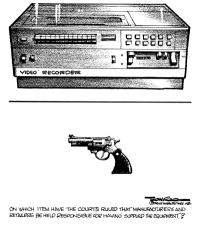
Should we outlaw the gun or the VCR?
A Paul Conrad cartoon from 1981 suggests we haven't progressed too far in the past 24 years (the caption reads "On which item have the courts ruled that manufacturers and retailers be held responsible for having supplied the equipment?"):

ScienTOMogy spoof site gets nastygram
A website, hosted in New Zealand, which ridicules Tom Cruise and his connections with Scientology has attracted the attention of institution's lawyers. Thanks to IPKat for the link.
History on a digital loop
John is on good form on the battle of the super-DVD formats and how it reflects the Betamax v VHS story of the late 1970s.
Durant drops landmark data protection case
From Out-law,
"Michael Durant, who lost a landmark Court of Appeal ruling on the meaning of "personal data" two years ago, has withdrawn his petition to the House of Lords. This means the House of Lords will no longer review the Court of Appeal's narrow interpretation of the definition.
The focus of attention now turns to the European Commission which has used the Durant decision as evidence that the UK's Data Protection Act of 1998 is a defective implementation of the Data Protection Directive of 1995."
ID Cards to unlease bullies
Carol Sarler, writing in the Sunday Observer, sees the latest anti terrorism proposals and the ID card scheme as a boon for bureaucratic bullies.
"The act, like the suss laws before it and the ID cards to come, are all toys in the playbox of wannabe bullies and nothing that I have seen, either here or anywhere else, suggests that such people will ever learn to play nicely. Shortly after the fall of Ceausescu, I had Romanian friends to stay. En route to the theatre, one of them began to weep; they wouldn't let her in. She had left her passport at home. Passport? For the doorman at Cats? It can happen. That's all I'm saying.
In a land of ID cards I would be very afraid for my personal liberty. But only because Sod's law says if I were to be confronted one time too many by an officious twat, I'd be the one banged up. For slapping him."
A classic example of how clueless top down regulation can facilitate societal poisoning from the bottom up.
US drug group fund drug import scare novel
Apparently the Pharmaceutical Research and Manufacturers of America (PhRMA), a powerful lobbying group in the US, through a "rogue employee" funded the development of a novel, where the story involved terrorists poisoning cheap drug imports from Canada. Or so says the Globe and Mail, a Canadian newspaper. Hardly a major conspiracy but you could see how the PR would work.
£30 ID card guarantee not all it seems
It looks like the £30 price touted by the government for our forthcoming ID cards is not the water tight promise it has been sold as, according to John Lettice.
" If Charles Clarke is announcing that ID cards are only going to cost £30, then the ID Cards Bill must be due back in Parliament any day now (yup, Tuesday), and Labour Party MPs must be looking for some threadbare justification for continuing to support it. And if that's not quite enough ('Isn't £30 pretty much what they said last time we bravely gave in?') then Clarke also has a report demonstrating "strong public support for the scheme" and an "independent analysis" from KPMG backing him up on the scheme costs.
We now propose to demonstrate how Clarke, who announced the £30, the report and the KPMG analysis in a written answer to a parliamentary question on 13th October, was to all intents and purposes misleading the House. We should however note that he was not lying as such - he was merely giving his target audience on the Labour benches the tools to believe what they desperately want to believe..."
Read two biometrics get worse results
John Lettice at the Register has been going over some of John Daugman's calculations about the effects of combining multiple biometrics to authenticate an individual. The results are actually quite straightforward when you stop to think about it, though not necessarily intuitive.
"On the one hand, a combination of different tests should improve performance, because more information is better than less information. But on the other, the combination of a strong test with a weak test to an extent averages the result, so the result should be less reliable than if one were relying solely on the strong test...
If the two biometric tests differ significantly in their power, and each operates at its own cross-over point, then combining them gives significantly worse performance than relying solely on the stronger biometric...
Daugman produces the calculations governing the use of two hypothetical biometrics, one with both false accept and false reject rates of one in 100, and the second with the two rates at one in 1,000. On its own, biometric one would produce 2,000 errors in 100,000 tests, while biometric two would produce 200. You can treat the use of two biometrics in one of two ways - the subject must be required to pass both (the 'AND' rule) or the subject need only pass one (the 'OR' rule). Daugman finds that under either rule there would be 1,100 errors, i.e. 5.5 times more errors than if the stronger test were used alone.
He concludes that a stronger biometric is therefore better used alone than in combination, but only when both are operating at their crossover points...
Which suggests to us that simply regarding a second or third biometric as a fall back to be used only if earlier tests fail constructs a scenario where the combined results will be worse than use of the single stronger test..."
Mitchigan University President on Google Print
Mary Sue Coleman, president of the University of Michigan, sees the Google Print project as "Riches We Must Share..." in the Washington Post.
An author in the WP on the same day had a different perspective. The author, Nick Taylor, is president of the Authors Guild, the representative body which has sued Google for copyright infringement.
An author in the WP on the same day had a different perspective. The author, Nick Taylor, is president of the Authors Guild, the representative body which has sued Google for copyright infringement.
Friday, October 21, 2005
Does Google Print violate copyright
Peter Suber has taken a detailed look at the Google Print issues and whether the company is infringing on copyright.
"First we have to get clear on two terms. "Google Publisher" is the name of the project to scan books that publishers voluntarily offer Google to scan. "Google Library" is the name of the project to scan books in certain libraries, with the consent of the libraries but not necessarily the consent of the publishers. Both are parts of the larger "Google Print" project, which is to scan full-text print materials for adding to the Google search index. For publishers, Google Publisher is opt-in, while Google Library is opt-out. Google Library covers books under copyright as well as books in the public domain. The Authors Guild lawsuit is about the copyrighted portion of Google Library...
I've seen a plausible case for copyright infringement by Google Library --which, by the way, is opposed by a plausible case against copyright infringement (more below). But I haven't yet seen a plausible case that the authors or publishers will be injured by Google Library. On the contrary, publishing groups who address this, like the ALPSP, tend to concede that the program will benefit them but insist that the rules be followed anyway. The AG press release doesn't mention harm or injury. Deep within the complaint that it filed in court, however, it alleges the members of the class-action suit have suffered "depreciation in the value and ability to license and sell their Works [and] lost profits and/or opportunities" (p. 10). The complaint seeks to collect damages for these losses.
If the AG mentions losses merely as a formality --which is how it looks-- and covertly concedes that Google Library will increase book sales, then the suit might still make sense. But instead of trying to stop a continuing injury, the AG would be trying to extract a settlement. It may want a cut of Google's ad revenue on top of increased sales. If so, then (as I said last month) we're watching a shakedown...
If the case goes to trial, some of these arguments are likely to be more central than others. If I had to boil down this summary to the most essential elements, I'd put it this way. The authors --and the publishers who share the same grievance-- are getting far too much mileage from the claim that Google's opt-out policy turns the usual copyright rule on its head. This claim has a deceptive strength. It's strong because it would be valid for most full-text copying. It's deceptive because it assumes without proof that the Google copying is not fair use. Hence it begs the question at the heart of the lawsuit. If the Google copying is fair use, then no prior permission is needed and the opt-out policy is justified. Moreover, Google has several good arguments that its copying really is fair use, most notably its argument that its indexing will enhance rather than diminish book sales and its analogy to long-accepted opt-out policies for search-engine indexing of other copyrighted content.
On the merits, it's an important question to settle. But I admit that I'm not very comfortable having any important copyright question settled in today's legal climate of piracy hysteria and maximalist protection --a new world order getting old fast."
WSJ v DRM
Walter S. Mossberg at the Wall Street Journal is not overly enamoured with the use of DRM.
"For some activists, the very idea of Digital Rights Management is anathema. They believe that once a consumer legally buys a song or a video clip, the companies that sold them have no right to limit how the consumer uses them, any more than a car company should be able to limit what you can do with a car you've bought.
But DRM is seen as a lifesaver by the music, television and movie industries. The companies believe they need DRM technology to block the possibility that a song or video can be copied in large quantities and distributed over the Internet, thus robbing them of legitimate sales.
In my view, both sides have a point, but the real issue isn't DRM itself -- it's the manner in which DRM is used by copyright holders. Companies have a right to protect their property, and DRM is one means to do so. But treating all consumers as potential criminals by using DRM to overly limit their activities is just plain wrong."
Update: Ed Felten has a useful follow up to Mossberg's column.
Blackboard and WebCT to merge
The two biggest electronic learning platform vendors for higher education have agreed on a merger/takeover deal. Blackboard are to acquire WebCT by early 2006 in a deal that will give the new company about two thirds of the world market in learning management system (LMS) or virtual learning environments (VLEs), as we have come to call them in the university sector.
This gives me some concern, not because my own university uses either of these platforms (we don't yet), but because Blackboard have demonstrated a will to censor inconvenient research. In the Spring of 2003 they rolled out the lawyers to prevent two students presenting a research paper on security flaws in the Blackboard campus ID card system.
The two, Billy Hoffman of the Georgia Institute of Technology and Virgil Griffith of the University of Alabama had decided to publish a paper on the problem at a security conference in Georgia but Blackboard’s lawyers stepped in and got a court to issue an injunction preventing the disclosure of the details of the problem.
The students eventually reached an out of court settlement with Blackboard apologising to the company for their actions and agreeing to "refrain from any further unauthorized access to or use of the System," including "any transaction designed to better understand or determine how the System works." They also agreed to do 40 hours community service.
Now Blackboard got their injunction preventing these students from presenting their research, so they had an arguable legal case. However, the builders of one of the widest deployed platforms for the creation and delivery of higher education digital content were prepared to go to court to block the publication of inconvenient research and extract a settlement whereby a couple of techie students agreed to refrain from “any transaction designed to better understand or determine how the System works."
Blackboard is a business and has a duty to protect the interests of the company’s shareholders. These interests, however, may not necessarily coincide with those of their education institution customers.
So, universities should think carefully before locking themselves into propriety VLEs. The corollary of that is that the architecture of higher education VLEs should be:
• based on open standards
• modular
• flexible
• expansible
• interoperable with other systems
If a small number of players with closed systems come to dominate the HE market for VLEs in the long term we could face restrictions on information development and distribution which we take for granted today. Restrictions built into the architecture of the systems we use, backed up by force of law.
Latest EDRI-gram
The latest EDRi-gram has been published with, as usual, many notable stories. The one that caught my eye was the European Ombudsman Mr Diamandouros' call for EU Councils of Ministers to legislate in a more transparent manner.
He basically said the Council have failed to provide valid reasons for meeting behind closed doors and recommended:
"The Council of the European Union should review its refusal to decide to meet publicly whenever it is acting in its legislative capacity."
He basically said the Council have failed to provide valid reasons for meeting behind closed doors and recommended:
"The Council of the European Union should review its refusal to decide to meet publicly whenever it is acting in its legislative capacity."
Lessig on drm, cc and interoperability
Larry Lessig's latest newsletter is on drm and interoperability.
"Interoperability. Perhaps the most important thing that the Internet has given us is a platform upon which experience is interoperable. At first, the aim of the computer and network geniuses was simply to find a way to make computers talk to each other. Then application geniuses found ways to make the content that runs on these different devices interoperate on a single digital platform. We are close to a world where any format of sound can be mixed with any format of video, and then supplemented with any format of text or images. There are exceptions; there are some who don't play in this interoperability game. But the push of the network has been to produce a world where anyone can clip and combine just about anything to make something new...
The Internet was not built with permissions in mind. Free access was the rule.
That free access creates many problems for many – indeed in principle, it might create problems for us all. Record and film companies are notorious for complaining about this Internet feature. Given its original design, you could "share" your complete record and film collection with your 100,000 "best friends." It's not surprising that they view this feature rather as a bug. But I suggest any of us might regret this feature of the net in certain circumstances. Do you really like it that someone can take a personal email you sent him and forward it to his 100 best friends?
The point is that however good free access is, sometimes, at least some think its not very good, at least for them. And the most powerful of these some have therefore pushed for technologies that would be layered onto the Internet and enable them, or content owners generally, to control how digital content gets used."
Adelphi Charter
John had a nice piece on the RSA Adelphi Charter on his blog last week.
Since then Google have been sued again over their Google Print project which aims to make all the worlds's books searchable online. ZDNet had a report earlier in the week suggesting the American Association of Publishers were behind the lawsuit. The names on the actual complaint, though, are those of some of the major publishers, McGraw-Hill, Pearson, Penguin Group, Simon & Schuster, and John Wiley & Sons.
The AAP president, Patricia Schroeder, said
"The publishing industry is united behind this lawsuit against Google and united in the fight to defend their rights. While authors and publishers know how useful Google's search engine can be and think the Print Library could be an excellent resource, the bottom line is that under its current plan, Google is seeking to make millions of dollars by freeloading on the talent and property of authors and publishers."
Which in translation reads - publishers want a bigger slice of the earnings.
Google spokesman, David Drummond said
"Google Print is a historic effort to make millions of books easier for people to find and buy. Creating an easy-to-use index of books is fair use under copyright law and supports the purpose of copyright: to increase the awareness and sales of books directly benefiting copyright holders. This short-sighted attempt to block Google Print works counter to the interests of not just the world's readers, but also the world's authors and publishers."
Which in translation reads - don't be stupid, we're doing you a favour sending loads more customers your way with no effort on your part; and you want to cash in on our business too?!
Wednesday, October 19, 2005
Google Print moves on Europe
From the NYT, "Google said Monday that it had begun operating local-language sites in eight European countries for its Google Print program, its closely watched effort to make all of the world's books searchable online, expanding into territories where it has drawn fierce criticism."
Tuesday, October 18, 2005
Universities and the new terrorism act
I accidentally happened across an interesting discussion on this afternoon's BBC Radio 4's "The Learning Curve", where Libby Purves interviewed Dr Steve Wharton, President of the Association of University Teachers and Professor Les Ebdon, Vice Chancellor of Luton University, who is updating guidance on terror and intolerance for Universities UK. (The relevant interview starts about 16 minutes into the programme).
Both Wharton and Ebdon raised serious and legitimate concerns about the potential impact of the "glorifying terrorism" provisions of the new anti-terrorism bill, Education Secretary Ruth Kelly's recent call for academics to play an active part in "cracking down on campus extremists" and the government's use of a report (the Gleeson report) published by a think tank known as the Social Affairs Unit, which if it is to be believed, Purves says, "paints a disturbing picture" of extremism in universities.
Wharton runs courses in political discourse and persuasion propaganda and could theoretically be directly targetted by law enforcement authorities if the bill were to become law in its present form. He expects his students to engage with difficult subjects and to acquire the tools to critically analyse propaganda and had been planning to introduce a course specifically on the discourse of terrorism.
Ebdon dismissed, as "widely discredited," the Gleeson report which claims UK universities are riddled with terrorists. He was particularly keen to point out that claims in the report about the so called "4th bomber" being associated with Luton were based purely on a story in the Daily Mail that the paper had withdrawn and apologised for.
Wharton also rejected Ruth Kelly's call for vigilance amongst academics in the cause of anti-terrorism as an effort at turning academics into "a kind of 21st century stasi by the back door." The notion that academics should be "obliged to hunt out people in the classroom" was ridiculous.
I doubt the interview will get much exposure but at least it gets it's 15 minutes here on b2f. :-)
Microsoft CTO condemns UK ID card plan
Microsoft's UK technology chief, Jerry Fishenden, has condemned the UK government's ID card plans.
"Mr Fishenden, national technology officer for the computing giant, said it could lead to "massive identity fraud".
"Putting a comprehensive set of personal data in one place produces a honeypot effect - a highly attractive and richly rewarding target for criminals," he told The Scotsman.
The system was "something that no technologist would ever recommend", he said."
Good for him.
Monday, October 17, 2005
Adviser to Canadian Prime Minister on Open Access
Arthur Carty, national science adviser to the Canadian Prime Minister has called for a culture of sharing to facilitate a global information system.
"With the world looking to science to find solutions to global problems, the need to safeguard, evaluate and exchange information and knowledge has never been more pressing...
Above all, our goal must be to maximize the impact of research for societies everywhere, not just the developed world. People in developing nations must be able to access and contribute to the vitality of the global research information and communications system. An open-access philosophy is critical to the system’s success: if research findings and knowledge are to be built upon and used by other scientists, then this knowledge must be widely available on the web, not just stored in published journals that are often expensive and not universally available...
Creating a system with these attributes is no longer just a question of developing appropriate technologies; for the most part these already exist. Rather, it’s a matter of building, integrating and improving the technical infrastructure, operational standards, research support systems, regulations and institutional roles and responsibilities. It’s also a matter of nurturing a culture of open access and sharing, beyond what researchers have ever embraced...
a culture of open access and sharing. This is harder to build than the nuts and bolts of the system because it requires a new mindset among researchers, administrators, governments and in some cases companies – everyone involved in the creation and dissemination of knowledge.
This past year has seen a major change in the way two important funders of health research do business. The National Institutes of Health in the United States and the Wellcome Trust in the United Kingdom both announced that all research that they fund must be archived in a free repository that’s accessible by other scientists and the public.
However, filling archives, though necessary, will not be able to change the mindset of people in the research enterprise. We have to find ways to motivate researchers in all countries to preserve and exchange their research data, to publish their findings in open access journals and to deposit their published articles in institutional repositories... Institutions, too, need to know that their investments in expanding and improving the quality of their data archives and open-access repositories are recognized as measurable scientific outputs."
This latter point - what's in it for us - is one that many institutions, even my own University which exists purely to facilitate supported open access to higher education, are stuggling with when they consider creating their own repositories. The good news on the Open University front is that we are looking at getting our own open access project underway in 2006.
Crypto-gram, October 15, 2005
Bruce Schneier's latest Crypto-Gram Newsletter has been published. Extract:
"DUI Cases Thrown Out Due to Closed-Source Breathalyzer
According to the article: "Hundreds of cases involving breath-alcohol tests have been thrown out by Seminole County judges in the past five months because the test's manufacturer will not disclose how the machines work."
This is the right decision. Throughout history, the government has had to make the choice: prosecute, or keep your investigative methods secret. They couldn't have both. If they wanted to keep their methods secret, they had to give up on prosecution.
People have the right to confront their accuser. People have a right to examine the evidence against them, and to contest the validity of that evidence. As more and more evidence is collected by software, this means open-source equipment.
We are all safer because of this decision. (And its implications are huge. Think of voting systems, for one.)
<http://tampatrib.com/floridametronews/MGBUBJ5QK9E.html> "
and from one of his recent essays:
"The effects of wholesale surveillance on privacy and civil liberties is profound; but unfortunately, the debate often gets mischaracterized as a question about how much privacy we need to give up in order to be secure. This is wrong. It's obvious that we are all safer when the police can use all techniques at their disposal. What we need are corresponding mechanisms to prevent abuse, and that don't place an unreasonable burden on the innocent."
Expensive, pointless, dangerous - ID cards
AC Grayling, author of In Freedom’s Name: the Case Against Identity Cards, (published by Liberty) has an article in the Times this morning spelling out some of the problems with ID cards. Extract:
"Forged cards might not fool forensic experts, but in most cases they will not be recognised by bank clerks and shop assistants, so their effect on fraud will be minor.
ID cards might help to catch illegal immigrants if it becomes necessary to produce a card in order to get, say, hospital treatment (an idea strongly opposed by the BMA), but they will not deter illegals from anything other than seeking services for which a card is needed. To put the entire population to the necessity of paying for an ID card in order to catch a small number of illegal immigrants is like killing flies with bombs."
If you think Mr Grayling is just one of those extremists from the "civil rights industry," as I heard it described on the radio over the weekend, how about this:
"Instead of wasting hundreds of millions of pounds on compulsory ID cards as the Tory Right demand, let that money provide thousands more police officers on the beat in our local communities."
Another civil rights industrialist? No. That was Tony Blair speaking to a Labour party conference, ten years ago, beofre he became prime minister.
For me it simply makes no sense to spend billions of pounds of public money on technology which will not work.
ID card scanning system riddled with errors
The Independent on Sunday have discovered something that has been widely known for some time - that ID card scanning systems based on biometric technology are flawed.
"The Government is planning to use face, iris and fingerprint scans to identify people on ID cards. But studies have found that being scanned in the wrong type of light or in shadow could lead to an inaccurate ID, because biometric technology is flawed.
Internal reports for the Government warned that manual labourers whose fingertips are worn or nicked, could find their fingerprints are not recognised. Men who go bald risk being identified as someone else, experts say. Pianists, guitarists and typists - whose fingerprints can be worn down - could also face inaccurate readings.
Government trials have found that the biometrics of black, elderly and disabled people have a higher chance of being incorrectly matched against their true ID. People with eye problems also have a relatively high chance of inaccurate identification."
Which is why CTO, Ian Watmore, has been quietly working behind the scenes to ensure most ID card authentication checks won't be based on scanning biomentrics but on a pin number. Ministers, however, are not really interested in minor details like that though, so expect all the usual overblown rhetoric in the debates this week.
Friday, October 14, 2005
Adelphi Charter
I attended the launch of the RSA's intellectual property charter yesterday evening. Written by an international commission consisting of a hugely distinguished group of artists, scientists, lawyers, politicians, economists, librarians, academics and business experts, The Adelphi Charter on Creativity, Innovation and Intellectual Property represents an immensely important set of principles for the future of the knowledge economy. Here's a taste:
1. Laws regulating intellectual property must serve as means of achieving creative, social and economic ends and not as ends in themselves.
2. These laws and regulations must serve, and never overturn, the basic human rights to health, education, employment and social life...
and so on to number 9 which basically requires evidence of claimed benefits from people asking for changes in IP laws.
The real challenge comes from attempting to put these principles into practice and I'm reminded of the story of the lost tourist in Connemara who stops to ask one of the locals the way, only to be told, "Now if I was going there, I wouldn't start from here."
So it's a difficult road ahead if the charter is to have any real influence. James Boyle has already got his own measure of success for it - when it becomes so "banal and obvious" that anyone who might have an interest would be stunned beyond belief at the notion that it had ever been the subject of serious debate. When it comes to IP, requiring evidence of the claimed benefits before engaging in massive expensive policy changes, is considered controversial. This in itself is rather a sad reflection on our modern policy making processes in the area.
John Howkins, veteran of many policy fora, and chairman of the Adelphi Charter Commission said last night that he has never been subject to such personal vitriol as he has over this charter, almost exlusively based on a misunderstanding or mischaracterisation of what the commission are trying to do. This was evidenced in the RSA lecture theatre by an authors' representative saying that the charter was worthless because it made no reference to an author's right to be paid for their work. Yet the charter explicitly includes the language: "Creativity and investment should be recognised and rewarded."
My systems colleagues at the Open University would suggest that this represents a thinking trap. but when it comes to people's personal beliefs and values it's quite a tough one to break through.
In any case, here's to the rapid descent of the Adephi Charter into universally accepted banality!
Thursday, October 13, 2005
How cc
Larry Lessig's second newsletter on Creative Commons explains how the importance of copyright saw a paradigm shift with the advent of digital technologies. An obscure law, with very little significance for most people, now directly affects anyone with a PC connected to the Net. Lary writes:
"there has always been proprietary culture — meaning work protected by an exclusive right. And in my view at least, that's not a bad thing either. Artists need to eat. Authors, too. A system to secure rewards to the creative community is essential to inspiring at least some creative work.
But for most of our history, the burdens imposed by copyright on
other creators, and upon the culture generally, were slight. And
there was a great deal of creative work that could happen free of the
regulation of the law. Copyright was important to cultural
development, but marginal. It regulated certain activities
significantly, but left most of us free of copyright's control.
All that began to change with the birth of digital technologies, and
for a reason that no one ever fully thought through.
If copyright regulates "copies," then while a tiny portion of the
uses of culture off the net involves making "copies," every use of
culture on the net begins by making a copy. In the physical world, if
you read a book, that's an act unregulated by the law of copyright,
because in the physical world, reading a book doesn't make a copy. On
the Internet, the same act triggers the law of copyright, because to
read a book in a digital world is always to make a "copy." Thus, as
the world moves online, many of the freedoms (in the sense of life
left unregulated by the law of copyright) disappear. Every use of
copyrighted content at least presumptively triggers a requirement of
permission. The failure to secure permission places a cloud of
uncertainty over the legality of the use...
Now many don't care about clouds of uncertainty. Many just do what
they want, and ignore the consequences (and not just on the Net). But
there are some, and especially some important institutions like
schools, universities, governments, and corporations that rightly
hesitate in the face of that uncertainty. Some, like an increasing
number of universities, would require express permission to use
material found on the Internet in classrooms. Some, like an
increasing number of corporations, would expressly ban employees from
using material they find on the web in presentations. Thus just at
the moment that Internet technologies explode the opportunities for
collaborative creativity and the sharing of knowledge, uncertainty
over permissions interferes with that collaboration."
Wednesday, October 12, 2005
Do we want perfect law enforcement
Daniel Solove has been wondering if we really want perfect law enforcement?
"I believe that people have ambivalent views toward many laws, such as speeding laws. They generally support the laws, but they often violate them. For example, would society really want perfect enforcement of the drug laws? Imagine if everybody who did drugs at one point in their lives were caught. This could nab quite a lot of people, including many corporate CEOs, politicians, and probably every celebrity.
What about perfect enforcement of underage drinking laws? Probably the majority of the population has at one time during their childhood engaged in underage drinking. And quite a lot of adults have furnished alcohol to a minor at one point in time.
So perhaps we don’t want to enforce these laws perfectly. Yet, doesn’t imperfect enforcement unfairly penalize the unlucky few who get caught? Indeed, prior drug use can disqualify people for certain jobs, such as the FBI (which is considering rethinking some of its policies). Underage drinking violations can appear on a person’s record. Should these stains on people’s records be put there haphazardly? After all, if many people are guilty of these things, why should only the unlucky few who get caught be punished?"
A real remedy for phishing
Bruce Schneier has an excellent article in Wired about phishing.
"The actual problem to be solved is that of fraudulent transactions. Financial institutions make it too easy for a criminal to commit fraudulent transactions, and too difficult for the victims to clear their names. The institutions make a lot of money because it's easy to make a transaction, open an account, get a credit card and so on. For years I've written about how economic considerations affect security problems. They can put security countermeasures in place to prevent fraud, detect it quickly and allow victims to clear themselves. But all of that's expensive. And it's not worth it to them...
In economics, this is known as an externality: It's an effect of a business decision that is not borne by the person or organization making the decision. Financial institutions have no incentive to reduce those costs of identity theft because they don't bear them.
Push the responsibility -- all of it -- for identity theft onto the financial institutions, and phishing will go away... It will go away because the information a criminal can get from a phishing attack won't be enough for him to commit fraud -- because the companies won't stand for all those losses.
If there's one general precept of security policy that is universally true, it is that security works best when the entity that is in the best position to mitigate the risk is responsible for that risk. Making financial institutions responsible for losses due to phishing and identity theft is the only way to deal with the problem. And not just the direct financial losses -- they need to make it less painful to resolve identity theft issues, enabling people to truly clear their names and credit histories. Money to reimburse losses is cheap compared with the expense of redesigning their systems, but anything less won't work."
Joi Ito's iTunes Mess
Joi Ito has been having grief with his iTunes purchases. More good publicity for drm.
"I had set Mizuka up with iTunes music store on a Mac Mini with an external drive. At some point, she had filled up most of the external drive with stuff and she alleges that iTunes told her it was going to start moving stuff to another drive. Then certain songs stopped playing. I sort of ignored her mumbling until I asked her to run disk doctor on the drive. The utility told us that her disk was irreparably broken. The songs are broken on her iPod too. (The bad songs skip.) Apple says back up, or when you disk dies you out of luck.
Is there nothing we can do? I'm about to copy all of the music onto a new drive, erase any files that don't play and call it a day. Does anyone have any advice or a better idea?
UPDATE: Kevin Marks recommended Disk Warrior, which seems to have fixed the drive, but now many of the files are 0 bytes long. I guess we just lost a lot of music. Hmm..."
The home printing racket
John's been ruminating about the home printing racket, after reading a piece in the New York Times.
"It does not take an advanced business degree for those consumers to see how printer manufacturers like Hewlett-Packard and Canon make their money. They use the "razor blade" business model. It is named from the marketing innovation of King C. Gillette, who in the early years of the last century sold razors for a low price but made all his money on the high-margin disposable razor blades. Printer manufacturers also use this tied-product strategy.
Printers return relatively low profit margins. But the ink, ounce for ounce, is four times the cost of Krug Clos du Mesnil Champagne, which sells for around $425 a bottle. Ink is about the same price as Joy perfume, considered to be one of the more pricey fragrances, at $158 for a 2.5-ounce bottle."
Fergusson refused a trademark on his name
Alex Fergusson has been refused a trademark on his name, according to IPKat.
Business support for ID cards collapses
According to Life Style Extra, business support for compulsory biometric ID cards has collapsed.
Defending Google's licence to print
Bill Thompson at the BBC thinks Google Print is a great idea and is not impressed at the Authors Guild lawsuit to impede the project.
Fingerprint payments taking off
Robert Lemos at Security Focus reports that fingerprint payments are taking off in spite of the security problems associated with the approach.
Tuesday, October 11, 2005
Dear Recording Industry...
At Brainwash Tim Lee has written an open letter to the recording industry:
"Dear Recording Industry,
You're being had.
Online music sales have soared, from $220 million in the first half of last year, to $790 million in the first half of this year. Millions of consumers are discovering the convenience of buying music online. There's just one problem: if you don't change your strategy, you're going to give the store away to Apple CEO Steve Jobs. His iTunes Music Store is the industry leader, and thanks to digital rights management (DRM) technology, every customer who buys your products from the iTunes Music Store becomes locked into Apple products. If that's not changed, that will soon make Steve Jobs the most powerful man in your industry.
Fortunately, there's an easy solution: when you renew your contract, you should demand that Apple remove the digital rights management (DRM) technology from the iTunes Music Store.
Yes, you read that right: you need to stop letting Apple use DRM technology with your songs. I know that DRM was originally developed at your request, but I hope to persuade you that that was a strategic blunder. If you don't correct it, you run the risk of making Apple's shareholders very wealthy at your expense..."
Read on. He makes a lot of sense.
GlaxoSmithKline pay $150 Million in false-Claims case
From Findlaw, GlaxoSmithKline Settles False-Claims Suit for $150 Million:
"Pharmaceutical powerhouse GlaxoSmithKline will pay $150 million to settle a whistle-blower action accusing the company of inflating cancer-drug prices and defrauding the federal Medicare, Medicaid and Tricare programs, according to the U.S. Department of Justice.
The settlement agreement reports that Philadelphia-based GSK denied the allegations but agreed to pay the money and change its drug marketing practices to avoid the expense and inconvenience of litigation."
Monday, October 10, 2005
Judge convicts hacker with "considerable regret"
A security consultant has been convicted under Section 1 of the UK Computer Misuse Act, of unauthorised access to the Disaster Emergency Committee's tsunami fundraising web site. Yet it was agreed by all sides that he had not done anything malicious. However, the law effectively applies a strict liability test and unauthorised access is a crime regardless of the motive of the perpetrator. As the judge said, "unauthorized access, however praiseworthy the motives, is an offense."
Peter Sommer of the London School of Economics reckons the police should have just given him a slap on the wrists. Even the judge said he was convicting "with some considerable regret."
The defendant, Daniel Cuthbert, has lost his job and is having difficulty finding another. Apparently he lied to the police when first arrested, which could have been the reason they decided to prosecute, even when the full circumstances of Cuthbert's actions came to light. The folks working in high tech crime units are over-worked and under-resourced. And I wonder to what the degree the politics of the need for successful convictions drove this case but on balance I agree with Peter Sommer. The prosecution of someone with no malicious intent, who has done no damage, though he has admittedly wasted scarce specialist police ressources, was not in the public interest.
Thanks to Seth Finkelstein for the link.
EU & Canada airline passenger data deal
I missed this last week:
"The EU has signed a deal with Canada that will allow European airlines to provide Canadian authorities with details of who is scheduled to fly on planes headed for the country."
Thanks to Steve Hedley for the link.
"The EU has signed a deal with Canada that will allow European airlines to provide Canadian authorities with details of who is scheduled to fly on planes headed for the country."
Thanks to Steve Hedley for the link.
Friday, October 07, 2005
Larry's letter
Larry Lessig will be writing a weekly newsletter about creative commons between now and Christmas. You can read his first one online, naturally.
Thursday, October 06, 2005
Analysis of the Sony v Stevens mod chip decision
Kim Weatherall has an insightful analysis of the Sony v Stevens Australian High Court decision I mentioned earlier.
"Even though the law considered by the High Court will all change, the judgments get at something which is fundamental, but which it is easy to forget. And that is this:
that the technical measures used by Sony are not, in essence, about preventing infringement of copyright.
Infringement happens regardless of whether measures like Sony's are used. While anti-circumvention laws are sold as being about 'preventing piracy', the fact remains: the Sony measures do not prevent infringement, no matter which way you turn it. That's why, in the end, the court has decided the way it did.
In reality, measures like those used by Sony are about controlling use of and access to Sony PlayStation consoles. Sony controls all kinds of things about the way people use Sony consoles. For example: they control whether people can:
play legitimately purchased games sold in overseas markets;
play games created by someone other than Sony on the Sony console (something that cannot be done on a non-chipped console owing to the absence of an access code).
So while Sony can argue that it wanted to prevent piracy (it clearly did), and that the measures acted in part to deter piracy (they clearly could), Sony's own approach to the measures muddies the waters. It doesn't just act to prevent infringement, and that point is taken notice of by the Court here. One can't help but suspect the legal reasoning would look different, in this case, if Sony only used its power over the console to actually prevent use of 'pirated' disks. The way Sony goes about its business quite apparently takes its measures outside the heart of what is covered by the legislation: and justifies the High Court's approach."
Declaration of InDRMpendence
David Berland at ZDNet has issued his own declaration of inDRMpendence.
"Earlier today, after describing to a close friend the rock and the hard place that I'm between since I can't easily play the 99 cent songs I buy through Apple's iTunes music store on my $20,000 whole home entertainment setup, he said "Dave… check out Sonos' solution. It'll solve your problem for about $500 per room."
Not that I have another $500 per room to spend, but I checked into it and the solution is indeed very cool. The units that you put into each room wirelessly form a self-organized mesh and just one of them needs access to your music library on a computer or network attached storage (NAS) device. Unfortunately, if I buy Sonos' gear, it appears as though I'll run in the same problem that I'm already having. According to a technical specifications page on Sonos Web site, "DRM-encrypted and Apple or WMA Lossless formats not currently supported." In other words, songs purchased through iTunes that are wrapped in Apple's FairPlay digital rights management (DRM) envelope won't work. Neither will songs you buy from stores based on Microsoft's DRM technology found in content purchased through PlaysForSure-logoed merchants (eg: Napster-to-Go). While I hate to be the breaker of bad news, I sent him an e-mail explaining the situation.
But now that DRM is coming up on my radar every day, and the more I read about it (on the Web, in our TalkBacks, and in my e-mail), the angrier I get. To vent, I've decided to start regularly ranting about DRM. "
It's a very readable rant if you're concerned about drm.
Mum targets RIAA with every available law
The Recording Industry v the People blog has more details on a woman who got targetted by the RIAA for copyright infringement.
"ATLANTIC V. ANDERSEN
This is the case peer-to-peer file sharers have been waiting for. Tanya Andersen, a 41 year old disabled single mother living in Oregon, has countersued the RIAA for Oregon RICO violations, fraud, invasion of privacy, abuse of process, electronic trespass, violation of the Computer Fraud and Abuse Act, negligent misrepresentation, the tort of "outrage", and deceptive business practices."
Are books good for you
Michael Madison thinks it is a "great time to be a copyright lawyer" and that we should think carefully about the massive digital archives of printed works that Google (Authors Guild lawsuit notwithstanding) and Yahoo and others are creating.
"If we care about books as such, and if we care about libraries as repositories for books, then we should think carefully about how to manage Google’s and Yahoo’s proposed transition from atoms to bits."
"If we care about books as such, and if we care about libraries as repositories for books, then we should think carefully about how to manage Google’s and Yahoo’s proposed transition from atoms to bits."
Uk copyright term extension debate
Larry Lessig has been back in the UK for another debate on copyright term. Suw Charman was making notes.
"RSA, IPPR, PCMLP Lecture
Prof. Lawrence Lessig, Creative Commons
John McVay, CEO of PACT (representing film and TV producers)
Adam Singer, CEO of MCPS and the PRS (musicians' royalty collecting societies)
Moderated by John Howkins, RSA
My preamble
I really enjoyed this debate, although I was a little surprised to see quite a lot of agreement between the panellists. Not sure how much of this was just out of a desire on the part of John McVay and Adam Singer not to get into a fierce debate in public, and how much was genuine agreement with the points that Larry Lessig was making. But I was pleased to see Adam and John take the stage with Larry - Adam joked a couple of times about how he'd get fired for publicly agreeing with Larry, and I there were definitely undercurrents that some of his constituents would likely not be happy with this event even taking place, so all credit to him for resisting pressure and helping make this debate happen.
It would be easy to paint the industry as the antichrist, and in fact I have heard Adam described as just that (ironic, then, that he joked about how some people in the industry see Larry as the antichrist). But picking an extreme standpoint and sticking to it is not always the best way to progress towards a reasonable compromise and it was encouraging to see Adam acknowledging some of Larry's points as valid and to see Larry suggesting potential middle paths.
I do have to disagree with Larry on one point, though. I don't think copyright term extension in the UK/Europe is inevitable. Maybe I'm just being optimistic, but software patents were defeated, and I think that we can defeat term extension too. But we need to start debating this in public now, not wait until it gets to a crucial juncture in parliament.
So, now, on to the notes from the evening..." here.
Aussie High Court rule in Playstation2 mod chip case
The High Court of Australia (the highest court in the land) has made its ruling in Stevens v Kabushiki Kaisha Sony Computer Entertainment. From the press release:
"The High Court of Australia today allowed an appeal against a finding that Mr Stevens’s modifications to Sony PlayStation consoles to allow unauthorised copies of games to be played were illegal."
This is the first time a country's highest court has ruled in a so called "mod-chip" case, to deal with "technological protection measures" (a form of digital rights management). At least two men have been jailed in the US for installing mod chips on gameboxes such as Sony's Playstation2 or Microsoft's Xbox.
At issue was Steven's installation of mod chips in Sony Playstation2s, which allowed users to play Playstation2 games legitimately bought in the US, for example (or other noncompatible geographic zone). Sony's Playstations, like most DVD players, have digital locks which prevent the device playing games sourced from a different geographic zone from which the machine itself was bought. The digital lock system allows the PlayStation2 to search CDs or DVDs for embedded codes identifying them as authorised games which the console will play. If it can't find the codes, it will not play the CD or DVD.
As in the US and the EU it is illegal in Australia to bypass copyright protection technologies and it seems the case turned on the specific definition of "technological protection measures." The court decided that Sony's digital locks did not qualify as "technological protection measures" because they didn't inhibit copyright infringement.
By contrast, Sony efforts to shut down similar mod chipping operations in the UK have proved successful, most notably in the Sony v Owen case which is very similar to the Stevens case in Australia.
Thanks to Pamela Jones for the news. Kim Weatherall will be producing a commentary shortly.
And since my own University will be releasing my internet law course openly soon (again), I'd better update the part that deals with the mod chip cases!
Yahoo challenge Google on books
Katie Hafner, writing in the New York Times, characterises Yahoo's decision to digitise thousands of books as a direct challenge to Google.
"An unusual alliance of corporations, nonprofit groups and universities plans to announce today an ambitious plan to digitize hundreds of thousands of books over the next several years and put them on the Internet, with the full text accessible to anyone.
The effort is being led by Yahoo, which appears to be taking direct aim at a similar project announced by its archrival, Google, whose own program to create searchable digital copies of entire collections at leading research libraries has run into a series of challenges since it was announced nine months ago.
The new project, called the Open Content Alliance, has the wide-ranging goal of digitizing historical works of fiction along with specialized technical papers. In addition to Yahoo, its members include the Internet Archive, the University of California, and the University of Toronto, as well as the National Archive in England and others."
Yahoo, contrary to Google, intend to make their book index searchable via any search engine.
Latest EDRi-gram published
The latest EDRi-gram, as usual, has a load of interesting and important stories.
A Spanish programmer who was facing jail for creating a video game which made fun of a Holy Week procession, amongst other things, has been aquited.
The European Commission has launched a public consultation on its program to digitise the collections of European libraries.
In the past nine months, 50000 people (including 4000 children) have been fined in Holland for not producing ID when requested to do so by police.
Also prominant is a note about FIPR's analysis of the proposal for another intellectual property enforcement directive.
Wednesday, October 05, 2005
Will Google censor books in Google Print
Public Interest Watch seem to think that Google are planning to censor some of the books they scan for the Google Print project. Peter Suber doesn't buy the warning.
" On its web site, PIW describes its mission as "Keeping an eye on the self-appointed guardians of the public interest." OK. But PIW is another self-appointed guardian of the public interest. If I may appoint myself as someone to keep an eye on PIW, then my recommendation is: use less caffeine. The PIW warning is an overreaction. I'm familiar with cases of Google capitulation to the Chinese government and the Church of Scientology and I join PIW in deploring them. But PIW cites no evidence that Google has censored passages from the books in the Library project. Moreover, PIW makes inconsistent recommendations about the risk of book censorship. Libraries can't both (1) withhold their books from Google indexing and (2) demand guarantees of uncensored indexing. PIW also seems unaware that Google's contract with the participating libraries gives the libraries a role in deciding what content Google will index (Par. 2.1) and the right to back out if Google's indexing doesn't live up to the agreed-upon guidelines (Par. 2.4)."
Have to say I'd never heard of "PIW" before. Suber, on the other hand, has a long track record of understanding the open access landscape.
$100 laptop
Susan Crawford is pleased with the MIT Media Lab initiative " to get tens of millions of inexpensive laptops into the hands of children in developing nations around the world."
Criminal software
Can writing software be a crime? So asks Mark Rasch in the Register.
"Can writing software be a crime? A recent indictment in San Diego, California indicates that the answer to that question may be yes. We all know that launching certain types of malicious code - viruses, worms, Trojans, even spyware or sending out spam - may violate the law. But on July 21, 2005 a federal grand jury in the Southern District of California indicted 25 year old Carlos Enrique Perez-Melara for writing, advertising and selling a computer program called "Loverspy," a key logging program designed to allow users to capture keystrokes of any computer onto which it is installed. The indictment raises a host of questions about the criminalization of code, and the rights of privacy for users of the Internet and computers in general."
"Can writing software be a crime? A recent indictment in San Diego, California indicates that the answer to that question may be yes. We all know that launching certain types of malicious code - viruses, worms, Trojans, even spyware or sending out spam - may violate the law. But on July 21, 2005 a federal grand jury in the Southern District of California indicted 25 year old Carlos Enrique Perez-Melara for writing, advertising and selling a computer program called "Loverspy," a key logging program designed to allow users to capture keystrokes of any computer onto which it is installed. The indictment raises a host of questions about the criminalization of code, and the rights of privacy for users of the Internet and computers in general."
Tuesday, October 04, 2005
FIPR response to 2nd IPR Enforcement Proposal
FIPR have produced a considered response to the UK government's consultation on the latest EU proposal for a second intellectual property rights enforcement directive. (The original was passed in the Spring of 2004). I hope Ross Anderson, the chairman of FIPR and author of the response, won't mind me quoting large chunks here:
"The Foundation for Information Policy Research strongly opposes the new enforcement directive.
I will focus on the main issues.
Until now, large-scale copyright or trademark infringement has been a crime here, while patent infringement has been a matter for civil litigation. The new proposal will force the UK to make patent infringement a crime, and to criminalise incitement to infringement.
First, the criminalisation of patent infringement will damage competition, resulting in higher prices for consumers. For example, companies who make generic drugs once the molecule patent has expired are often harrassed by the original patent holder with lawsuits over secondary patents - which have a low probability of success but which are used cynically to delay competition by a year or two...
Second, new business formation and economic growth will also be hit, especially if patent infringement remains a civil matter in America. At present, all technology entrepreneurs take risks with intellectual property. There are so many patents, written so obscurely, that it's impractical to read them all; and many patents don't stand up in court once people dig hard for prior art. So a sensible entrepreneur will just start a business, and if it's successful she will have the money to pay royalties if she has to. Making patent infringement a crime rather than a civil matter will undermine this - especially as it will happen only in Europe, not in the USA. The natural reaction of European entrepreneurs will be to move to America and start their businesses there. (It's particularly interesting to note that while Microsoft is lobbying for IPRED 2 in Brussels, it's lobbying in the USA for less severe civil damages there - see here.)
Third, the criminalisation of aiding and abetting will create pressures for censorship. Phone companies and ISPs will be asked to filter Internet traffic for potentially infringing material...
Fourth, the UK software industry will be particularly vulnerable, as will people who rely on free and open-source software platforms. The Software Directive permits EU companies to reverse engineer their competitors' products in order to produce compatible, competing products. This is a historic compromise, worked out 17 years ago to promote enterprise and competition while still respecting the rights of incumbents. IPRED 2 will undermine it...
A particularly pernicious threat to free and open source software will come from the predatory abuse of IP by its enemies. At present Microsoft is reported to be funding SCO to bring civil cases against firms such as IBM that use GNU / Linux in their products...
Fifth, the disabled could be hit as the tools necessary to read copy-protected books, in order to make lawful `talking' versions of them under fair-use provisions of copyright law, could be criminalised.
Sixth, librarians already have a lot of trouble complying with copyright. For example, in the UK there are about fifty different durations of copyright, depending on whether the material is published and in what media. With electronic publications, there are often contract terms too: a library typically has dozens of contracts, all with different conditions. The current proposals will make this worse by making librarians criminally liable for aiding and abetting, unless they become more active enforcers of copyright law in their libraries. And since copyright infringements are not necessarily black and white, and librarians' employers are risk-averse, libraries will err on the safe side and discourage practices which would not actually be deemed infringements by a court. This will reduce, in practice, the freedoms to copy that UK citizens enjoy in theory.
Seventh, universities will also feel the squeeze. Academics often put preprints of papers on our web sites, which can be a technical infringement if the papers are subsequently published in a journal whose contract restricts it. Also, we suffer increasing harrassment by the record industry over students swapping songs. If university managers can be jailed as accessories for all copyright infringement that is claimed to have a commercial effect, then they will be much more aggressive at policing the content that passes over their networks - which will be profoundly contrary to academic values.
There is a specific concern for people who engage in security research. The Directive does not contain any exemption for research; it may become technically illegal to possess a laser (as it can be used to forge a hologram), or a magnetic-card reader-writer (as it can be used to forge a credit card)...
Finally, there are issues of justice. Previously most companies preferred to sue over copyright infringement rather than to bring criminal charges, because they could get discovery, injunctions and damages (see, for example, Cornish's textbook `Intellectual Property'). By insisting that Member States make such remedies available to the injured parties in criminal cases about intellectual property, the Directive will distort the system of justice itself. The police will be able to demand information from defendants in copyright cases that they are not allowed to demand even in terrorism cases (see `Brown gets tough on France, Italy over trade', Evening Standard, 9 September 2005 p 10). This will lay ministers open to ridicule from both the IP-rights lobby and the law-and-order lobby at the same time. Is that what you want to achieve?
The UK's interests are not at all well served by this directive, and I strongly urge you and your colleagues to use the opportunity of the UK Presidency to kick it into touch."
Becta adopt open source for schools
The UK Government's educational technology agency, Becta, are deploying an open source authentication system across the entire schools sector.
Monday, October 03, 2005
Yahoo's version of Google Print - lawsuit free
Yahoo have launched their own version of the Google Print project,
"Yahoo is working with the Internet Archive, the University of California and others on a project to digitize books in archives around the world and make them searchable through any Web search engine and downloadable for free, the group was set to announce Monday."
"Yahoo is working with the Internet Archive, the University of California and others on a project to digitize books in archives around the world and make them searchable through any Web search engine and downloadable for free, the group was set to announce Monday."
Is privacy law "environmental law" for the information age?
Dennis Hirsch of Capital University Law School asks some intersting questions in his paper, Is Privacy Regulation the Environmental Law of the Information Age?
Ever since James Boyle raised the analogy of the environment in the context of intellectual property and the public domain, I've been thinking it has a resonance across a multitude of policy areas in the information society. Dr Hirsch's paper focuses on the potential for environmental covenants, environmental management systems and emission fees to provide models for privacy regulation but there are, as he recognises, many more.
And in Who's in Charge of Who I Am? Identity and Law Online, Susan Crawford takes an insightful look at our online personas and whether we have enough control over the data associated with them.
"As we enter this new century, identity online seems full of opportunity. Someday virtual world identities will be just as important as real identities - just as ecommerce has become indistinguishable from commerce. Control over online avatar identities will have many real-world consequences, because these clouds of bits may include our credit records, our buddy lists, our job records, personal references and other reputational information, medical histories, certifications, and academic transcripts. As soon as something is valuable and persistent, we seek to associate rights and duties with it. What will be the law of online identity to which those rights apply? And what will those rights be?"
Thanks to Steve Hedley for the links.
Sunday, October 02, 2005
Google CEO has Yahoo email address
John Naughton and his colleague, Conal Walsh, express concerns about Google's impact on our personal privacy in the Observer today.
They both have some very valid points, of course. Google CEO, Eric Schmidt, (who, interestingly enough, has a Yahoo email address) recently fell out with the CNET News folks for publishing personal information, which they had found by doing a search on Google. The threat not to speak to CNET reporters for a year has been quietly dropped this week, though.
They both have some very valid points, of course. Google CEO, Eric Schmidt, (who, interestingly enough, has a Yahoo email address) recently fell out with the CNET News folks for publishing personal information, which they had found by doing a search on Google. The threat not to speak to CNET reporters for a year has been quietly dropped this week, though.
Subscribe to:
Posts (Atom)