Friday, January 18, 2013

Corruption, proportionality and the prosecution of Aaron Swartz

Orin Kerr's observations on the proportionality of the prosecution of Aaron Swartz are worth reading. His summary:
"On the first question, I think that some kind of criminal punishment was appropriate in this case. Swartz had announced his commitment to violating the law as a moral imperative in order to effectively nullify existing federal laws on access to information. When someone engages in civil disobedience and intentionally violates a criminal law to achieve such an anti-democratic policy goal through unlawful means — and when there are indications in both words and deeds that he will continue to do so — it is proper for the criminal law to impose a punishment under the law that the individual intentionally violated. (Indeed, usually that is the point of civil disobedience: The entire point is to be punished to draw attention to the law that is deemed unjust.)  As that appears to be the case here, I think some punishment was appropriate.
On the second question, I think the proper level of punishment in this case would be based primarily on the principle of what lawyers call “special deterrence.” In plain English, here’s the key question: What punishment was the minimum necessary to deter Swartz from continuing to try to use unlawful means to achieve his reform goals? I don’t think I know the answer to that question, but that’s the question I would answer to determine the proper level of punishment. The prosecution’s plea offer of 6 months in jail and a felony conviction may have been much more than was needed to persuade Swartz not to engage in unlawful and anti-demoratic means to pursue his policy goals in the future. If so, then I think it was too severe. But it depends on how much punishment was necessary to deter Swartz from using unlawful means to pursue his policy goals. In my view, that’s the question that we need to answer in order to say what punishment was appropriate in Swartz’s case.
On the third question, the issue of who was to blame if the prosecution was too severe, I think it’s important to realize that what happened in the Swartz case happens it lots and lots of federal criminal cases. Yes, the prosecutors tried to force a plea deal by scaring the defendant with arguments that he would be locked away for a long time if he was convicted at trial. Yes, the prosecutors filed a superseding indictment designed to scare Swartz evem more in to pleading guilty (it actually had no effect on the likely sentence, but it’s a powerful scare tactic). Yes, the prosecutors insisted on jail time and a felony conviction as part of a plea. But it is not particularly surprising for federal prosecutors to use those tactics. What’s unusual about the Swartz case is that it involved a highly charismatic defendant with very powerful friends in a position to object to these common practices. That’s not to excuse what happened, but rather to direct the energy that is angry about what happened. If you want to end these tactics, don’t just complain about the Swartz case. Don’t just complain when the defendant happens to be a brilliant guy who went to Stanford and hangs out with Larry Lessig. Instead, complain that this is business as usual in federal criminal cases around the country — mostly with defendants who no one has ever heard of and who get locked up for years without anyone else much caring.
On the fourth issue, yes, the Swartz case does point to a serious problem with the Computer Fraud and Abuse Act. But that problem is not the definition of “unauthorized access,” as some people seem to believe. (That definition is a problem, but with the Nosal case from the Ninth Circuit and likely Supreme Court review in the next year or so, I think the Courts are likely to take care of it.) Rather, the problem raised by the Swartz case is one I’ve been fighting for years: Felony liability under the statute is triggered much too easily. The law needs to draw a distinction between low-level crimes and more serious crimes, and current law does so poorly. I would recommend two changes. First, the felony enhancements for 1030(a)(2) are much too broad. I would significantly narrow them. Second, I would repeal 1030(a)(4), which is redundant as it only a combination of 1030(a)(2) and the wire fraud statute, 18 U.S.C. 1343. It therefore only leads to extra and redundant charges to confuse juries, and is better off repealed."
 Seb Schmoller's essay even more so.
"As we think about what happened to Aaron, we need to recognize that it was not just prosecutorial overreach that killed him. That’s too easy, because that implies it’s one bad apple. We know that’s not true. What killed him was corruption. Corruption isn’t just people profiting from betraying the public interest. It’s also people being punished for upholding the public interest. In our institutions of power, when you do the right thing and challenge abusive power, you end up destroying a job prospect, an economic opportunity, a political or social connection, or an opportunity for media. Or if you are truly dangerous and brilliantly subversive, as Aaron was, you are bankrupted and destroyed. There’s a reason whistleblowers get fired. There’s a reason Bradley Manning is in jail. There’s a reason the only CIA official who has gone to jail for torture is the person – John Kiriako - who told the world it was going on. There’s a reason those who destroyed the financial system “dine at the White House”, as Lawrence Lessig put it. There’s a reason former Senator Russ Feingold is a college professor whereas former Senator Chris Dodd is now a multi-millionaire. There’s a reason DOJ officials do not go after bankers who illegally foreclose, and then get jobs as partners in white collar criminal defense. There’s a reason no one has been held accountable for decisions leading to the financial crisis, or the war in Iraq. This reason is the modern ethic in American society that defines success as climbing up the ladder, consequences be damned. Corrupt self-interest, when it goes systemwide, demands that it protect rentiers from people like Aaron, that it intimidate, co-opt, humiliate, fire, destroy, and/or bankrupt those who stand for justice.
More prosaically, the person who warned about the downside in a meeting gets cut out of the loop, or the former politician who tries to reform an industry sector finds his or her job opportunities sparse and unappealing next to his soon to be millionaire go along get along colleagues. I’ve seen this happen to high level former officials who have done good, and among students who challenge power as their colleagues go to become junior analysts on Wall Street. And now we’ve seen these same forces kill our friend."
I understand and respect Orin Kerr's perspective but I don't agree that Aaron Swartz's efforts to undermine or nullify a federal law can necessarily be characterized as "an anti-democratic policy goal", particularly given the money driven systemic corruption of US politics so passionately articulated by Seb Schmoller.

I do think Prof Kerr is right in his assessment that there is a higher probability that the US Supreme Court will do a better job than Congress of reigning in the abuse of the US Computer Fraud & Abuse Act to prosecute less serious computer related activity which can currently be categorized as crimes. Unfortunately neither Congress nor the Supreme Court have a particularly good understanding of computer technology, so I'd be pessimistic about the chances of either of these venerable forums properly dealing with the overly broad provisions of the Act.

There was one final point I wanted to note in relation to Prof Kerr's careful and thoughtful analysis. He says at one stage:
"I don’t think it would have been right to just let Swartz go ahead with his plan to intentionally violate the law, releasing millions of articles onto file-sharing networks, without the law responding at least in some way. The great tradition of civil disobedience is to intentionally violate the law and proudly bear the consequences in order to change public opinion and eventually change the law, not to violate the law in secret and try to render the law you oppose unenforceable  while avoiding punishment."
I'm no political scientist or philosopher but that seems a very narrow characterization of civil disobedience, even of the variety that involves breaking the law (and I don't recommend the latter). Yes attempting to draw attention to the unjust nature of some laws by breaking them is one tactic of civil disobedience but it's not the only or even the most effective one. One of the other key tactics I believe Thoreau discussed in his essay, On the Duty of Civil Disobedience (original title: Resistance to Civil Government), was to encourage society to behave in ways that made the unjust law or unethical behaviour of government unenforceable.
"If a thousand men were not to pay their tax-bills this year, that would not be a violent and bloody measure, as it would be to pay them, and enable the State to commit violence and shed innocent blood. This is, in fact, the definition of a peaceable revolution, if any such is possible."
He was suggesting people undermine a bad law by ignoring, circumventing or breaking it, encouraging others to do likewise and demonstrating to the public and the government that it is a bad law. Aaron Swartz's close friend Larry Lessig's four forces - law, architecture/environment, social norms and market forces - along with context all have a part to play in whether a law gets enforced.

Not getting caught and jailed or punished in any other way is an important part of such action. The Underground Railroad and the Boston Tea Party are prominent examples in US history that one of Prof Kerr's blog respondents draws attention to. Not only is it an important tactic, Thoreau says we have a moral imperative to engage in such non compliance and there is no inherent assumption that that need require partial martyrdom through deliberately orchestrating personal jail time.

Ghandi's Salt March was another prominent example. Thousand of Indians were brutally beaten and jailed by the British as a result of these protests. The non cooperation of thousands more and worldwide publicity and condemnation of British behavior failed to get the British to change the law but did make them realize their control of India was dependent on the cooperation of the indigenous population.

Whatever the rights and wrongs of the Aaron Swartz case, his death is a personal tragedy for his family, friends and the society that will never again derive the benefits of the passionate commitment of this brilliant young man to social justice.

Update: James Boyle's thoughtful and compelling critique of Orin Kerr's assessment is essential reading.
"I think that much of the rest of Orin’s argument is — very uncharacteristically — rather one-sided.  I think that in his descriptions of the facts,  the issues surrounding prosecutorial discretion, and even sometimes of the law he tends to stress evidence against Aaron and to minimize or ignore facts that might put him in a more favorable light.  Finally, I think Orin’s account lacks sympathy.  What I mean by sympathy is something very particular — something that the humanist discipline of the law neglects at its peril. One kind of sympathy is bad — and that is the kind Orin is writing against. We shouldn’t base prosecutorial decisions on the fact that Aaron knew smart and famous people who can wax eloquent about his virtues, or on the fact that he looked like this. 432px-Aaron_Swartz_profileThat’s the bad kind of sympathy, and Orin rightly warns us against it.  But prosecution is a human act, a humanist art.  Most of the prosecutors I know are humbled by the awesome responsibility of wielding the power of the state.  They are aware that they wield it for people and against people, with all their complexities, their weaknesses, but also their strengths, their nobility, the things they do for good, their connections to others.  They have discretion and they want to wield that discretion with sympathy and judgment — for both victims and alleged perpetrators.  And they want to learn from their mistakes — and there will be mistakes.
I think, in the laudable attempt to avoid the bad kind of sympathy, Orin sometimes loses the good kind.  There is not much, almost nothing in fact, in Orin’s lengthy posts about the good things Aaron did. "
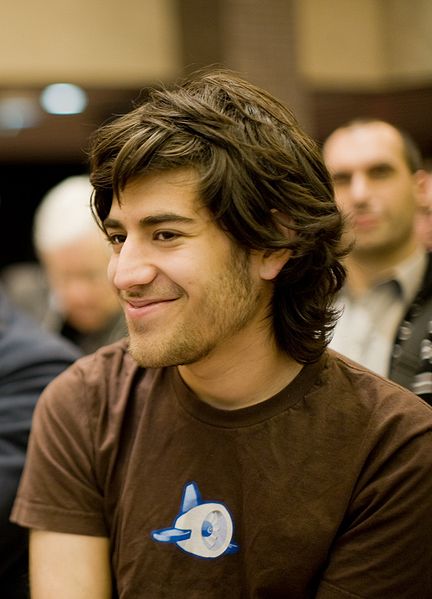
As usual with James, he throws a light on something that had been troubling me about an argument but I hadn't been able to quite work out yet. He highlights particularly poignantly what he considers the lack of sympathy, the one-sided characterization of Aaron Swartz's motives and the radical special deterrence theory of punishment put forward by Prof Kerr. On the latter point he says:
"He argues that Aaron’s announced ideals would lead him to violate the law again and that therefore the prosecutor would be right to ask for a sentence sufficient to stop that hypothetical continued criminal conduct.
Now maybe this is right.  But I think it is a lot more revolutionary than Orin gives it credit for and a lot more contentious than his post suggests.  I return to the Martin Luther King or Rosa Parks examples.  (Or if you prefer, the anti-abortion activist who trespasses on Planned Parenthood in order to spray paint his slogan.)  Legislatures had enacted segregation laws.  If Dr. King trespasses and violates state rules mandating segregation, and announces that he considers these laws wrong and that he will encourage others to do the same in the future, do we really believe that the prosecutor should ramp up the penalty until it would amount to special deterrence?  What would that take?  Death?  Life imprisonment?  Is that then “not disproportionate”?  I would have thought that one of the reasons we treat the protester who acts out of conviction (even conviction we disagree with) more leniently, is that we recognize that this is not mere profit seeking, not mere personal interest, and that in the past, such protesters have eventually changed our minds about the rightness of the actions the law prohibits.  There are limits to leniency, surely.  But there seem few limits on Orin’s special deterrence.  Again, I think his post is more conclusory than is warranted, and again those conclusions run against Aaron."

Monday, January 07, 2013

Digital rights cyberlaw clinics

Thanks to an energetic group of academics including Martin Kretschmer, Lilian Edwards, DaithĂ­ MacSĂ­ghigh, Burkhard Schafer and many others including Tony Clayton at the UK Intellectual Property Office, CREATe, the Research Council's centre for copyright and new business models in the creative economy will be launched at the end of January.
"With an ambitious programme of 40 projects delivered by an interdisciplinary team of academics (law, cultural economics, management, computer science, sociology, psychology, ethnography and critical studies), CREATe is a pioneering academic initiative designed to help the UK cultural and creative industries thrive and become innovation leaders within the global digital economy...
The research programme links seven interrelated themes: (i) Good, Bad and Emergent Business Models; (ii) Openness and Open Business Models; (iii) Regulation and Enforcement; (iv) Creative Practice and the Creative Environment; (v) Intermediaries and Platforms; (vi) User Creation, User Behaviour and Community Norms; and, (vii) Human Rights and the Public Interest."
It's a great research initiative which will hopefully begin to get to the heart of these issues with empirical evidence, so more power to their collective elbows.

The Open Rights Group's Executive Director, Jim Killock is one of eight members of CREATe's governance board. Last year ORG which is run on a shoestring budget, and is one of the few organizations campaigning effectively in the UK on digital rights, had to make special appeals for funds to intervene in the Golden Eye case and to recruit a legal officer. The Golden Eye case is the first in what ORG hope will be a number of legal interventions in the public interest.

Even with a legal officer in place, however, ORG are not going to have the capacity to tackle all the necessary cyberlaw cases. Likewise the Foundation for Information Policy Research, Privacy International, Consumer Focus (soon sadly to be no more), Big Brother Watch or Index on Censorship.

I was half joking with colleagues before Christmas that we should be setting up a pro bono legal clinic to challenge the bad behaviors of the evil empires of the internet and the collective ignorance of parliament about technology. The public interest is vastly under-represented in the evolution of our information society and ORG, brilliant though they undoubtedly are, can only do so much with limited resources.

It is time for the academy to step up to  the plate. There are multiple academic managed and student fueled legal clinics throughout UK academia focused on a range of areas of law. A network of effective ORG pro bono clinics would be a small step in the right direction. Additionally, the direct intervention of groups of academic lawyers in key cases via amicus briefs and/or their direct professional support for ORG in such cases might be a welcome development.

With notable exceptions we're nothing like as well organized or active on this side of the pond as our cyberprof colleagues in the US. ORG has nothing like the resources of US equivalents like the EFF, EPIC or ACLU. If you're an academic with expertise in (ottmh) -
  • Digital rights
  • Anonymity
  • Privacy
  • Data protection
  • Data retention
  • Data management
  • Defamation
  • Identity
  • Biometrics
  • Blogging
  • Constitutional and administrative law
  • Medical privacy
  • Freedom of expression
  • Censorship 
  • Education
  • Environment
  • Employment
  • EU
  • Extradition
  • Extraordinary rendition
  • Freedom of information
  • Immigration
  • Mass surveillance
  • NotW phone hacking
  • Public protest
  • Search and seizure
  • Smart meters
  • State secrets & secret trials
  • Terrorism
  • Torture
  • Travel, PNR, airports, border control, TSA etc
  • Watchlists
  • Web tracking
  • Whistle blowing
  • Wiretapping
  • Surveillance
  • Security
  • Cybercrime
  • Digital forensics
  • E-commerce
  • Economics
  • E-voting
  • Governnance
  • ICANN
  • Intellectual property - copyright, patents, trademarks, 3 strikes, databases, DRM, DMCA, EUCD, P2P, Berne, ACTA, DEA, gene patents, Google book, Hargreaves, image rights, levies, medical diagnostics, pharmaceuticals, publicity, section 301 reports, news-speak, software patents, business method patents, trade negotiations, TPP, CETA, trade secrets, web blocking, WIPO,
  • Intelligence and policing
  • Internediaries
  • Jurisdiction
  • Legal process
  • Libraries
  • Mobiles and tablets
  • International law
  • Net neutrality
  • Online child protection
  • Open access
  • Open source
  • Open data
  • Science and media
  • Search
  • Social networking
  • Statistics
  • Tort
- and short of a new year resolution, offering practical help to ORG and like minded public interest organisations in this way would not be a bad place to start.

The length of the list is illustrative of the challenge and that was just off the top of my head. I broke down the IP point into some constituent issues just to demonstrate how demanding this whole challenge is even if we were only focusing on IP. A nice summary of the Apple/Microsoft/Sony/RIM v Google/Intel bidding battle on the Nortel patents auction from 2011 gives a hint of what's at stake in just the mobiles and tablets wars.

A short review of just the IP story of 2012 I did for a colleague prior to the holidays included:
UK –

Hargreaves is still in play in the UK – the IPO have done an implementation report but the government have not given it a lot of attention Ofcom have done work on the DEA implementation and details of sanctions for suspected infringers.

One department in government has declared the blocking provisions of the DEA are defunct; another has introduced blocking on a protect kids from porn basis;

The Finch report let everyone down going for “gold” standard open access.

Richard Clayton and Consumer Focus published a terrific report on traceability of P2P copyright infringement

Lots of cases – eg DEA fake fine letters, Richard O'Dwyer, Newzbin, Meltwater appeal

Three big deals on EU level –

Commission signed ACTA in the early part of the year then got it rejected by the EU parliament in the summer (the parliamentarians got the idea there might be a problem following mass public protests in Poland). ACTA is reportedly dead but in reality in temporary stasis. At least 2 Commissioners have stated an intention to push it through regardless of what the parliament want. Additionally the new ACTA, “CETA” is now on the table (ACTA+).

EU approved (limited) directive on orphan works.

The Unitary Patent has been endorsed by the Council of Ministers just before Christmas. The theory is there should be a one stop euro patent shop rather than patent applicants having to going through expensive multi-jurisdictional patent application processes. Also proposing a specialist EU patent court so the ECJ would not have to deal with patent cases. The detail of the proposals is widely considered to be shambolic with IP experts almost universally opposed to the specifics as opposed to the overarching ideas.

Lots of interesting EU cases – eg ECJ decision in AstraZeneca v Commission in December (relating to alleged abuse of dominant position by preventing the marketing of generic drugs)

WIPO’s most recent SCCR ended in December. Various developments perhaps the most significant being the EU theoretically supporting a treaty for the blind and visually impaired; for the first time leaving the US isolated in opposing. (Particularly interesting in the light of EU siding with US to block the treaty in the summer and Judge Baer’s decision in the HathiTrust case in October).

The ITU summit on Net governance has a lot of hidden detail – similar to ACTA provisions – related to IP.

Myriad and the BRCA 1 and 2 patents have been in the news again, coming EU side plus a US court decision.
And lots of other interesting cases…
the mobile/tablet wars (Apple, Samsung, Google, Microsoft, Motorola, Nokia etc.) probably being the biggest… (Groklaw is terrific on the Apple v Samsung case)...
Viacom v Youtube (April) on intermediary liability, the silly automated takedowns (e.g. of NASA’s Mars Rover footage, the Hugo Awards and the Michelle Obama’s speech from the Democratic National Convention) and the Golan v Holder US Supreme Court decision from September which was something of a re-run of the Eldred v Ashcroft SCOTUS case in 2003 on copyright term extension. The reductionists had high hopes for Golan but it ultimately went the same way as Eldred (except with a 6-2 rather than a 7-2 majority this time). Rosetta Stone v Google was important on keyword advertising and trademarks in relation to functionality – if used in functional way it’s not infringement (though this will likely be narrowly interpreted) Akami v Limelight arguably expanded the scope of inducing patent infringement or ‘secondary patent infringement’ in US. The Sony v Tenenbaum and Capital v Thomas-Rasset cases were back in court this year on damages for p2p file sharing. Tenenbaum damages $675k upheld; Thomas-Rasset damages of $220k upheld. Plus of course Google wiped the floor with Oracle in the Java APIs copyright case.
And there were lots of interesting small events like the Republican Party issuing a report urging major copyright reform and immediately disowning it after a few heated phone calls from Hollywood executives...

Then there was... the Tobermory Cat dispute; Richard Posner started getting active on the dysfunctionality of the patent system – put himself in the middle of the Apple v Motorola case and threw it out and declared modern patents, especially software patents, restrict competition and creativity excessively; the big US Supreme Court rejection of drugs use patent in Mayo v Prometheus, US six strikes.
A full digital rights review of 2012 would be much longer but would include -
  • the temporary curtailment of SOPA/PIPA in the US
  • similar knocking of ACTA into temporary cryogenic stasis by the EU parliament
  • the conclusion of the Twitter joke trial and a variety of social networking offensive speech prosecutions, 
  • the developments with the horrendous Communications Data Bill (CDB, CCDP), 
  • ICO's siding with UK government on refusing to release 2008 draft of CDB
  • one branch of government's intention to drop the web blocking provisions of the Digital Economy Act followed by another's passion for web blocking with the excuse of protecting children
  • the Education Secretary's touting of open commerical access to the national pupil database
  • export of surveillance technologies to despotic regimes
  • Olympics rights and wrongs
  • Aviation industry's demands that FAA ignore privacy
  • ECJ 1st sale doctrine decision on software
  • EPDS opinion on EU data protection reform proposals
  • Partial conclusion of McKinnon and O'Dwyer extradition cases
  • FTC's instigation of data brokers investigation
  • Further evolution of the airport naked scanners saga
  • Big tech cos tax status
  • multiple cases of large personal data leaks
  • limited Protection of Freedoms Act
  • EU Data Protection agencies ordered Google to take positive steps to improve user privacy following the company's rationalisation of its multiple privacy policies in March
  • a US Presidential Commission on bioethics published "Privacy and Progress in Whole Genome Sequencing."
  • blog censorship by mobile operators
  • international trade negotiations
And again this list is barely scratching the surface of the issues.

In a rather long winded way - apologies for that - this brings me back to the point. There are too many important ongoing developments in digital rights for the excellent Open Rights Group and handful of other public interest actors to fight these battles on their own. So how about some energy from the academy, equivalent to that behind the CREATe programme, to enable the establishment of a network of ORG related digital rights cyberlaw clinics? In addition some active direct professional engagement,  through amicus curiae briefs in key cases would not go amiss, funded, if necessary, via specially targetted research grants.

Wednesday, January 02, 2013

Arsenal ticket prices & a Ticketmaster Q

To get tickets for a match at Arsenal's Emirates Stadium you have to pay an annual subscription to go on a list of members. There are various grades of membership, the higher levels only being available to those who have served their apprenticeship for an (as far as I can tell) indeterminate though lengthy period at the lower levels, with the higher echelons getting the most privileged access to tickets. The wealthy and corporate sponsors get to bypass this scheme.

As a lowly red member supporter I, for the first time, have access to tickets for an Arsenal match against one of the big clubs. In contrast to previous seasons, tickets are still available (behind the goal) less than two weeks before the match.

A seat at the top end of the stand behind the goal for the Arsenal v Manchester City match on 13 January is £72.50. That made me pause for thought. £72.50?! It's no wonder they are still available. It seems that the Silver, Gold and Platinum/Gold members with priority call on these tickets and habitually/routinely engaged in throwing money at the club either cannot afford or are not prepared to shell out that kind of hard earned cash to watch Arsenal any more. That should (but may not) ring some warning bells in the boardroom.

Family enclosure tickets for the same match are (though they are sold out), I'm led to believe, £62 for adults and £23.50 for young gunners.

Tickets for the Liverpool match on 30 January are similarly priced.

Tickets for the Stoke match on 2 February are £42 behind the goal, £35.50 for adults in the family enclosure and £14.50 for young gunners (under 16) in the family enclosure.

Stoke are currently a place above Liverpool in the Premier League.

I had not appreciated that there was a 70%+ premium on ticket prices for the nominally 'bigger' matches.

Also this morning I had an email from Oxford Utd encouraging me to get tickets for their FA Cup 3rd round clash with Sheffield Utd this coming Saturday.  £19 for adults, £11.50 for under 16s. Or premium tickets near the halfway line are £20.50 and £13 respectively.

Both Premier League and Oxford's FA cup tickets are sold through Ticketmaster, the company that had the LOCOG (London Organising Committee of the Olympic and Paralympic Games) contract controlling Olympic ticket sales.

£145 plus a trek into London to see Arsenal v Man City or circa £30 to see Oxford v Sheffield Utd. Which would you choose? 

Ticketmaster Q:

Does anyone have a raw data breakdown of Ticketmaster's pricing structures and the relative revenue flows between the company and the Premier League football clubs?
 
Note: Ticketmaster merged with concert promoter Live Nation in 2010 to become Live Nation Entertainment. The merger went ahead despite some reportedly vocal opposition from such notables as Bruce Springsteen, the Computer & Communications Industry Association (CCIA) and 25,000 who emailed the US Department of Justice to object. The Competition Commission the in UK initially opposed the merger in October of 2009 and then reversed that decision upon further consideration in December 2009.